


The best shower door handle is the one that fits your glass, matches your drilled holes, feels secure with wet hands, and does not turn cleaning into a chore. If the measurements are off, the handle will not work. If the finish is wrong, it can show spots fast. And if the grip is too small or too slick, you will feel it every day.
Here’s the short version:
- I’d check glass thickness first: 1/4", 5/16", 3/8", or 1/2"
- Then I’d confirm hole spacing, with 6" and 8" center-to-center being common in U.S. homes
- For everyday use, C-pulls and D-pulls are often the easiest to hold
- For small showers, round knobs and beveled knobs keep the look lighter
- For tight bathrooms, a handle + towel bar combo adds one more job without adding wall hardware
- For large, heavy doors, 14-inch pulls give more hand room and better control
- For finish, brushed nickel usually hides spots better than polished chrome
- Matte black hides fingerprints well, but hard-water haze and soap film can show up
One detail matters more than most people think: tempered glass cannot be re-drilled after it is made. So before you spend money, measure the glass edge, check the hole size, and match the hardware exactly.
How to Choose the Perfect Shower Door Hardware
Quick Comparison
| Handle Type | Best For | Grip | Upkeep | Common Fit Notes |
|---|---|---|---|---|
| Back-to-back vertical pull | Main bathrooms, daily use | Strong, easy hold | Depends on finish | Often 6" or 8" CTC |
| Compact round knob | Small showers | Less hand room | Low to medium | Usually single 1/2" hole |
| Beveled knob | Small showers with better grip | Better than smooth knob | Low to medium | Usually single 1/2" hole |
| Handle + towel bar combo | Tight wall space | Good | Medium | Often uses 1/2" holes |
| 14-inch pull | Heavy frameless doors | Best reach and leverage | Medium | Often 10" or 12" CTC |
| Matte black handle | High-contrast bathrooms | Depends on shape | Medium | Match the rest of the metal finish |
| Brushed nickel handle | Low-fuss bathrooms | Good | Easier | Good at hiding spots and wear |
A quick rule I’d use: pick fit first, grip second, finish third. That keeps the choice simple and helps you avoid buying a handle that looks good online but does not work on your shower.
How to Pick the Right Shower Door Handle
Start with the faucet and shower valve. In most bathrooms, those pieces set the finish direction for the whole space [1][2]. A simple rule helps here: stick to two metal finishes max, and keep them in the same warm-or-cool family [2][3].
Next, think about grip. This is a small detail, but you use it every day. A slick, high-polish handle can get slippery when your hands are wet or soapy. By contrast, a contoured handle or one with light texture gives you more friction and a steadier hold [6]. That’s one reason C-pulls and D-pulls show up so often on frameless shower doors – they feel natural in the hand and make the door easier to open [4].
Finish also changes how much cleanup you’ll deal with. Some options look great but ask for more upkeep.
- Polished chrome shows water spots fast [3][7]
- Brushed nickel does a better job hiding smudges [3][7]
- Matte black masks fingerprints well, but soap residue can stand out [3][7]
So be honest with yourself. If you’re not going to wipe it down often, pick a finish that hides the mess better.
Before you order, measure the glass edge and double-check the center-to-center spacing of any holes already drilled in the glass [1][8]. This part matters more than people expect. Common U.S. glass thicknesses are 1/4 inch, 5/16 inch, 3/8 inch, and 1/2 inch, and each one calls for matching hardware [1][8]. The most common residential center-to-center sizes are 6 inches and 8 inches [1][8]. Also, most back-to-back pulls use 1/2-inch drilled holes [1].
After you know the hardware works with the glass, make sure it looks right on the door itself. Keep the mounting center distance at about 25% to 40% of the door width [4]. That proportion helps the handle look right instead of off-balance. A short handle on a wide panel can seem too small, while a long handle on a narrow door can feel bulky and awkward.
Use these checks to compare the handle styles below.
1. Koalaty Remodel Bathroom Hardware Planning Guide
 Transform your bathroom into a modern and functional space with expert remodeling services.
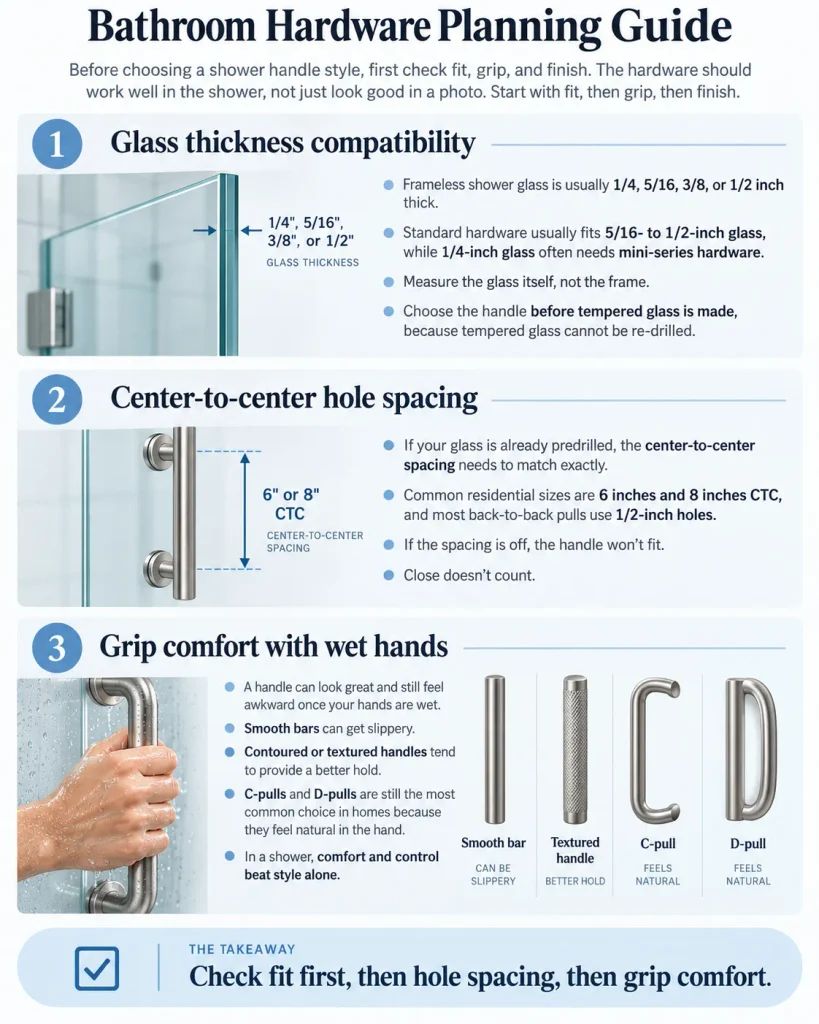
Before you pick a handle style, check fit, grip, and finish first. That way, the hardware works well in your shower instead of just looking good in a photo. It’s the same process a contractor would use before pointing you toward a handle. Start with fit, then check grip, then finish.
Glass thickness compatibility
Frameless shower glass is usually 1/4, 5/16, 3/8, or 1/2 inch thick. Standard hardware usually fits 5/16- to 1/2-inch glass, while 1/4-inch glass often needs mini-series hardware. Measure the glass itself, not the frame. That small step can save you a headache later.
It also helps to choose the handle before tempered glass is made, because tempered glass cannot be re-drilled [1][5]. If the glass matches the hardware, the next thing to check is hole spacing.
Center-to-center hole spacing
If your glass is already predrilled, the center-to-center spacing needs to match exactly. Common residential sizes are 6 inches and 8 inches CTC, and most back-to-back pulls use 1/2-inch holes [1][8].
This part is pretty simple: if the spacing is off, the handle won’t fit. Close doesn’t count here.
Grip comfort with wet hands
A handle can look great and still feel awkward once your hands are wet. Smooth bars can get slippery. Contoured or textured handles tend to give you a better hold, and C-pulls and D-pulls are still the most common choice in homes because they feel natural in the hand [4][6].
That matters more than people think. In a shower, comfort and control beat style alone.
Finish maintenance
Some finishes are easier to live with day to day. Brushed nickel and matte black tend to hide water spots better than polished chrome. At the same time, matte black can show soap haze if you don’t rinse it often [3][7].
For better long-term wear in humid bathrooms, go with PVD-coated hardware. It holds up better against corrosion, tarnish, and pitting than standard electroplated finishes [3][7].
Once you’ve checked these basics, you’re ready to compare the handle shapes below.
2. Back-to-Back Vertical Pull Handles
Once you’ve checked fit and finish, back-to-back vertical pulls are usually the next style to look at. They’re the go-to pick for frameless showers: simple, secure, and easy to use. In many homes, they’re also one of the most common frameless shower handle styles [4]. Because they mount on both sides of the door, you get a solid grip whether you’re opening or closing it.
Before you order, match the handle to your current glass thickness and the drilled hole pattern.
The most common sizes are 6-inch and 8-inch hole spacing. On many standard shower doors, 8-inch centers tend to look well balanced [1][4].
One thing people like about vertical pulls is the tall grab area. When the door is wet, that extra reach can feel more secure than a smaller handle. Brushed nickel does a good job hiding water spots, while matte black is better at hiding smudges but may show soap haze in hard-water showers [3][7].
If you want a simple, reliable handle that works well in most frameless showers, this is the baseline style to compare with smaller knob options, especially if you’re after a lighter visual look.
3. Compact Round Knob Handles
If pull handles seem too big, knobs are the smaller, cleaner option. Compact round knobs tend to work best in smaller showers and minimalist bathroom designs. They keep the door looking light and uncluttered, but there’s a tradeoff: they give you less to grab than a pull.
Glass thickness compatibility
Before you order, make sure the knob is rated for your door’s exact glass thickness.
Center-to-center hole spacing
Most round knobs use a single 1/2-inch drilled hole, so the opening needs to match exactly.
Grip comfort with wet hands
After the hole pattern checks out, the next thing to think about is grip. A knob might look great on paper and still feel slippery once your hands are wet.
Standard diameters usually range from 30 mm to 45 mm, which can feel a bit small in that situation [5]. A textured or contoured knob can give you a steadier hold without changing the overall look.
Finish maintenance
Finish plays a big part in how often you’ll be wiping the handle down. Brushed nickel does a good job hiding water spots, matte black is fairly forgiving but can show hard-water buildup, and polished chrome looks sharp but usually needs more frequent wiping [7][3].
If easy upkeep matters, brushed or matte finishes are the better pick.
If you want a little more visual detail without moving to a full pull, the next style is a beveled knob.
4. Beveled Knob Shower Door Handles
A beveled knob sits right between a plain knob and a pull. You still get the clean, simple look of a knob, but the shaped edges add a bit more detail and make it easier to hold. Put simply: it looks neat and feels better in the hand.
Glass thickness compatibility
Before you order, make sure the knob matches your door’s exact glass thickness.
Center-to-center hole spacing
Most knob-style handles install through a single 1/2" (12 mm) drilled hole [1]. If you’re swapping out old hardware, check the hole diameter first so the new knob fits without surprises.
Grip comfort with wet hands
This is where a beveled knob pulls ahead of a smooth round one. The angled edges give your hand more traction and a more natural place to grab, especially when the surface is wet [6]. If you want a bit more control but don’t want the look of a full pull, this style makes a lot of sense.
Finish maintenance
Brushed nickel does the best job of hiding water spots. Matte black hides fingerprints well, though soap haze can show up. Polished chrome usually needs the most wiping.
If you want hardware that does more in the same amount of space, the next style adds another use.
5. Handle and Towel Bar Combo Designs
If you want more function without adding wall hardware, a combo design is the cleanest upgrade. It gives you a door pull and towel bar in one piece, which is a smart fit for small bathrooms where wall space is tight. On wider panels, a longer bar can also make the door look more balanced [4].
This style sits between a basic pull and a larger statement handle in both size and visual weight.
A combo handle works best when you want a door pull and towel storage in one piece.
Glass thickness compatibility
Most standard frameless shower combo hardware works with glass thicknesses from 1/4" (6 mm) to 1/2" (12 mm). Most through-glass combo hardware uses 1/2-inch (12 mm) holes [1][8].
Length and clearance
Standard towel bars usually come in 18-inch, 20-inch, and 24-inch lengths [1]. On a 24-inch door panel, an 18-inch or 20-inch bar leaves at least 2 inches of clearance on each side, so the bar doesn’t stick past the glass edge [1].
Grip comfort with wet hands
A round bar is easier to hold than a square one when your hands are wet [4].
Finish maintenance
Brushed nickel does a good job hiding water spots and fingerprints [1][7]. Matte black also hides fingerprints well, but in hard-water areas, it can start to show a mineral haze over time [7].
If your shower door is larger or heavier, the next handle style gives you more reach and a more solid feel.
6. Heavy Glass 14-Inch Pull Handles
If your shower door is big, wide, or built with thick glass, a 14-inch pull handle usually makes more sense than a small knob or short pull. You get more leverage, more room for your hand, and a steadier grip. That matters even more when the glass panel is heavy and your hands are wet.
"A premium handle should feel deliberate and stable, never rattling or shifting." – Glass Components UK [5]
Glass thickness compatibility
This style is usually made for 3/8" (10 mm) or 1/2" (12 mm) tempered glass in frameless shower enclosures [1][5]. And the weight here is no joke: a 32-inch-wide heavy glass panel can weigh up to 120 lbs [1]. So the handle hardware has to fit the door’s load.
Not sure what glass thickness you have? Open the door and measure the exposed edge. A quick clue: 3/8" glass often has a noticeable green tint [1]. Most heavy-duty back-to-back pull handles also need 1/2-inch (12 mm) diameter holes drilled through the glass [1].
Center-to-center hole spacing
This part trips people up all the time. Overall handle length is not the same as hole spacing.
A 14-inch handle often comes with a center-to-center (CTC) spacing of 10 or 12 inches, based on the maker [1][6]. Before you buy, check the product’s CTC measurement against the holes already in your glass. That’s a must, because tempered glass can’t be re-drilled later [1][4].
Grip comfort with wet hands
A longer bar gives your whole hand something to grab, instead of forcing you to pinch with your fingertips [5][6]. In day-to-day use, that tends to feel more solid and easier to control.
For a firmer feel, go with solid brass or stainless steel construction instead of hollow tubing. Hollow handles can flex or rattle when you pull on them [5]. In a humid bathroom, marine-grade stainless steel or handles with a PVD coating tend to hold up better against corrosion over time [5][3].
Finish maintenance
If you want the easier-care option, brushed nickel is usually the best bet. Its satin finish does a good job of hiding water spots and small signs of wear [7][9].
Polished chrome looks sharper and more architectural, but it usually needs almost daily wiping to stay clean [7][9]. And if you live in a hard-water area and want matte black, expect to squeegee it every day to help stop mineral haze from building up on the surface [7][9].
7. Matte Black Frameless Shower Door Handles
If you want the same secure feel but with a bolder look, matte black is the next pick.
It creates sharp contrast in bright bathrooms and fits modern, industrial, and minimalist spaces. It looks best when the room already has a clean, high-contrast style. One simple rule helps here: use matte black only if the rest of the bathroom hardware stays in that same finish family.
Glass thickness compatibility
Matte black handles are usually made for 5/16-inch, 3/8-inch, or 1/2-inch tempered glass.
Center-to-center hole spacing
The handle’s center-to-center spacing needs to match the drilled holes exactly. 6-inch and 8-inch spacing are the most common.
Grip comfort with wet hands
The matte black finish doesn’t change grip much. With wet hands, rounded C-pulls and D-pulls still tend to feel best.
Finish maintenance
Matte black does a better job than polished chrome at hiding fingerprints and water spots, which is a nice everyday plus. That said, it still needs regular wiping. In hard-water areas, a faint mineral haze can build up over time. If you want better resistance to humidity and corrosion, go with PVD-coated hardware [3][7].
If matte black feels too bold, brushed nickel gives you a softer look and easier day-to-day upkeep.
8. Brushed Nickel Shower Door Handles
If you want a softer, easier-to-live-with finish, brushed nickel is one of the simplest all-around picks. It has a warm, low-contrast look that fits most bathrooms, and it remains one of the most common residential shower hardware finishes.
Grip comfort with wet hands
The brushed surface gives you a steadier grip than polished hardware. That means it’s easier to hold with wet hands and looks less busy in day-to-day use.
Finish maintenance
Brushed nickel has a satin-like surface that diffuses light and helps hide water spots, fingerprints, and minor wear [1][7]. Clean it with mild soap and water, and skip abrasive cleaners. If your bathroom stays humid, go with PVD-coated brushed nickel for better corrosion resistance [3][7]. That mix of looks and low upkeep makes it a good baseline when you compare other handle styles.
Which Handle Style Works Best for Your Bathroom
Once you’ve compared shapes, the next step is simpler: think about how the door gets used and how much weight the handle should support.
A good pick comes down to three things:
- Door weight
- Hand comfort
- Bathroom layout
For most main bathrooms, long C-pull and D-pull handles are the safest bet. They’re practical, easy to grip, and well-suited for daily use.
Knob handles make more sense in compact or minimalist showers, especially when a larger pull would feel out of place. On the other hand, round or square bar pulls tend to work better on heavier or wider frameless doors.
Use the table below to match the handle style to your shower layout.
| Handle Style | Best Situation | Best Fit |
|---|---|---|
| C-Pull / D-Pull | Main bathrooms, daily use | Standard frameless doors |
| Knob | Compact or minimalist enclosures | Narrow or standard doors |
| Towel Bar Combo | Tight wall space, small bathrooms | Mid-size to wider panels |
| Bar Pull | Heavy or wide frameless doors | Large or oversized panels |
How Different Finishes Hold Up Over Time
 Shower Door Handle Finishes: Maintenance & Performance Comparison
Finish affects cleanup just as much as looks. And on a handle you touch every day, that difference shows up fast. It helps to narrow down the finish first, then check measurements.
Polished chrome looks crisp, but it shows fingerprints and water spots the fastest. If your bathroom has hard water, expect to wipe it down often.
Brushed nickel is the easiest option to live with in most homes. Its softer sheen does a better job of hiding spots and day-to-day wear than chrome.
Matte black does well at hiding fingerprints and water marks, but soap residue can leave behind a white mineral haze. Stick with mild soap and water for cleaning.
Satin brass and oil-rubbed bronze fall somewhere in the middle. Both hide spots better than chrome, though brass can patina unless it has a PVD coating.
| Finish | Water Spot Visibility | Fingerprint Resistance | Maintenance Level |
|---|---|---|---|
| Polished Chrome | High | Low | Frequent |
| Brushed Nickel | Low to Moderate | High | Easy |
| Matte Black | Very Low | High | Moderate |
| Satin Brass | Moderate | Moderate | Moderate |
| Oil-Rubbed Bronze | Low | High | Moderate |
In coastal bathrooms, polished chrome tends to show wear sooner. Matte black, gunmetal, and PVD-coated hardware usually hold up better [7].
After you choose a finish, match the handle to the glass thickness and hole spacing before you buy.
Measurements and Placement to Check Before You Buy
Before you order anything, double-check the measurements. This is the last step before you start weighing styles and finishes.
The main number to confirm is center-to-center (CTC) spacing. That’s the distance between the two drilled holes in the glass. It needs to match exactly. In many homes, the most common sizes are 6 inches and 8 inches [1].
Common glass thicknesses include 1/4 inch, 5/16 inch, 3/8 inch, and 1/2 inch.
Handle size should also look right on the door. A handle that’s too small can look a bit lost, and one that’s too large can feel awkward. Use the table below as a quick fit check.
| Door Width | Typical Handle Size | Common CTC |
|---|---|---|
| 18"–24" | Small pull | 4"–6" |
| 24"–36" | 6"–8" pull or 18" towel bar | 6"–8" |
| 36"–48" | 12"–18" pull or 18"–24" towel bar | 12"–18" |
| 48"+ | 24" towel bar or full-width bar | 24"+ |
Then check height and clearance. Install the handle 36 to 42 inches above the finished floor. If you’re using a towel bar-style handle, leave at least 2 inches of clearance from each edge of the glass panel. That helps keep the bar from hitting the wall or sticking past the glass when the door swings open [1].
If the measurements check out but the door still feels loose or out of line, the problem may go past the handle itself. Once the hardware fits, the next step is figuring out whether a simple handle swap will do the job or whether the door needs more attention.
When a New Handle Is Enough and When It Is Not
It comes down to the condition of the door itself. A bad handle doesn’t always mean you only have a handle problem.
Focus on the door, not just the hardware.
A handle swap makes sense when the door is stable, sits in line, and the glass has no chips, deep scratches, or stress cracks near the mounting holes. If the only problem is a worn finish, stripped threads in the handle, or tired gaskets, replacing the handle is usually a clean, low-cost fix [1][6].
Some signs point to a bigger issue:
- The handle keeps coming loose. That often means a poor fit or stripped threads [5][6].
- The door drags on the floor or curb. That usually points to a hinge or alignment issue, not the handle [1].
- Water is getting out of the enclosure. Leaks often trace back to failing seals or the door sitting out of line, not the handle [1].
- Small cracks or pitting around the mounting holes. That can signal glass stress and uneven pressure on the panel [5][8].
If you see any of those signs, a new handle won’t fix the root problem. If the door itself is starting to fail, use the Shower Remodel Guide to check the enclosure and the Bathroom Remodel Basics guide to map out the next step.
Bathroom Planning Resources to Help You Move Forward
Once you’ve narrowed down the handle style and finish, it helps to step back and look at the rest of the bathroom. A small hardware change can shift the feel of the whole space, so it’s smart to check fit, finish, and project scope before you buy.
Use the Bathroom Lighting & Mirrors Guide to line up your handle finish with vanity lighting and mirror hardware. That kind of detail can make the room feel pulled together instead of pieced together.
For room-wide planning, the broader remodel guides below can help:
- Bathroom Remodel Basics is a solid reference for finish coordination across the full bathroom.
- Complete Bathroom Remodeling Guide helps you check that the handle works with the overall bathroom design.
- Shower Remodel Guide covers glass fit and installation details, including how the handle mounts to the glass.
If the measurements and finish check out, the next step is pricing the hardware and install. Get a free bathroom quote through Koalaty Remodel to confirm shower-door hardware and installation costs before ordering.
Conclusion
The best shower door handle is the one that fits the glass, feels solid in your hand, and looks right in the bathroom. If it doesn’t match your current hole spacing or glass thickness, it’s not the right pick. And because tempered glass can’t be re-drilled, those measurements need to be right the first time.
This is also one of those details you use every day, so grip matters just as much as looks. A handle can look great in photos and still feel awkward every morning.
Stick with the same finish family as the faucet, showerhead, and other visible hardware. The handle should work well with faucets, towel bars, mirror hardware, and lighting so the room feels pulled together. Before buying, check glass thickness, center-to-center spacing, and the handle’s overall proportion. When fit and finish line up, the handle just blends into the remodel in the best way.