


I’d choose a pivot shower door only if its swing clears nearby fixtures, leaves a comfortable entry, and keeps water inside. As part of your bathroom renovation checklist, I’d trace the door’s path – including the handle – and measure the opening after tile and trim are finished.
Here’s what I’d check first:
- Space: The open door shouldn’t block the walkway, drawers, or bathroom exit. If it swings both ways, check both paths.
- Water: The curb should slope inward about 1/4 inch per foot, with seals that close without gaps. Expect occasional drips when opening wet glass.
- Installation: Have an installer check wall support, mounting points, and opening alignment. Heavy glass needs more than tile and backer board for support.
- Cost: Budget $1,100–$5,000 for a frameless pivot-door installation, with wall or tile repairs priced separately.
My rule: <u>confirm fit before choosing finishes</u>. A door that fits the opening still needs to work when you step through it.
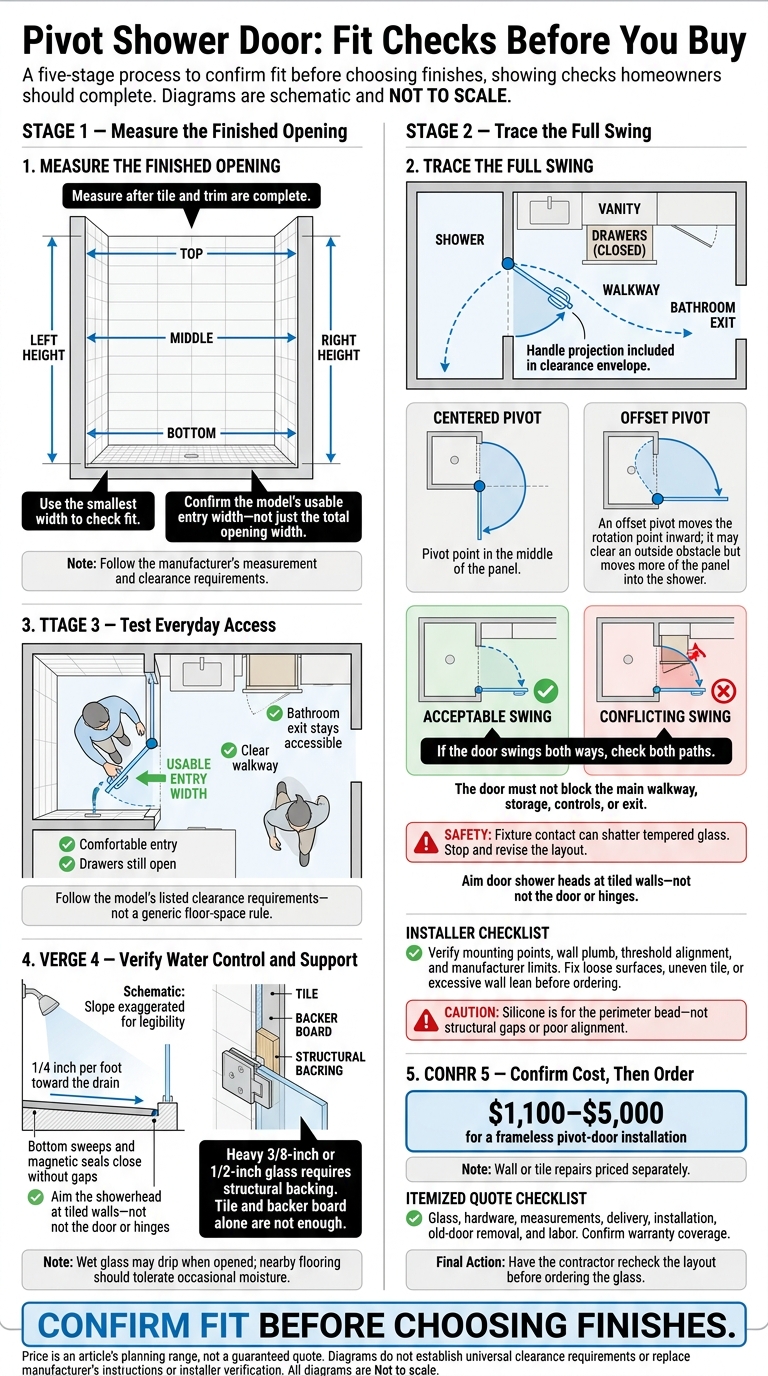
Pivot Shower Door: Fit Checks Before You Buy
Measure Door Swing and Entry Space
Measure the opening in inches after tile and trim are complete. Include hardware projection and follow the model’s clearance requirements. Panel width alone won’t tell you how much clearance the door needs. [1][2]
Map the Door’s Swing Path
Measure the finished opening at the top, middle, and bottom. Use the smallest width to determine whether the door will fit. [6][1][4]
Find the pivot location in the installation guide’s overhead drawing, then mark it on the floor. Trace the full swing arc, including the handle’s projection. A centered pivot and an offset pivot create different paths, so mark the entire arc before checking nearby fixtures, cabinets, and the bathroom door. [2][5][6]
Check Entry Width and Walking Space
Confirm the model’s usable entry width, not just the total opening width. Pivot placement and hardware can leave less room to step through. Larger panels may also need more clearance, so check the installation requirements before choosing a larger size. [2][3][1]
With the full-open arc marked, stand where you’d reach for the handle and step through. Check whether a second person can pass and whether the vanity drawers still open. Follow the model’s listed clearance requirements rather than a generic floor-space rule. [3][2]
Check Whether a Pivot Door Fits Your Layout
Once you’ve marked the swing path, check how the layout works in daily use. A wide entry isn’t enough. The door’s swing, threshold, and approach space need to work together.
| Fit factor | Why it fits | Why it fails |
|---|---|---|
| Circulation | The door opens without interrupting movement through the bathroom | The swing cuts into the main walkway |
| Usable entry | The entry feels comfortable to use | Hardware and the door’s swing leave too little room to enter |
| Fixture clearance | Fixtures remain within reach | The door blocks storage or controls |
| Water control | The threshold and nearby flooring can handle occasional drips | Water regularly reaches moisture-sensitive flooring |
Next, check how the pivot style affects the opening path. If the door swings both ways, check both sides for contact with the bench, faucet, or controls. An offset pivot moves the rotation point inward. That can help the door clear an outside obstacle, but it also moves more of the panel into the shower. [2][3]
If the door comes close to any fixture, stop and revise the layout. Fixture contact is a safety issue: an impact can shatter tempered glass. Also check whether the open door blocks the bathroom exit when someone is at the vanity. [3][6]
Fix Water and Installation Issues Before Ordering
Once you’ve confirmed the swing path works, check the shower opening for water, support, and alignment problems. Look for pooled water on the curb, loose tile, bowed trim, and uneven gaps. Before ordering, have an installer verify the finished measurements, wall support, and mounting points. [4][6]
Control Drips Outside the Shower
The curb should slope 1/4 inch per foot toward the drain. A flat curb or one that slopes outward can let water collect under the sweep and reach the bathroom floor. [3]
Bottom sweeps and magnetic seals must close without gaps. Aim the showerhead at the tiled walls – not the door or hinges. Even with proper seals, water on the glass can drip onto the floor when you open the door, so nearby flooring should tolerate occasional moisture. [2][3][5][6]
Check Wall Support and Opening Alignment
The walls and opening need to support the hardware safely, not just keep water inside.
Heavy 3/8-inch or 1/2-inch glass requires structural backing. Tile and backer board alone won’t do the job. Confirm that studs or blocking are present at the required mounting points, and follow the manufacturer’s support and fastener instructions. Use anchors only where those instructions allow them. [3][4]
Take final measurements after the tile is installed. Measure the opening’s width at the top, middle, and bottom, plus its height on both sides. The installer should check wall plumb and threshold alignment against the manufacturer’s limits, too. Fix loose surfaces, uneven tile, or excessive wall lean before ordering. Use silicone only for the perimeter bead – it cannot fix structural gaps or poor alignment. [1][4][6]
Choose Based on Fit and Cost
Once the layout passes the clearance and water checks, cost and finish are the last factors to weigh.
Review the Total Installed Cost
Plan to spend $1,100 to $5,000 for a frameless pivot-door installation. Ask for an itemized quote based on the finished shower opening. It should include glass, hardware, measurements, delivery, installation, old-door removal, and labor. Have wall or tile repairs listed separately, and confirm what the warranty covers. [2]
Beyond price, consider whether custom sizing and matching finishes make the upgrade worth the cost. Custom sizing can help with unusual openings or out-of-square walls. Match the hinge and handle finishes to your faucets and vanity pulls. [7][6]
Recheck the Layout Before Ordering
Ask the contractor to do one last walkthrough before ordering the glass. Open nearby drawers and cabinet doors, then check that you can move comfortably through the bathroom while the shower door is open. Address any space or installation conflicts before placing the order. [2][4][3][6]
FAQs
How much clearance does a pivot shower door need?
A pivot shower door needs clear floor space to swing fully without hitting a toilet, vanity, towel bar, or nearby fixture. It’s not a good fit for tight layouts that block the door’s swing path.
Before choosing a door, measure the finished opening at the top, middle, and bottom. Check that the walls are plumb, and make sure the floor or curb slopes inward to help keep water inside the shower.
Does a pivot shower door open inward or outward?
The door’s design and hardware determine which way it swings. Leave enough clearance for it to open fully without hitting a toilet, vanity, towel bar, or another nearby fixture.
If the door swings outward, water on the glass can drip onto the bathroom floor. Pay attention to the threshold design and the flooring near the door.
Is a pivot shower door good for a small bathroom?
A pivot shower door works well when there’s enough clear floor space to open it fully without hitting a toilet, vanity, or towel bar. It gives you a wide, direct entry and a simple, uncluttered look.
If anything blocks the door’s swing, it’s not a good fit. Before choosing one, measure the opening at the top, middle, and bottom. Check that the walls line up and that the floor or curb slopes inward.
Can water drip onto the bathroom floor when it opens?
Yes. When a pivot shower door opens outward, water left on the glass can drip onto the bathroom floor. The threshold design and nearby flooring matter, so check that the floor or curb slopes inward to help guide water back into the shower.
What affects the cost of a pivot shower door?
The cost of a pivot shower door depends on the glass size, opening dimensions, hardware, wall condition, custom measurements, and labor. Better hardware or custom sizing may cost more, but they can help the door fit better and make it easier to use every day.
What should homeowners measure before choosing one?
Measure the finished shower opening, usable entry width, and clearance for the door to swing. Check wall alignment, walking space around the shower, and the distance to nearby toilets, vanities, and towel bars. The door should open fully without hitting fixtures or blocking movement through the bathroom.