


Most semi-frameless shower doors end up at $700 to $2,500 installed – and the opening, not just the glass, often decides where you land. For broader planning context, review the shower remodel guide. This choice also fits within a broader bathroom remodel.
If I were pricing one, I’d focus on five things first: opening size, glass thickness, hardware finish, wall and tile condition, and labor. A standard opening with 1/4-inch glass and chrome hardware will usually stay near the low end. A custom size, 3/8-inch glass, upgraded finish, and wall prep can push the total much higher.
Here’s the short version:
- Installed cost: about $700 to $2,500
- Old door removal: about $50 to $200
- Custom sizing: often adds $200 to $400
- Wall blocking or opening fixes: often add $200 to $500
- Extra tile or surface prep: often adds $50 to $200
- Semi-frameless vs. frameless: semi-frameless is often 30% to 40% less
A few fast takeaways:
- Standard sizes cost less than custom-cut glass
- 3/8-inch glass costs more than 1/4-inch glass, but feels firmer
- Chrome is usually the base finish
- Out-of-plumb walls, bad tile, or a poor curb slope can add labor
- A low quote can miss sealing, measurement, disposal, or final fitting
If you want a clean look without paying frameless prices, a semi-frameless door often hits the middle ground. But in my view, the best quote is the one that spells out the full installed job in writing, not just the door itself.
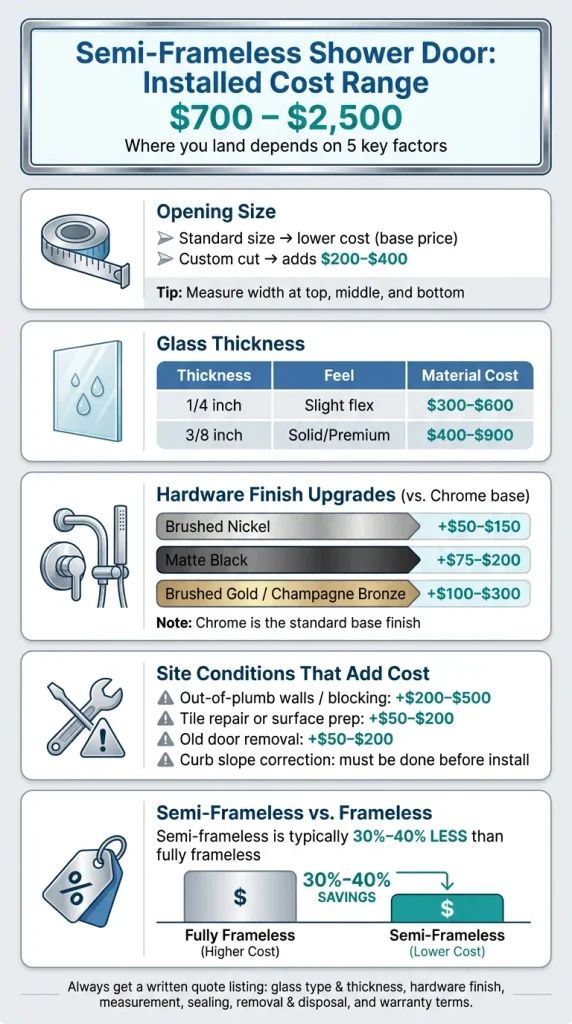 Semi-Frameless Shower Door Cost Breakdown: Key Price Factors
The Main Factors That Affect Semi Frameless Shower Door Price
Opening Size and Measurement Accuracy
Opening size sets the base price. Standard sizes usually cost less because they don’t need custom cutting [2][3]. Go beyond those common dimensions, and the glass has to be cut to order. That often adds $200 to $400 in setup costs, plus higher material rates [2].
It’s also smart to ask how the installer measured the opening. They should check the width at the top, middle, and bottom. Shower openings aren’t always perfectly even, and small shifts can cause big headaches later – gaps, rubbing, or water sneaking out at the edges.
Once the opening is measured the right way, the next big cost drivers are glass weight and hardware.
Glass Thickness and Door Weight
Glass thickness has a direct effect on both price and day-to-day feel. In most cases, 1/4-inch glass is the starting point, while 3/8-inch glass costs more [1][3].
| Glass Thickness | Typical Use | Feel | Approximate Material Cost |
|---|---|---|---|
| 1/4 inch | Standard semi-frameless | Can flex slightly | $300–$600 |
| 3/8 inch | Premium semi-frameless | Solid | $400–$900 |
For a primary bathroom that gets used every day, 3/8-inch glass often makes sense despite the higher price [3][4]. It feels more solid, and that difference is easy to notice. For a guest bath or a lower-use space, 1/4-inch glass with frame support usually works well without the extra spend [1][4].
Heavier glass also means tougher demands on hardware and wall support. The wall behind the tile needs solid wood blocking at the hinge points. Standard drywall anchors just aren’t built to hold that kind of weight for the long haul [4][5].
Hardware Finish and Support Details
Chrome is the base option. Other finishes cost more [6].
| Finish | Price Premium Over Chrome |
|---|---|
| Brushed Nickel | +$50–$150 |
| Matte Black | +$75–$200 |
| Brushed Gold / Champagne Bronze | +$100–$300 |
Improve storage, layout, and style with custom bathroom upgrades.
Matte black and brushed gold tend to show water spots more easily [4][6]. So while they can look sharp, they may ask for more upkeep.
Finish isn’t the only thing that matters here. Hinges, handles, clamps, and wall supports all need to match the glass weight and the opening size. If the opening is wider than 36 inches, installers often need stronger hardware and extra supports. That alone can add $100 to $200 to hardware costs [2].
A simple rule of thumb: match the door finish to the rest of the bathroom fixtures so the whole space feels pulled together.
After hardware, the next price jump usually comes from the shower opening’s condition.
Semi Frameless Sliding Doors
Bathroom Conditions That Can Raise Installation Cost
Even if you pick the right glass and hardware, the price can still go up when the shower opening needs work first. In many cases, the added cost comes from the opening itself, not the door.
Wall, Tile, and Threshold Problems
Adjustable wall jambs can hide up to 1/2 inch of out-of-plumb wall per side [4]. If the wall is farther off than that, the opening usually needs correction before the door can be installed the right way [4][6]. And if that fix calls for new blocking behind the tile, installation can climb by $200 to $500 [2][6].
Tile problems can add labor too. Cracked, loose, or uneven tile may stop the frame from making a watertight seal. In that case, surface repair or removal of old adhesive and caulk before mounting often adds $50 to $200 in labor [3].
The curb matters just as much. It needs to slope inward. If it’s flat or pitched outward, water can leak out and damage the subfloor [4]. That fix has to happen before the door goes in, not later.
After the opening is repaired, the next issue is simple: can the door swing and seal without making the room feel cramped?
Layout and Clearance Around the Door
A hinged door needs 24 to 30 inches of clearance in front of the shower [5]. If a toilet or vanity sits too close, that tight space may call for a different hinge setup or a custom adjustment, which adds labor.
Hinge placement can affect performance too. Putting the hinge on the side farthest from the showerhead lowers the chance that water will hit the door gap head-on [4].
Once the opening is in good shape, the next price gap usually comes down to what’s included in the estimate. At that point, homeowners can compare bids based on labor, finish details, and adjustment work.
How to Judge Value and Read Quotes Clearly
After size, glass, hardware, and site conditions are priced, the next step is simple: does the quote match the job?
That’s where a lot of people get tripped up. Two quotes can look close at first glance, but once you read the details, they may cover very different work.
When a Semi Frameless Door Is Worth the Cost
A semi-frameless door can be a smart middle ground if you want a cleaner look, solid water control, and a lower price than fully frameless doors.
It tends to make the most sense when the shower opening is standard-sized, the walls are in good condition, and the bathroom gets regular daily use.
What a Quote Should Spell Out in Writing
A low price doesn’t always mean a better deal. Sometimes it just means key work was left out. A fair quote should show exactly what you’re paying for.
Before you approve any estimate, make sure it clearly lists:
- Glass type and thickness (clear, low-iron, or frosted; 1/4-inch to 3/8-inch) [1][5]
- Hardware finish and support pieces [4]
- Measurement, installation, and sealing [3][6]
- Removal and disposal of the old door [1][3]
- Warranty terms for glass and labor [1][6]
Compare bids line by line, not just by the total at the bottom. One contractor may look cheaper, but leave out final measurement at the opening, disposal, or sealing. And those costs have a way of showing up later anyway.
Once the quote is clear, the last call comes down to fit, water control, and how the door will hold up in daily use.
Conclusion: Choose Based on Fit, Water Control, and Daily Use
Once the cost factors are clear, the next step is simple: pick the door that fits the space and how the shower gets used every day.
A semi-frameless shower door is often the practical option when the opening is the right size, the walls are in good shape, and the bathroom sees steady daily use. Semi-frameless doors usually cost about 30% to 40% less than similar frameless options[2][4], while still giving the bathroom a clean, modern look.
The final price can climb if the opening needs to be adjusted, the walls need prep work, or the hardware has to be upgraded.
A semi-frameless door tends to work best when the opening, hardware, and water control all match up. It also helps to plan for routine cleaning and occasional resealing.
Choose the door that fits the opening, keeps water where it should be, and works well day after day.