

Most shower door hinge problems start with fit, support, or alignment – not the finish. For broader planning context, review the shower remodel guide. This choice also fits within a broader bathroom remodel.
If I had to boil this down, I’d say long-term hinge performance comes from five things: door weight, hinge rating, wall backing, opening alignment, and moisture exposure. A frameless shower door often weighs 60 to 110 pounds, and 3/8-inch glass weighs about 3.3 lb per square foot. If the hinge or wall support is undersized, the door can start to sag, rub, squeak, or loosen over time.
Here’s the short version:
- Match the hinge to the glass weight and size
- Make sure hinges fasten into studs or wood blocking, not tile alone
- Check for out-of-plumb walls and uneven curb slope
- Control moisture and clean off soap scum and mineral buildup
- Treat grinding, repeat sagging, and wall movement as warning signs
In other words: if your shower door opens smoothly, closes evenly, stays level, and keeps even gaps, the hinge system is doing its job. If not, the issue is often bigger than the hinge itself.
Below, I break down what causes hinge wear over time, what warning signs to watch for, and when to adjust, repair, or replace parts.
Load and Support: Matching Hinges to the Glass and Wall

Glass weight, door size, and hinge capacity
Once you know the door size, the next step is simple: make sure the hinge can handle the load. The hinge rating needs to match the panel’s weight, size, and the strength of the wall support behind it.
A good place to start is the glass itself. 3/8-inch tempered glass weighs about 3.3 lb per square foot [5]. From there, add a 20% safety margin to the total panel weight before you pick the hardware [5]. Most quality hinges list a weight limit, often 60 lb or 90 lb per pair [5].
Glass thickness affects more than just weight. It also changes how much the door flexes. Doors wider than 28 to 32 inches often use 1/2-inch tempered glass for more rigidity and less movement at the hinge points [4]. That upgrade usually adds $100 to $300 per panel [4].
The clamp gasket matters too. It needs to match the glass thickness exactly. If it doesn’t, the panel can sit unevenly and work loose over time [5].
And here’s the catch: a hinge rating only means anything if the wall behind it can carry the load without moving.
Wall backing and why fasteners keep loosening
Fasteners need solid backing in a stud or in blocking. Tile alone will not hold the load over time [3][4][5]. A frameless glass door puts 60 to 110 lbs through two or three hinges into the wall, so that force has to land on a stud or on 2×4 or 2×6 wood blocking installed during the rough-in stage, before tile goes up [3][4][5].
Daily use adds a little shake every time the door opens or closes. Over time, that repeated vibration can cause low-grade screws to strip or back out, especially if they’re set into weak material [6].
When something starts moving, the location tells you a lot:
- If the wall plate moves, the backing or anchor has failed.
- If the glass shifts in the clamp but the wall plate stays still, the issue is usually the gasket, clamp, or torque [5].
Other signs to watch for include cracked tile near the fastener points or a door that sits noticeably lower than it did when it was first installed [5].
Frameless Door Adjustment
Alignment and Installation: Why Good Hardware Can Still Wear Out
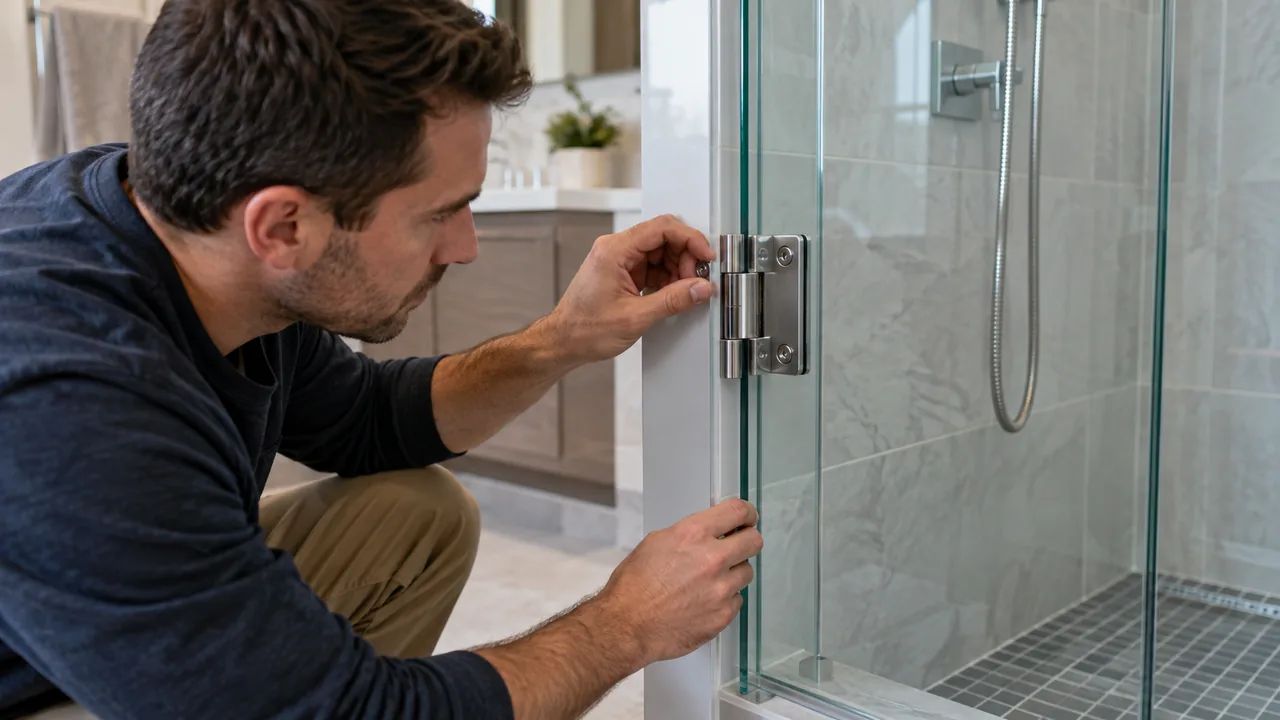

Once the hinge is the right size and has proper backing, the opening becomes the next place trouble starts. Even a hinge with a strong rating can wear out early if the opening is out of square. Why? Because the hinge takes uneven force every time the door moves.
Opening geometry that puts stress on hinges
The best check is also the easiest: measure the opening at the top, middle, and bottom to see if the walls are bowing or out of plumb [4][5]. In most cases, installers allow only 1/8" to 1/4" of variance per side. Anything beyond that usually means the wall or curb needs to be corrected before installation [4].
A curb that slopes the wrong way can also cause trouble. Water can sit near the bottom hinge, and that can speed up corrosion.
Before any silicone goes on, the glass and hardware should be dry-fit to confirm even clearances. At the bottom, that gap is often 1/8" to 3/8" before sealing [4]. If the gap changes as the door swings, that’s a red flag. It means the opening geometry is putting the hinge under stress on every cycle.
Symptoms that point to alignment problems
These signs can look like hinge failure at first glance, but they usually point to alignment instead:
| Symptom | Likely Cause |
|---|---|
| Door drifts open or closed on its own | Hinge-side wall is out of plumb [5] |
| Door drags on the threshold | Out-of-level curb or out-of-plumb wall [3][5] |
| Uneven gaps at the strike jamb | Opening is out of square [4][5] |
| Clicking or grinding during swing | Hinge bushings wearing unevenly due to pivot misalignment [3][5] |
When the opening is off, the hinge has to fight the door’s normal swing path every single time the door opens and closes. Internal springs may be built to hold tension for more than 100,000 cycles, but bad alignment can make that tension fade sooner [6].
So if a door starts dragging, squeaking, or sagging soon after installation, don’t blame the hinge right away. In many cases, the opening is out of alignment. If the wall plate is still solid but the door drags or closes unevenly, check the opening geometry before swapping out the hardware.
Even if the opening is square, moisture and daily use still affect finish and movement.
Moisture, Finish Wear, and Daily Use
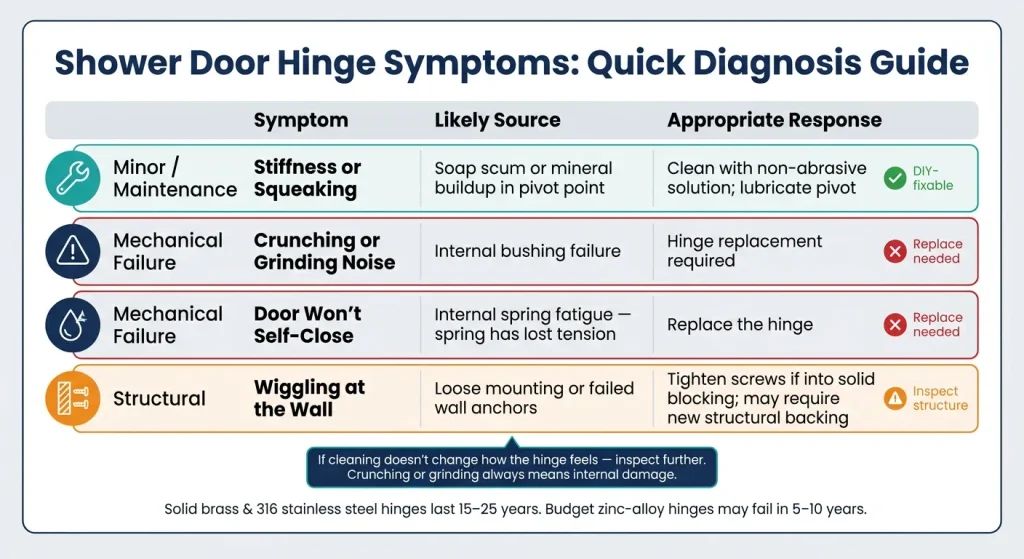 Shower Door Hinge Symptoms: Quick Diagnosis Guide
Even if the door is lined up the right way and mounted to solid backing, shower door hinges still take a beating from moisture and everyday use.
How bathroom conditions affect hinge finish and movement
The base metal matters more than the surface finish by itself. Solid brass and 316 stainless steel hinges usually last 15–25 years in residential settings. Budget zinc-alloy hinges, on the other hand, often start failing within 5–10 years as the plating peels at the corners from temperature swings [5]. Put simply, some metals handle moisture far better than others.
A damp bathroom speeds up that wear. When humidity hangs in the room after a shower, pitting and finish damage happen faster, especially with lower-grade hardware. Running the exhaust fan for at least 20 minutes after a shower can lower humidity enough to slow that process [2][1]. It also helps to wipe the hinges dry after use, since water tends to sit in small gaps around caps and pivots [1].
Soap scum and hard water minerals cause a different kind of trouble. They collect in the pivot points, add friction, and wear down internal bushings over time [1][7]. Clean hinges with a non-abrasive, pH-neutral cleaner, and skip abrasive pads that can scratch the finish [2][5].
Routine buildup or actual hinge failure?
A stiff hinge does not always mean the hinge is mechanically worn out. In many cases, stiffness and squeaking come from buildup, not internal damage. A good cleaning and light lubrication at the pivot point will often fix it. Crunching or grinding during the swing is a different story. That usually points to internal bushing failure, and cleaning won’t solve it [5].
The table below shows the difference between problems that usually respond to basic upkeep and problems that need a closer look:
| Symptom | Likely Source | Appropriate Response |
|---|---|---|
| Stiffness or squeaking | Soap scum or mineral buildup in pivot [1] | Clean with non-abrasive solution; lubricate |
| Crunching or grinding noise | Internal bushing failure [5] | Hinge replacement required |
| Door won’t self-close | Internal spring fatigue [5] | Hinge has lost its tension; replace |
| Wiggling at the wall | Loose mounting or failed wall anchors [5] | Tighten screws if into solid blocking; may require new structural backing |
If cleaning doesn’t change how the hinge feels, it’s time for a closer inspection.
Next Steps: Adjust, Repair, or Replace
When a small adjustment may be enough
If the door only drifts a little, starts to sit off-center, or feels loose at the clamp, an adjustment may fix it.
That’s often the case when the glass still feels stable, the wall mount is tight, and the hardware shows no visible corrosion or cracks. Some frameless hinges include a set screw that helps correct door centering. Before you loosen anything, support the glass with suction cups or have a second person hold it. If the door isn’t supported, it can drop or shatter.
Keep using the door only when the glass is intact, the hardware is in good shape, and the wall mount stays tight.
When the problem goes beyond the hinge
If tightening doesn’t last, the problem is usually with wall support or alignment, not the hinge body itself.
In plain terms: when the same hinge keeps loosening, something else is often going on. If the hinge moves at the wall plate instead of only at the glass clamp, weak backing or stripped anchors are usually to blame, not hinge wear [5]. Hinges should be fastened into solid wood blocking or studs behind the tile. If the hardware is mounted only into drywall or thin backer board, it will keep working loose [4][5].
If the door sags back to the same spot after adjustment, that usually points to a structural issue rather than a simple hinge setting.
Homeowner checklist and key takeaways
Before you decide to adjust, repair, or replace anything, check these basics:
| What to Inspect | What to Look For | Decision |
|---|---|---|
| Glass size vs. hinge rating | Hinge pairs rated at 60 lb or 90 lb; confirm the rating matches your door [5] | Upgrade hardware if underrated |
| Wall backing | Solid stud or 2x blocking at every hinge location – not just drywall [4][5] | Repair backing before reinstalling |
| Corrosion or finish lifting | Lifted finish or corrosion signals moisture damage [5] | Replace hardware if penetrated |
| Movement and alignment | Binding, sticking, or grinding during the swing points to wear or misalignment [2][5] | Adjust opening or replace hinge |
| Door height | A lower reading than the original measurement means the door has dropped [5] | Inspect backing and hinge capacity |
Upgrade your space with bathroom remodeling focused on comfort and functionality.
These checks help separate a simple adjustment from a case where replacement makes more sense. In the end, long-term performance depends on three things: hardware that can handle the door’s actual weight, solid backing behind every hinge, and spotting warning signs before the door starts dragging or the glass shifts.