

A flat commercial roof should be planned as one system, not just a new top layer. If I were sizing up a roof on September 24, 2026, I’d start with three things first: drainage, hidden moisture, and deck condition. That matters because standing water after 48 hours, wet insulation above 25%, or two existing roof layers can change the job from a small repair to a full replacement. For broader planning context, review the flat roof guide.
Here’s the short version:
- Fix drainage first. Code calls for 1/4 inch per foot slope to drains or scuppers.
- Inspect before choosing a membrane. Surface wear and hidden moisture are not the same problem.
- Match the system to the building.
- PVC fits roofs exposed to grease or chemicals.
- TPO is common for sunny, hot climates.
- EPDM is often used in colder regions.
- Modified bitumen handles foot traffic better than many single-ply options.
- Compare bids by scope, not brand name. I’d check tear-off vs. overlay, insulation, cover board, drainage work, flashing, edge metal, cleanup, and warranty.
- Know the cost triggers.
- Tapered insulation: $1.50–$5.00/sq. ft.
- Coating restoration: $2.00–$5.00/sq. ft.
- Deck replacement: $7.00–$14.00/sq. ft.
- Tear-off can add 30%–60% more labor.
My takeaway: if water movement and hidden damage are ignored, even a new membrane can fail early. So before I look at product names, I’d want a clear inspection, a clear scope, and a clear plan for drains, insulation, deck repairs, and flashing.
This guide breaks down how I’d sort repair, recovery, or replacement without guessing.
Commercial Flat Roof Costs in 2026: What You’ll Actually Pay
Check Existing Roof Conditions Before Choosing Materials
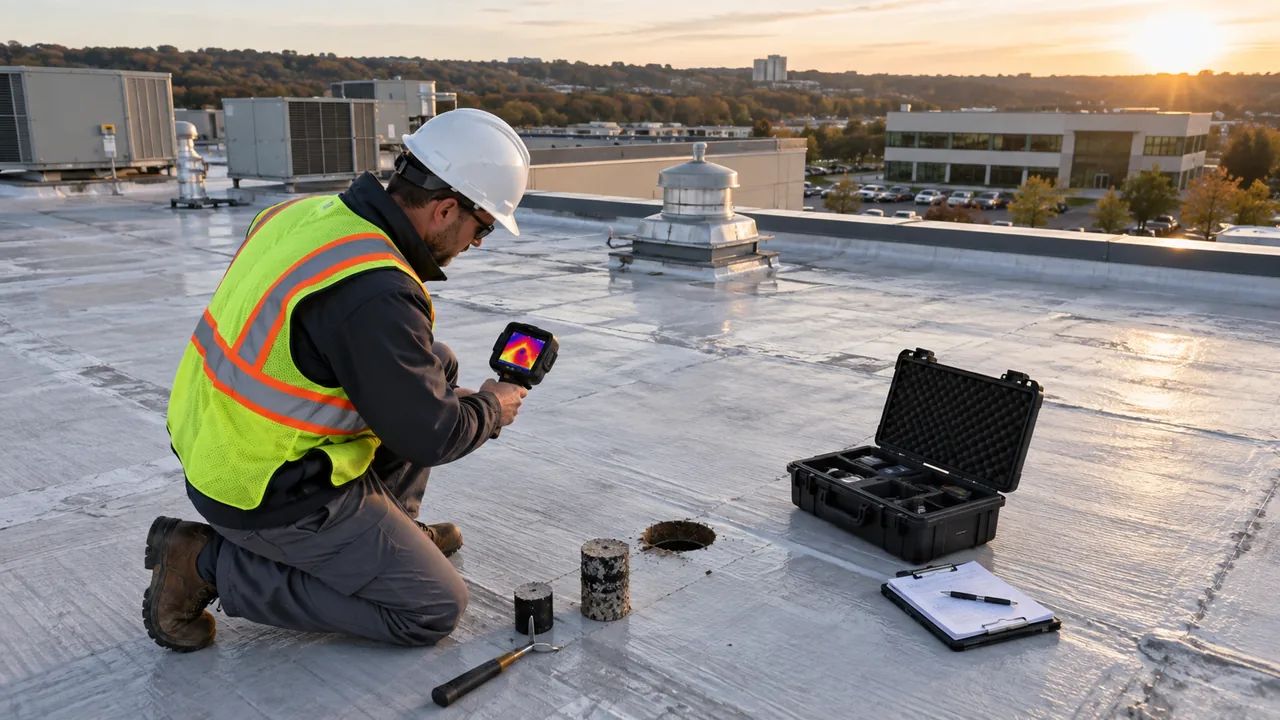
Before you compare roof systems, figure out what the current roof can still handle.
Start with what’s already there: the membrane, drainage, insulation, and deck. Once you know the roof’s condition, you can decide if the right move is a repair, a recover, or a full replacement.
What a Roof Inspection Should Cover
A qualified inspector should start with the main membrane and look for bruising, blistering, wear, and punctures. From there, the inspection should move to seams, penetrations, and edge details. HVAC curbs, pipes, skylights, and metal fascia or coping are often the first places where separation or fatigue shows up [1][2][6].
Drainage needs its own close look. Internal drains, scuppers, and overflow systems should be checked to make sure they’re clear and that primary and secondary drainage stay separate and unobstructed [2][3]. Each drain should also be hose-tested to confirm it clears within 30 to 60 minutes [1].
What’s under the surface matters just as much. Infrared thermography can help spot wet insulation by showing areas that hold heat longer after sunset. Then take 2 to 4 core samples to confirm adhesion, insulation thickness, and deck condition [1][5][7]. On steel decks, check for underside corrosion or through-rust. On wood decks, look for rot, delamination, or soft spots [3][7].
The point is simple: separate normal surface wear from hidden moisture and structural damage.
Warning Signs That Need Closer Investigation
Some roof issues look minor at first glance, but they often point to bigger trouble underneath. If you see any of the signs below, pause before choosing materials.
- Standing water 48 hours after rain usually points to slope issues, clogged drains, or undersized scuppers. It can also void most No Dollar Limit (NDL) warranties [2][6].
- Repeat interior stains often lead back to failed flashing at penetrations or parapet walls, not the open field of the membrane [2][3].
- Blisters or bubbles on the surface usually mean trapped moisture or adhesion failure between layers [6].
- Soft spots underfoot can mean saturated insulation or damaged decking, which may rule out a lower-cost re-cover and force a full tear-off [7].
- Loose or open seams in multiple areas are a strong sign the system may be near the end of its service life [6][7].
Why Drainage Problems Often Matter More Than Surface Upgrades
A new membrane won’t solve a drainage problem.
If the roof has poor slope, blocked drains, or undersized scuppers, water keeps stressing the seams, adhesion, and deck [3]. That’s why drainage issues often matter more than surface upgrades. You can install a new membrane, but if water keeps sitting there, the roof is still in trouble.
Adding tapered insulation to fix slope usually costs $1.50 to $5.00 per square foot [4][7]. That may feel like an added hit to the budget, but it’s much cheaper than paying for a membrane replacement early because standing water wore the system down too soon.
Fix drainage as part of the project scope before any new membrane goes down. Those findings shape the next step: matching the roof system to the building’s actual condition.
Match the Roof System and Project Scope to Actual Building Conditions
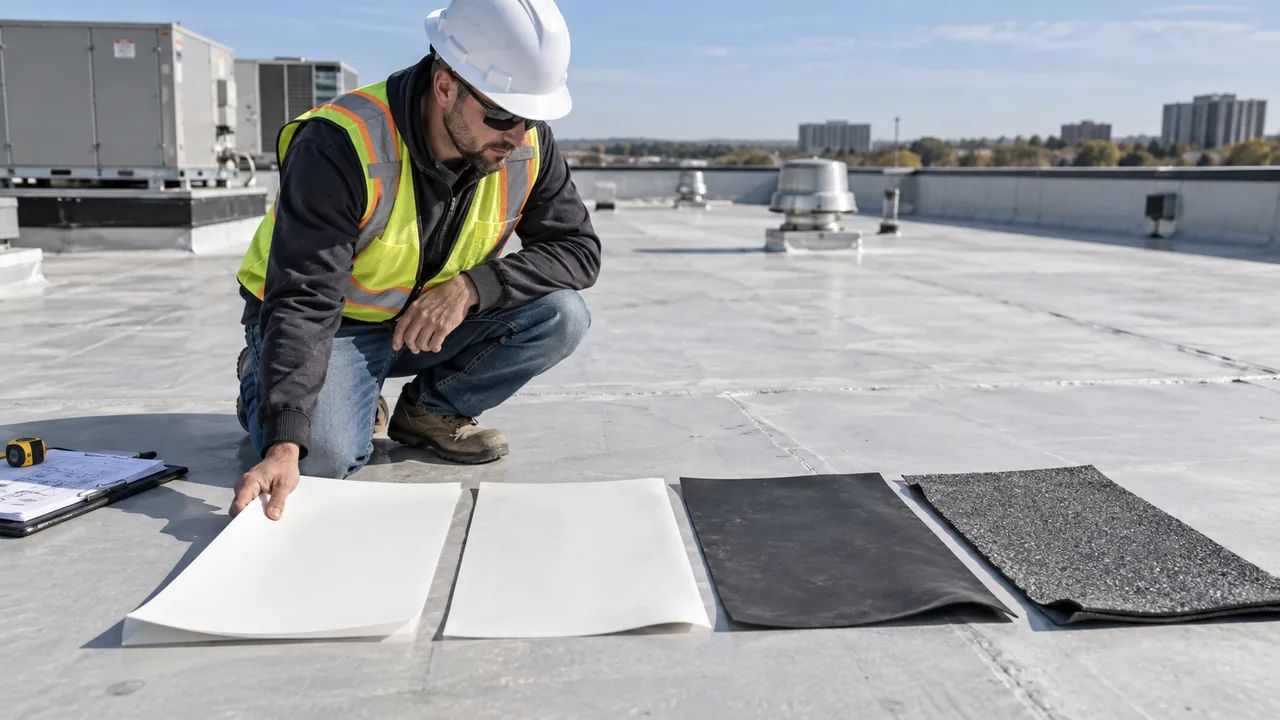
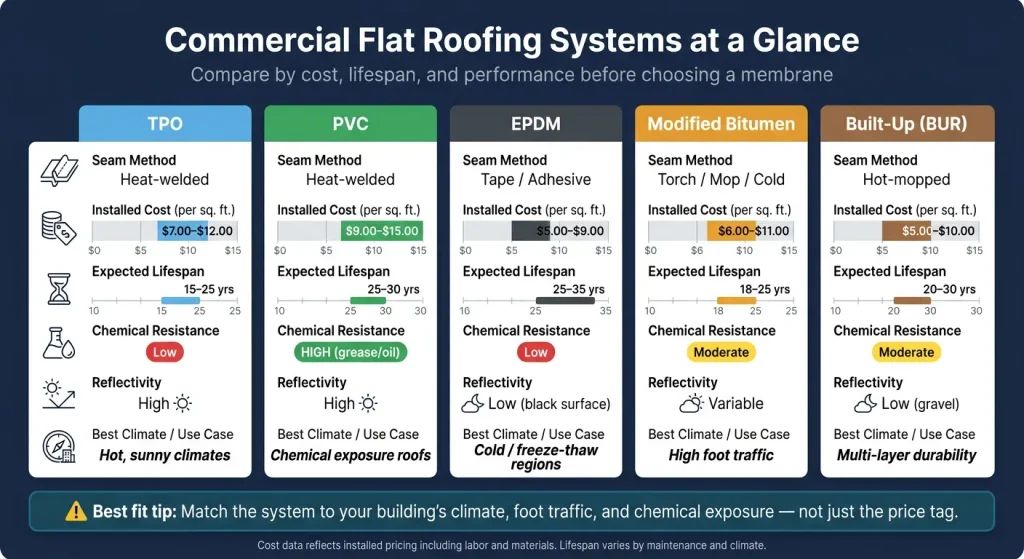 Commercial Flat Roofing Systems Compared: Cost, Life & Performance
After drainage and substrate checks, pick the roof system based on the building’s exposure, foot traffic, and budget, not just what’s popular or cheapest.
How Common Commercial Flat Roofing Systems Compare
Climate, traffic, chemical exposure, and roof penetrations usually narrow the field before price does. The more penetrations, the more foot traffic, and the more exposure a roof sees, the tighter your options get. If the roof will deal with grease, fats, or industrial chemicals, PVC is the better fit. TPO and EPDM don’t hold up as well in those conditions [4].
TPO is often the go-to for hot, sunny climates because it reflects heat well. EPDM tends to fit northern climates better, especially where freeze-thaw cycles and heavy snow are part of the job [1][4][5].
| System | Seam Method | Puncture Resistance | Chemical Resistance | Reflectivity | Installed Cost (per sq. ft.) | Expected Life |
|---|---|---|---|---|---|---|
| TPO | Heat-welded | Moderate | Low | High | $7.00–$12.00 | 15–25 years |
| PVC | Heat-welded | Moderate | High (grease/oil) | High | $9.00–$15.00 | 25–30 years |
| EPDM | Tape/adhesive | Moderate | Low | Low (black) | $5.00–$9.00 | 25–35 years |
| Modified Bitumen | Torch/mop/cold | High | Moderate | Variable | $6.00–$11.00 | 18–25 years |
| Built-Up (BUR) | Hot-mopped | High | Moderate | Low (gravel) | $5.00–$10.00 | 20–30 years |
Use that table to line up the system with the roof’s exposure, traffic load, and target service life. For roofs with heavy foot traffic, modified bitumen gives you the best puncture resistance among common systems [1]. On single-ply roofs, it also makes sense to include 80-mil membrane or walkway pads in high-traffic areas [4].
The system and the scope need to match. A good membrane paired with the wrong scope can still turn into a bad project.
What Changes the Scope of a Roof Replacement
Once you’ve picked the system, the next step is figuring out how much of the roof has to change with it. Scope and cost depend on the membrane, what’s under it, and how much detail work surrounds it.
The first big fork in the road is tear-off vs. overlay. A recover moves faster and creates less debris, but it usually works only when there’s already just one roof layer in place. Building codes generally cap roofs at two layers total. If the roof already has two, a full tear-off is required [7].
Tear-off usually costs 30% to 60% more in labor and adds $40 to $90 per ton in disposal fees [7]. Still, it gives you one thing an overlay can’t: a clear look at hidden deck damage before it gets buried.
Wet insulation or deck damage can force that full tear-off too. If more than 25% of the insulation is wet, a recover is usually off the table [7]. If a steel deck has through-rust or a wood deck has rot, structural repairs have to happen before the new roof goes on. Deck replacement alone usually adds $7 to $14 per square foot [7].
Detail work can push labor up fast. Parapet walls, HVAC curbs, and lots of penetrations all take time. A building with 200 penetrations can take 30% to 50% longer to flash than a similar building with 50 [7]. That’s not a small difference. It can change both schedule and labor cost in a hurry.
When Repair, Recovery, or Full Replacement Makes Sense
| Condition | Repair | Recovery (Overlay) | Full Replacement |
|---|---|---|---|
| Moisture spread | Isolated (<5%) | Minimal (<25%) | Widespread (>25%) |
| Seam status | Localized fatigue | Mostly sound | System-wide failure |
| Substrate | Sound | Sound | Rotted or corroded |
| Leak history | First-time or minor | Occasional | Chronic or recurring |
| Existing layers | N/A | 1 layer present | 2 layers already present |
A fluid-applied restoration coating costs $2 to $5 per square foot and can add 10 to 15 years to a roof’s service life. That can mean 60% to 80% savings compared with full replacement [1]. But coatings are not a fix-all. Use them only when the substrate is dry and stable. If seam failure is spread across the roof or moisture is above 25%, full replacement is usually the better call.
Those scope items should show up line by line in every estimate.
Compare Quotes by Full Project Scope, Not by Membrane Name
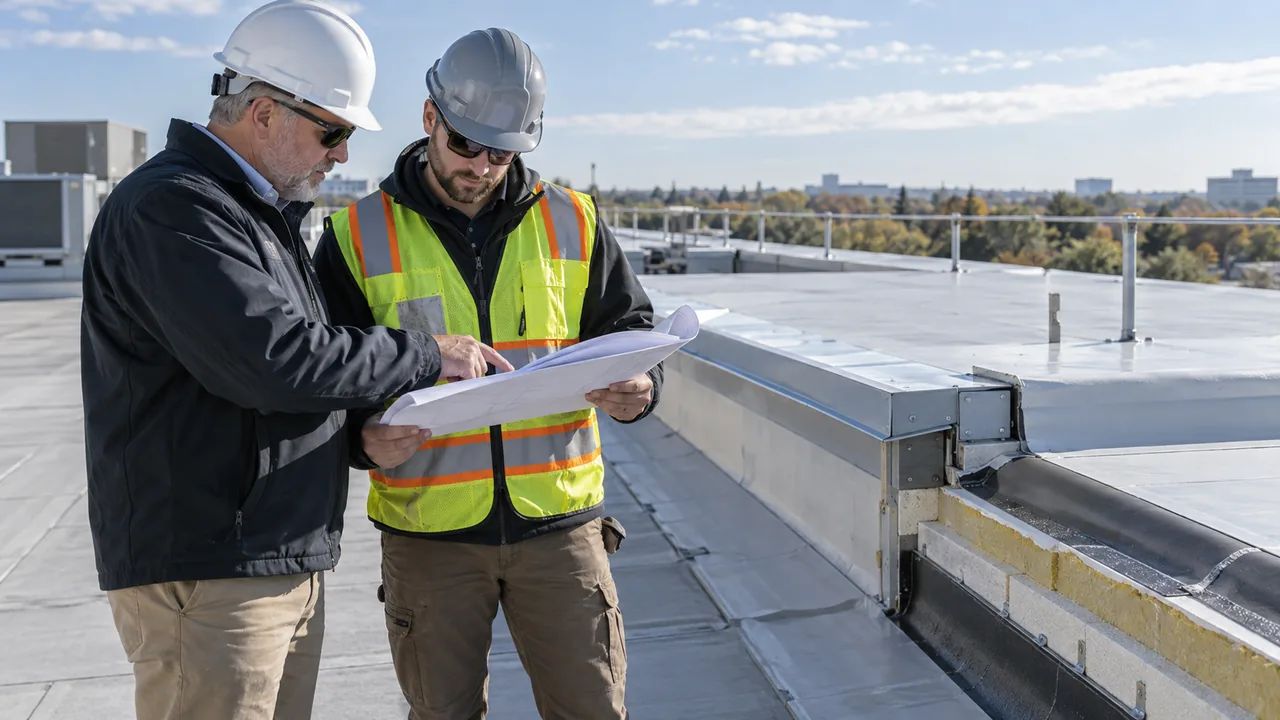
Once you know whether the roof needs repair, recovery, or replacement, compare bids by full scope, not by membrane name. The membrane name by itself doesn’t tell you much. The scope is what tells you what you’re paying for.
Each quote should define the entire roof assembly, including the deck, any vapor retarder, insulation, cover board, membrane, and the attachment method.
What Every Estimate Should Clearly Include
Every quote should spell out these items in writing before you sign anything.
| Estimate Line Item | What to Look For | Risk If Missing |
|---|---|---|
| Removal approach | Full tear-off or recover (overlay) | Hidden deck damage stays buried under the new roof |
| Deck repair allowance | Unit pricing for damaged decking | Surprise change orders if rot or rust is found |
| Insulation | Type, R-value, and layer count | Lower energy performance and thermal bridging |
| Cover board | Named cover board product | Membrane and insulation are more open to foot traffic and hail |
| Drainage corrections | Tapered insulation, crickets, and saddles | Ponding water that speeds up membrane aging |
| Edge metal | ES-1 rated edge metal | Wind-uplift failure at the perimeter |
| Penetration flashing | Boots, curbs, and HVAC transitions listed | Leaks at common failure points |
| Cleanup and disposal | Hauling and landfill fees included | Unexpected end-of-project charges |
| Warranty type | NDL (No Dollar Limit) or material-only | Much less coverage if something fails |
How to Spot Missing Scope and Hidden Cost Risks
Compare each quote line by line. Blank spaces and vague wording usually shift risk to you.
Low bids often assume hidden conditions are fine. But deck damage, wet insulation, and drainage problems may not show up until tear-off starts. If there’s no allowance, change orders often follow. That’s why it makes sense to ask for a preset price for deck replacement before work begins.
Drainage fixes are another item that often gets left out. If the roof needs tapered insulation to create slope, that work should be part of the scope, not added later like a last-minute patch. You should also pin down the warranty type, who issues it, and what it covers.
Use a Side-by-Side Quote Comparison Table
A side-by-side table makes scope gaps easier to spot.
| Scope Item | Quote A | Quote B | Quote C |
|---|---|---|---|
| Tear-off or overlay | Tear-off | Overlay | Not specified |
| Deck repair allowance | Included | Not included | Not included |
| Insulation R-value | Specified | Lower than expected | Not specified |
| Cover board | Included | Not included | Not included |
| Tapered insulation for drainage | Included | Not included | Not included |
| Edge metal (ES-1 rated) | Included | Included | Not specified |
| Penetration flashing detail | Listed by count | Lump sum | Not specified |
| Cleanup and disposal | Itemized | Included | Not specified |
| Warranty | NDL | Material-only | Not specified |
Once the scope is fixed, use these same line items for final inspection and maintenance planning.
Maintenance Priorities and a Pre-Approval Checklist
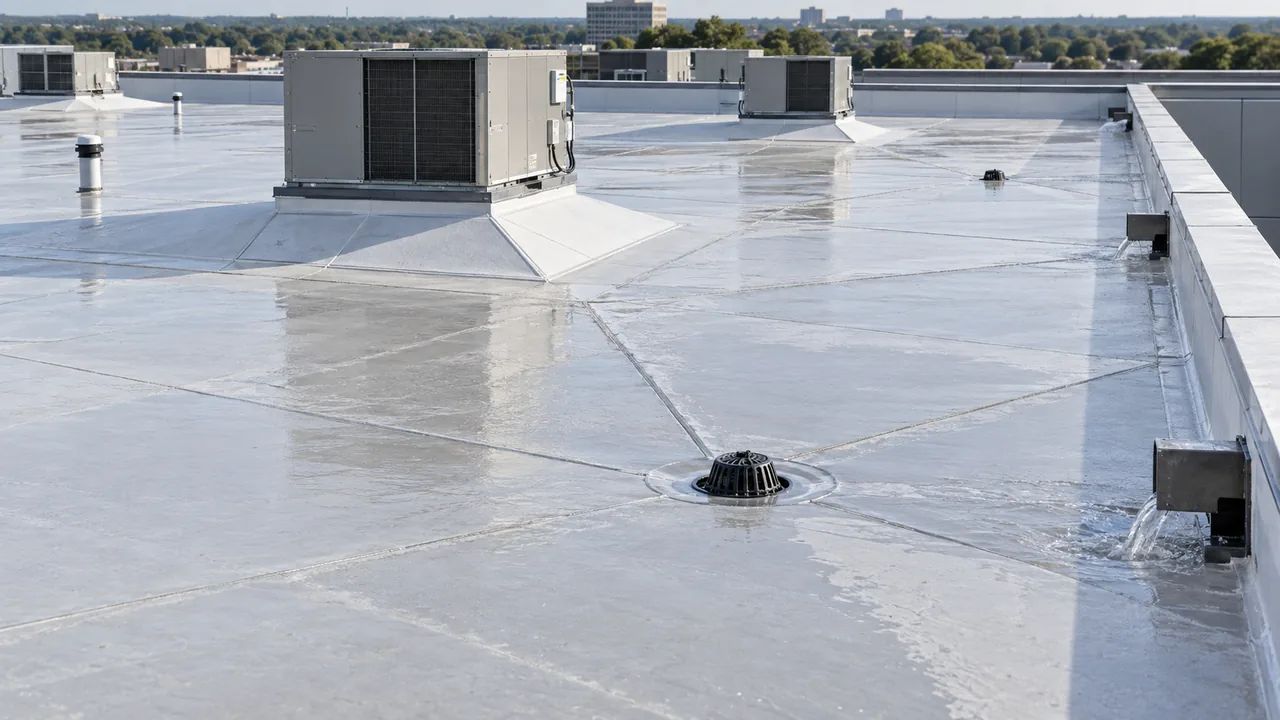

What to Prioritize After Installation or Repair
Once the roof is installed, maintenance becomes your main line of defense against leaks and early wear.
After installation or repair, protect the roof with scheduled maintenance. Inspect it twice a year and after major storms. Also check the roof monthly, especially after heavy weather, and deal with ponding water that lasts more than 48 hours. Focus on the spots where problems show up most often: drains, seams near movement areas, base flashings at parapet walls, and penetrations around HVAC curbs [6]. Keep dated photos and inspection reports on file to help protect warranty coverage.
Homeowner Checklist Before Signing Off on the Project
Before you sign off, make sure the contract lines up with the roof’s actual drainage, substrate, and warranty needs.
- Drainage slope: Confirm the roof drains at a minimum of 1/4 inch per foot toward drains or scuppers, with crickets or saddles behind rooftop units.
- Substrate condition: Define the unit price for damaged decking found during tear-off before work starts.
- Concealed damage terms: Put in writing how wet insulation or deck rot found mid-project will be priced.
- Warranty verification: Confirm the contractor holds current authorization for the installed system.
- Cleanup and disposal plan: Verify the scope includes temporary dry-in protection, daily cleanup, and itemized disposal pricing.
Conclusion: Plan Around Water Movement, Hidden Moisture, and Full Project Scope
Maintenance helps the system last, but only if drainage, substrate, and documentation were handled the right way from day one.
Inspect before you choose a system. Fix water movement before paying for surface upgrades. Match the system to your building’s actual conditions, not just a product name. When you compare quotes, use the full scope – removal, insulation, substrate, drainage, edges, penetrations, cleanup, and warranty – as the yardstick, not the membrane label alone. Use the Koalaty Remodel Roofing Cost Guide and Complete Roof Replacement Guide to get a clearer view before your first conversation with a contractor.
Related Blog Posts
- Flat Roof Installation Guide 2025: Best Materials and Common Challenges
- Flat Roof Systems: EPDM Roofing, Best Replacement Planning and Long Term Performance in 2026
- Flat Roof Shingles Guide for Homeowners: 7 Smart Tips and Insights
- How to Plan a Flat Roof Replacement Without Overpaying