

A flat roof replacement should start with scope, not price. In most cases, I’d expect costs to fall around $4 to $14 per square foot in 2026, but that number only means anything if I know what the quote includes.
Here’s the short version: before I compare bids, I’d confirm why the roof failed, check for drainage problems, plan for hidden deck or insulation damage, separate must-do work from add-ons, and review each estimate line by line. That’s how I avoid paying for work I don’t need – or getting trapped by low bids that leave out tear-off, flashing, drainage, permits, or disposal.
If I wanted a simple checklist, I’d use this:
- Find the cause of failure before replacing the membrane
- Document ponding water and slope problems
- Ask for pricing on hidden damage before tear-off starts
- Separate required work from upgrades like thicker membrane or extra insulation
- Compare bids by square foot and by exact scope
- Set aside 10% to 15% for hidden deck rot or wet insulation
One thing stands out: a cheap quote can cost more later if it uses vague lines like “repair as needed.” I’d rather pay a clear price up front than deal with open-ended change orders after the roof is opened.
Here’s a quick side-by-side view of the main flat roof systems mentioned in the article:
| Roof System | Typical Cost | Lifespan | Best Fit |
|---|---|---|---|
| EPDM | $4.00–$13.00/sq. ft. | 20–30 years | Cold climates, garages |
| TPO | $4.00–$14.00/sq. ft. | 15–25 years | Hot, sunny areas |
| PVC | $6.00–$14.00/sq. ft. | 20–30 years | Roofs with equipment or grease exposure |
| Modified Bitumen | $4.00–$13.00/sq. ft. | 15–20 years | Roofs with foot traffic |
| BUR | $4.00–$12.60/sq. ft. | 15–25 years | Older roofs with regular foot traffic |
So if I had to sum it up in one sentence, it would be this: the best way to avoid overpaying is to make sure every bid covers the same roof problems, the same repair scope, and the same terms before I sign anything.
Flat Roof Types, Cost, and Lifespan

Step 1: Find Out Why the Existing Flat Roof Is Failing
Replacing the top layer without finding the root cause is a good way to end up with the same leak on a new roof. On flat roofs, leaks often come from drainage issues, failed seams, bad flashing, or deck damage, not just the membrane itself. And if water is already showing up inside, there’s a decent chance the insulation or decking is wet too.
One simple field check: press on the membrane on a warm day. If it feels firm and still bends a bit, repair might still be on the table. If it feels brittle or crunchy, that usually points to a larger failure [8].
It also helps to know how flat roofs leak. Water doesn’t always drip straight down from the point where it got in. It can move sideways under the roof before it drops, which means a ceiling stain may come from a failed seam or flashing as far as 20 feet away [3]. So if you only inspect from inside the house, you may miss the actual breach.
Warning Signs That Point to Widespread Problems
Some signs jump out right away. Others take a closer look. Either way, the signals below usually mean you’re dealing with more than a single puncture or one bad seam:
| Warning Sign | What It Usually Means |
|---|---|
| Ponding water (standing 48 hours after rain) | Drainage failure or structural sagging [8] |
| Soft or spongy spots underfoot | Saturated insulation or rotted decking [3][5] |
| Blisters or bubbles on the surface | Moisture trapped beneath the membrane [5][7] |
| Recurring ceiling stains in the same area | Widespread failure or failed flashing [1] |
| Membrane shrinkage or edge separation | Material at end of service life [7] |
| Moisture around vents, skylights, or parapet walls | Failed curb flashings or deteriorated edge metal [1] |
Repeated patches in the same spot are another warning sign. If one corner or seam has needed repair more than once within two to three years, the base membrane is often too far gone to keep holding repairs [5].
If you’re seeing two or more of these signs, stop treating the issue like a simple surface patch.
When Repair May Still Make Sense
Repair can still make sense when the damage is isolated. But when you’re seeing several symptoms at once, replacement is often the safer call. Before you decide, ask for a core cut or a moisture scan. That helps show whether the problem is limited to one area or hiding below the surface.
For leak-source diagnostics, see the Roof Repair Guide.
Step 2: Check Drainage and Hidden Roof Conditions Before Choosing Materials
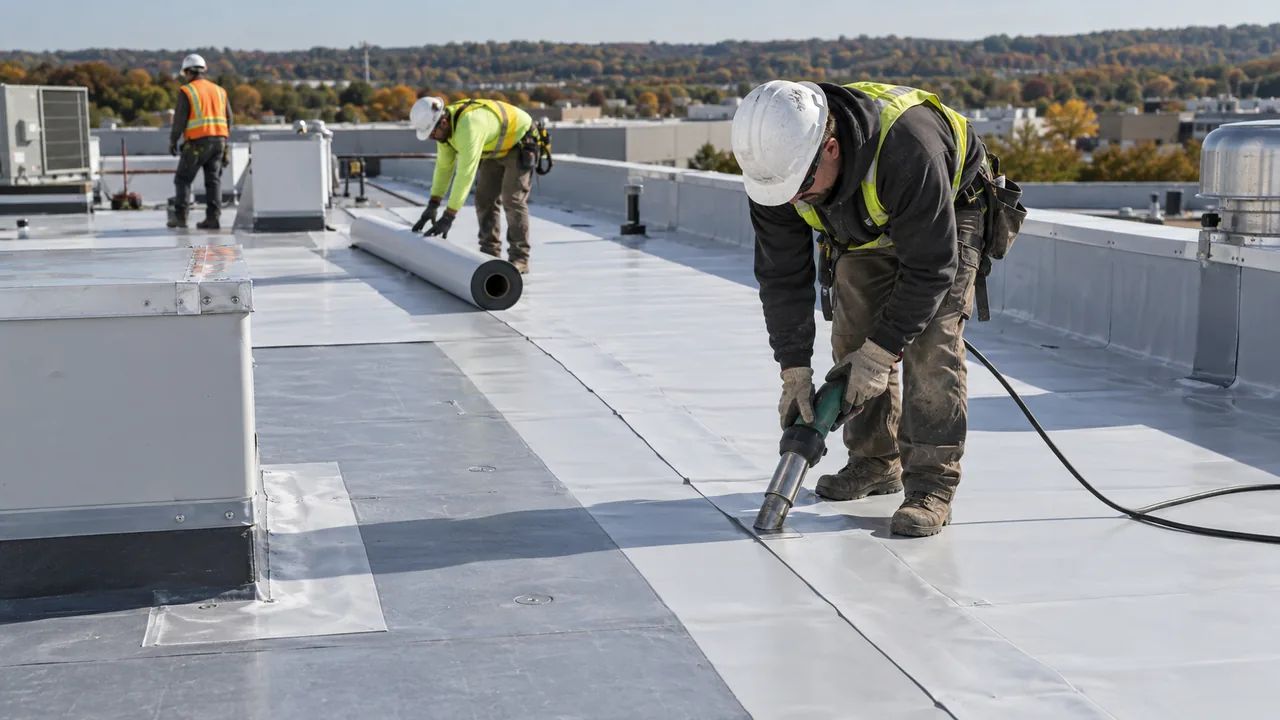

Once you’ve found the source of the failure, look at drainage next. A flat roof still needs at least 1/4 inch of slope per foot to move water toward drains or scuppers. If water is still sitting on the roof 48 hours after rain or snowmelt, that points to a drainage issue. Fix that first. If the roof can’t shed water the right way, the drainage fix should be part of the replacement scope before you pick the membrane. Otherwise, the new roof can fail sooner than it should.
Drainage Problems to Document in the Estimate
Take photos of every low spot and record how long water stays there after rain. That gives contractors something specific to price, and it makes it much harder for drainage fixes to quietly disappear from the scope.
| Drainage Fix | Estimated Cost | Why It Matters |
|---|---|---|
| Tapered insulation | $2.00–$4.00 per sq. ft. [3] | Creates the slope needed to move water off the roof |
| New drain or scupper | $1,500–$3,000 per unit [3] | Adds or replaces the hardware that carries water away |
If a quote ignores ponding areas you’ve already documented, it’s incomplete. Ask directly whether tapered insulation or slope correction is included if you’ve seen standing water.
What May Be Hidden Under the Roof Surface
Drainage is only part of the problem. The roof deck and insulation can shift the price just as much. Wet insulation, rotted decking, and the condition of the vapor-control layer often aren’t found until the old roof is removed [3][7]. That means these issues usually show up during tear-off, so they need to be priced ahead of time.
Replacing one 4-by-8-foot sheet of rotted plywood or OSB costs $150–$300 per sheet, including labor [3]. Tear-off adds $0.50–$1.50 per square foot per layer removed [5]. And if the roof already has two layers, many jurisdictions require a full tear-off [3][4].
Your quote should spell out two things:
- An allowance for roof deck repairs
- A clear change-order rate for hidden damage
It also makes sense to set aside a 10%–15% contingency above the quoted price for hidden deck rot [5].
Before you sign anything, ask how hidden damage will be found and how it will be priced. Once drainage issues and hidden roof conditions are on paper, it becomes much easier to separate must-do repairs from optional upgrades.
Step 3: Define the Right Replacement Scope and Cut Out Unnecessary Upgrades
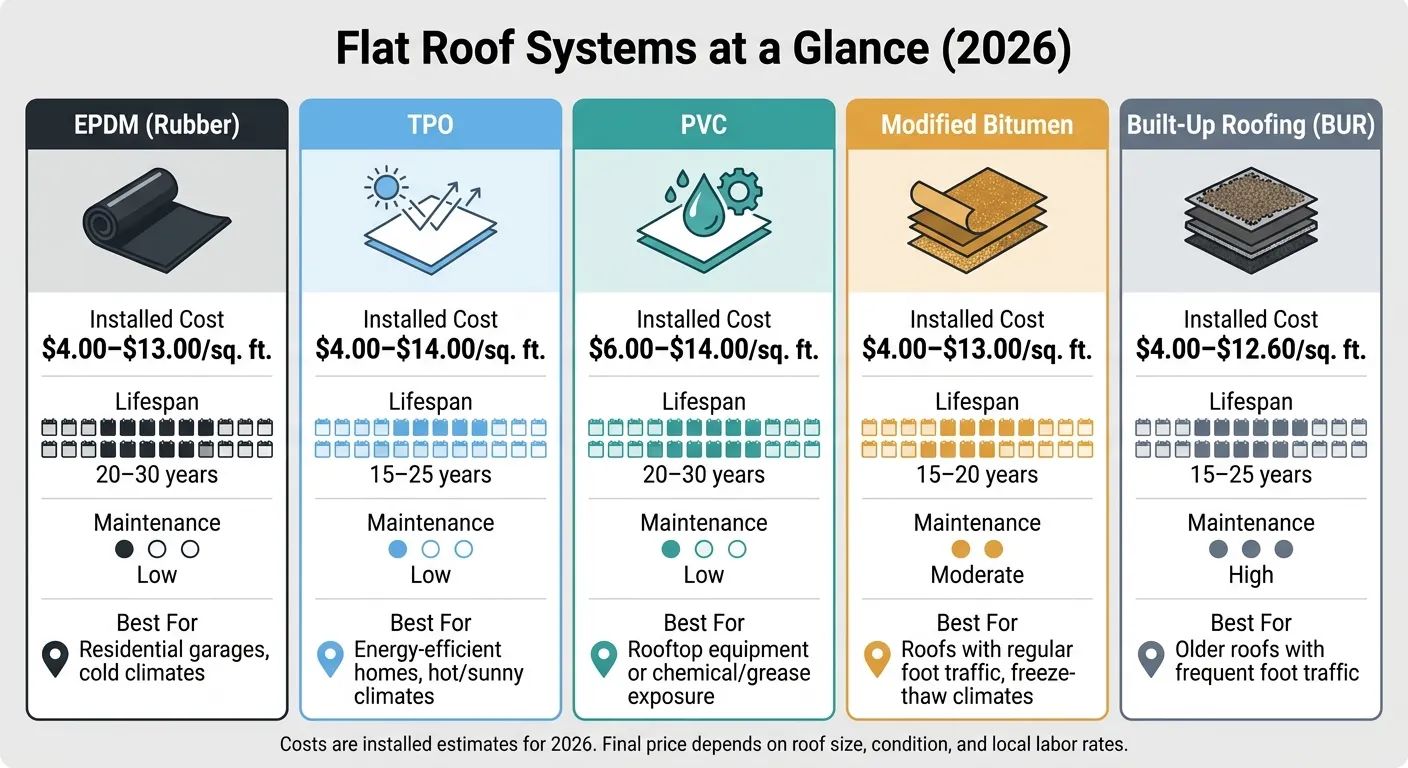 Flat Roof Systems Compared: Cost, Lifespan & Best Use (2026)
Once you’ve documented drainage issues and hidden damage, the next job is simple in theory but easy to mess up in practice: separate required repairs from nice-to-have upgrades.
That matters because a roof replacement can balloon in price when the scope is fuzzy. If you don’t know what the job must include, it’s easy for optional items to get mixed in with core repair work. The fix is to define the replacement scope up front and make the contractor spell out what’s included.
Required Work vs. Optional Upgrades
Every flat roof replacement should include a new membrane, flashing at all penetrations, edge metal, and local permits and inspections [1][5]. Some repairs only become clear after tear-off, so those should be listed as conditional work [3]. And one point is worth stressing: don’t accept vague tear-off language. The contractor should define each layer being removed and each repair item that may be added.
| Category | Work Item | Notes |
|---|---|---|
| Included Work (Required) | Tear-off & Disposal | Removal of existing membrane layers and hauling away debris [1][5]. |
| New Membrane | Primary waterproof membrane [1][3]. | |
| Flashing Details | Sealed flashings at parapets, pipes, HVAC curbs, and wall transitions [1][5]. | |
| Edge Metal | Controls water at the roof perimeter [1][2]. | |
| Permits | Local permits and inspections [4][5]. | |
| Conditional Repairs | Decking Repair | Decking repair [1][3][5]. |
| Wet Insulation Removal | Removal and replacement of saturated insulation boards [1][3]. | |
| Optional Upgrades | Tapered Insulation | Adding sloped insulation to eliminate ponding water; $2.00–$4.00 per sq. ft. [3]. |
| NDL Warranty | A "No Dollar Limit" warranty covering both materials and labor, usually adding 10%–20% to cost [3]. | |
| Thicker Membrane | Upgrading from 45-mil to 60-mil or 80-mil for better puncture resistance [3]. | |
| Extra Insulation | Extra insulation for energy goals [5][3]. |
A good way to think about it: the required items make the roof function, the conditional items depend on what turns up after tear-off, and the optional items may be worth paying for, but they shouldn’t be slipped into the base bid without a clear reason.
How Common Flat Roof Systems Compare
Once the scope is fixed, compare roof systems based on fit, not price alone.
EPDM stays flexible well below freezing, which makes it a practical pick for cold climates [5][7]. TPO and PVC both use heat-welded seams, and their white reflective surfaces can cut cooling costs by 10% to 30% in hot, sunny climates [7][3]. PVC also resists chemicals and grease, which matters more on homes with rooftop equipment [3][7]. Modified bitumen and built-up roofing (BUR) tend to make more sense on roofs that get regular foot traffic, especially older roofs where people are up there often.
| System | Installed Cost | Typical Lifespan | Maintenance | Best Use Case |
|---|---|---|---|---|
| EPDM (Rubber) | $4.00–$13.00/sq. ft. [5][7] | 20–30 years [7][6] | Low | Residential garages, cold climates [3][5] |
| TPO | $4.00–$14.00/sq. ft. [7][6] | 15–25 years [7][6] | Low | Energy-efficient homes, hot, sunny climates [5][7] |
| PVC | $6.00–$14.00/sq. ft. [5][7] | 20–30 years [5][7] | Low | Homes with rooftop equipment or chemical exposure [3][7] |
| Modified Bitumen | $4.00–$13.00/sq. ft. [4][7] | 15–20 years [4][7] | Moderate | Roofs that get regular foot traffic, freeze-thaw climates [4][7] |
| Built-Up (BUR) | $4.00–$12.60/sq. ft. [7][6] | 15–25 years [7][6] | High | Older roofs with frequent foot traffic [7] |
One more thing: if the installation happens in cold weather, ask what method will be used to meet bond requirements.
With scope and material choice pinned down, the next step is to compare contractor quotes line by line.
Step 4: Compare Contractor Quotes Line by Line Before Signing Off
Once the scope is clear, compare bids line by line. Don’t look at the total price alone.
A lower number can look good at first. But if that quote leaves out drainage fixes, wet insulation removal, edge metal, or disposal fees, it’s not cheaper in any meaningful sense. Those costs don’t vanish. They usually come back later as change orders.
That’s a big deal with flat roofs. Moisture and deck damage often sit under the surface, where you can’t see them until the work starts.
What a Complete Flat Roof Quote Should Include
Each line item should connect to an actual roof condition that was measured or confirmed. If a quote leans on vague wording like "seal all penetrations" or "repair as needed," slow down. Phrases like that often lead to cost disputes after the job begins [1][2].
| Line Item | Required Detail | Too Vague |
|---|---|---|
| Tear-Off | Exact number of layers being removed | "Tear-off included" with no layer count |
| Membrane | Brand, type, thickness | "New roof system" or "quality membrane" |
| Insulation | R-value, board type, new or reused | Not mentioned or "existing insulation to remain" |
| Substrate Repair | Allowance and unit rate | No allowance or unit rate |
| Drainage | Tapered layout or drain/scupper rebuild | No mention of ponding water or slope |
| Flashing | Exact locations: parapet, pipe, curb | "Seal all penetrations" |
| Disposal | Dumpster/haul-away cost itemized | Not mentioned; billed as an extra later |
| Warranty | Materials and labor terms in writing | Warranty terms not defined |
| Change Orders | Written approval required; per-unit rate defined | No process defined; verbal agreement only |
| Permits | Contractor pulls permit; fee included in total | Not mentioned or listed as homeowner’s responsibility |
Keep your home secure with roofing solutions built for durability and efficiency.
Set aside a 10% to 15% contingency for hidden deck rot that can’t be confirmed until the old membrane comes off [5][4]. In plain terms, if the roof looks fine from above, that still doesn’t mean the deck below is sound.
A contractor who includes hidden damage as a defined allowance is usually easier to work with than one who leaves it as an open-ended extra.
Pre-Approval Checklist for Homeowners
Use this checklist to make sure the bid matches the scope before you sign:
- Cause of failure confirmed
- Drainage corrections included
- Hidden-damage pricing defined
- Tear-off layers stated
- Flashing locations listed
- Change-order rate defined
- Permit responsibility assigned
- Warranty terms in writing