

If I had to boil it down to one takeaway, it’s this: a metal shingle roof can run from about $700 to $1,700 per square installed, and that number is only the starting point. In roofing, 1 square = 100 square feet of roof surface, not interior living space. And once I factor in tear-off, underlayment, flashing, waste, pitch, and hidden deck damage, the total can move a lot. For broader planning context, review the metal roofing guide. This factor also matters in a broader roof replacement project.
Here’s the short version:
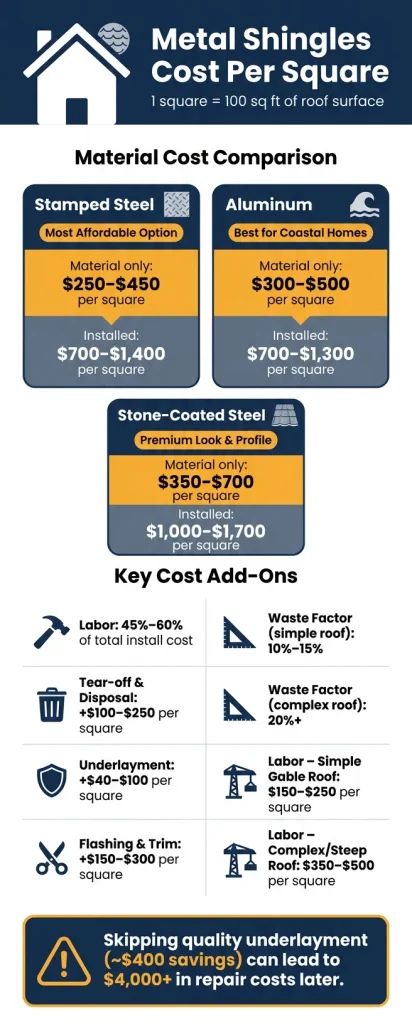
- Stamped steel: about $250–$450 per square for materials, or $700–$1,400 installed
- Aluminum: about $300–$500 per square for materials, or $700–$1,300 installed
- Stone-coated steel: about $350–$700 per square for materials, or $1,000–$1,700 installed
- Labor often makes up 45% to 60% of the full install cost
- Tear-off and disposal can add $100–$250 per square
- Underlayment can add $40–$100 per square
- Flashing and trim can add $150–$300 per square
- Waste is often 10% to 15% on a simple roof and 20%+ on a cut-up roof
- Steep roofs and damage found during tear-off can push the bill higher
 Metal Shingles Cost Per Square: Materials & Installed Prices Compared
How Much does a Metal Shingle Roof Cost? Cost Factors Included!
To get a personalized estimate for your project, you can use a roof replacement cost calculator to account for your specific roof type and labor rates.
Quick Comparison
| Material | Material Cost Per Square | Installed Cost Per Square | Best Fit |
|---|---|---|---|
| Stamped steel | $250–$450 | $700–$1,400 | Lower-cost metal shingle option |
| Aluminum | $300–$500 | $700–$1,300 | Homes near salt water |
| Stone-coated steel | $350–$700 | $1,000–$1,700 | Higher-end look and thicker profile |
When I compare quotes, I don’t stop at the per-square price. I check what’s included, how the roof was measured, what waste factor was used, and how repairs will be priced if the old roof comes off and problems show up.
Typical Metal Shingles Cost Per Square in the U.S.


Common Price Ranges by Material Type
These ranges give you a solid baseline when you’re comparing options on equal footing. Steel, aluminum, and stone-coated steel do not sit in the same price tier, so your material choice will shape the budget from the start.
| Material | Material-Only (per square) | Installed (per square) |
|---|---|---|
| Stamped steel | $250–$450 [2] | $700–$1,400 [2][3] |
| Aluminum | $300–$500 [2] | $700–$1,300 [3] |
| Stone-coated steel | $350–$700 [2] | $1,000–$1,700 [2] |
Stamped steel often lands at the lower end of the group. Aluminum usually costs a bit more, but it does not rust, which makes it a better fit for coastal homes near salt water [5]. Stone-coated steel tends to be the priciest option because the stone granules and thicker profile add manufacturing cost on top of the base metal [2].
Even within the same metal category, finish matters. Premium coatings usually cost more than basic painted finishes.
Material-Only vs. Installed Cost
Material-only pricing covers the shingles themselves. Installed pricing includes labor and the full scope of the job. That difference matters, because labor usually makes up 45% to 60% of the total installation bill [3][1][4].
For many mainstream systems, installed pricing often falls around $800 to $1,500 per square. Premium stone-coated systems can go above that range [4].
That leads to the next part of the pricing puzzle: what those installed numbers actually include – and what they don’t.
What Per-Square Pricing Includes and Leaves Out
The price gap usually comes down to scope, not just the metal itself.
Items Commonly Included in a Base Quote
A material-only quote usually covers the shingles and, in some cases, clips. An installed quote covers the parts and the labor needed to finish the roof.
Here’s how those line items usually split out:
| Line Item | Material-Only Quote | Installed Quote |
|---|---|---|
| Metal shingles | Yes | Yes |
| Fasteners/clips | Sometimes | Yes |
| Synthetic underlayment | No | Yes |
| Drip edge & trim | No | Yes |
| Labor | No | Yes |
| Tear-off (1 layer) | No | Sometimes included |
| Disposal fees | No | Often separate |
| Decking repairs | No | Separate charge |
| Permits and local fees | No | Varies by locality |
Costs Often Added as Separate Charges
Even installed quotes may leave out damage-related work. Decking repairs are almost always billed on top of the base price. A common charge is $45 to $75 per sheet of plywood replaced [4].
Other add-ons can hit hard too. Chimney flashing repair runs $500 to $1,800 per unit, and skylight replacement can add $1,500 to $4,500 per unit if it has to be handled during the project [2].
Questions to Ask Before Comparing Estimates
Before you compare two estimates, make sure they cover the same job:
- Is this price material-only or fully installed?
- Does it include tear-off and disposal, and for how many layers?
- Are underlayment, ice & water shield, drip edge, flashing, and other accessories clearly listed?
- How will hidden decking damage be priced if it shows up during tear-off?
- Are permits and local fees included, or billed on top?
Clear, itemized answers help you avoid budget surprises. Once the scope is nailed down, roof size, slope, and roof condition explain most of the rest of the price gap.
How Roof Size, Slope, and Condition Affect the Final Cost
Once you know the per-square price, the next thing that shapes the total is the roof itself – its size, shape, and what turns up after the old roof comes off. Roof pricing is based on actual roof squares, not the home’s interior square footage.
Why Two Similar Homes Can Have Very Different Roof Costs
Two houses can look almost the same from the street and still end up with very different roofing bills. That’s because roof geometry affects material use more than many homeowners think.
Overhangs, multiple roof sections, hips, and valleys all add surface area that doesn’t appear in the floor plan. Then there’s waste. A simple gable roof usually needs a 10% to 15% waste allowance, while a more complex roof may need 20% or more [2]. Pitch, dormers, skylights, and the number of tear-off layers can also push the installed price up fast.
Steep Slopes and Complex Roof Shapes Add to Labor Costs
Pitch is one of the biggest labor cost drivers in a metal shingle job. If the roof slope is steeper than 8/12, crews usually need roof jacks and fall protection. That slows the job by 25% to 40%.
Complex shapes add more labor too. Valleys, ridges, dormers, and skylights – and the flashing work around them – mean more cutting, more fitting, and more detail work.
Here’s how labor often breaks down [2]:
- $150 to $250 per square for a simple gable roof
- $300 to $450 per square for a complex roof with multiple sections
- $350 to $500 per square for a steep roof pitch over 8/12
Even a simple roof can end up costing more if the tear-off exposes damage.
Existing Damage Can Change the Budget Mid-Project
This is where many roofing budgets shift. Some problems stay hidden until the old roofing is removed. Soft or rotted decking, old skylights, and weak attic ventilation often don’t show up before the job starts. Once found, each one can add to the final bill.
That’s why the quote should spell out how the contractor will price hidden damage, ventilation work, and skylight repairs if they come up.
So yes, the per-square number matters. But it doesn’t tell the whole story. The lowest starting price isn’t always the lowest finished price.
How to Use Per-Square Pricing to Compare Quotes and Plan Your Budget
Once the roof size and scope line up, per-square pricing becomes a handy way to compare quotes. But that number, by itself, doesn’t tell you which bid gives you more for your money.
What to Match Across Every Roofing Estimate
Per-square pricing only works if every estimate uses the same roof measurement and the same waste allowance. Check that each contractor measured the same roof with a professional roof measurement. Then compare the waste factor in each bid. If the waste allowance doesn’t match, the totals won’t be apples to apples.
After that, look at the line items. Each estimate should spell out tear-off and disposal, underlayment type, flashing details, material gauge, and labor. If one quote includes upgraded underlayment, valley protection, or thicker metal, it’s not pricing the same job.
That difference matters. Skipping quality underlayment to save about $400 in materials can turn into $4,000 in repair costs later [2].
When a Higher Per-Square Price May Be Worth It
A higher bid can still be the smarter pick if it covers more work from the start. For example, a quote that includes chimney crickets, skylight reflashing, or gutter resets can help you avoid surprise charges once the job is underway.
Materials matter too. PVDF coatings cost more, but they resist fading for a longer time. Warranties deserve the same close look. Higher-priced bids often stand out here, especially if they offer non-prorated coverage that includes labor for the first several years instead of covering only the material.
There’s another catch many homeowners miss: some manufacturer warranties are only valid when the roof is installed by certified professionals [6][4]. So the contractor’s credentials aren’t just a nice extra. They can affect whether that warranty means anything at all.
Conclusion: Use Cost Per Square as a Starting Point, Not the Final Price
Use per-square pricing to narrow down bids, then check the full scope before you sign anything. A square equals 100 square feet of actual roof surface, not floor space. And the final price still depends on roof geometry, slope, existing damage, and what’s included in the written scope.
The per-square number is a starting point. The estimate you approve should be fully itemized, with measurements, materials, labor, tear-off, repairs, and warranty details. Compare matching scopes first, then pick the quote that gives you the best mix of coverage, warranty, and installation quality.