


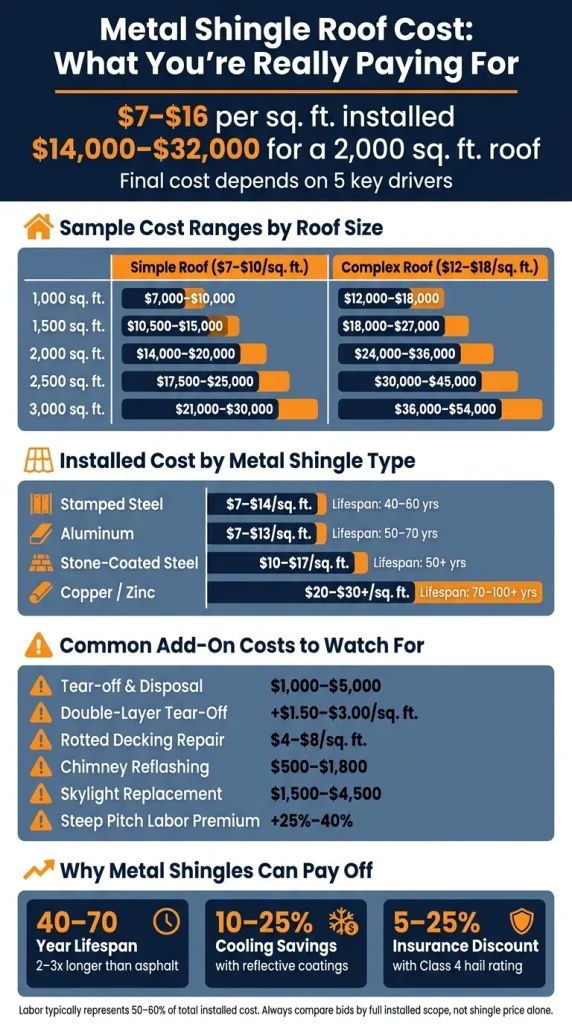
Metal shingle roofs usually cost about $7 to $16 per sq. ft. installed, or around $14,000 to $32,000 for a 2,000-sq.-ft. roof. But the price can jump fast if your roof is steep, cut up with valleys and dormers, or needs tear-off and deck repairs. For broader planning context, review the metal roofing guide. This factor also matters in a broader roof replacement project.
If I had to boil the whole topic down, it’s this:
- Roof size is not the same as home size
- Labor often makes up 50% to 60% of the bill
- Tear-off, disposal, and wood repairs can add a lot
- Material type, finish, and warranty change both price and lifespan
- The lowest quote is not always the lowest final cost
A few numbers stand out:
- Tear-off and disposal: often $1,000 to $5,000
- Double-layer tear-off: about $1.50 to $3.00 per sq. ft.
- Deck repair: about $4 to $8 per sq. ft.
- Reflective coatings: may cut cooling costs by 10% to 25%
- Class 4 hail-rated roofs: may help with insurance discounts of 5% to 25%
| Cost driver | What it does to price |
|---|---|
| Roof area | More squares = more material and labor |
| Roof shape | Valleys, dormers, and skylights add cuts and flashing work |
| Pitch and height | Steep and multi-story roofs cost more to work on |
| Tear-off | Old layers and dump fees add cost |
| Hidden damage | Bad decking and flashing can add change orders |
| Material and finish | Steel, aluminum, stone-coated steel, copper, and PVDF all price out differently |
The short version: I’d compare bids by installed scope, not by shingle price alone. That gives you a much clearer view of what you’re paying for and what may show up later as an extra charge.
 Metal Shingle Roof Cost by Type, Size & Complexity
How Much does Metal Shingles Roof Cost? Cost Factors Included!
Roof Size and Shape: The First Major Cost Driver
How Roof Area Changes Material and Labor Totals
A home’s floor plan and roof area are not the same thing. Roof pitch and overhangs add more surface area than the footprint below, which means the roof is often bigger than many homeowners expect.
For example, a 2,000-sq.-ft. floor plan can turn into about 2,200 sq. ft. of roof area once those factors are added in [2]. That’s why contractors measure the roof planes themselves instead of using the home’s floor plan as a shortcut.
Roofers price jobs in squares, and one roofing square equals 100 sq. ft. of roof surface [4][7]. So when the square count goes up, material and labor totals go up with it. That includes shingles, underlayment, trim, and the hours needed to install everything.
Why Slope, Valleys, Dormers, and Access Push the Price Up
Roof layout can change the price fast. Features like hips, valleys, dormers, and skylights create more cuts, more flashing work, and more labor.
Those extra cuts also mean more waste. A simple roof usually needs a 10% to 15% waste factor in the material order. A roof with lots of cuts can push that number to 20% [2][4]. The reason is pretty simple: off-cuts from valleys and dormers usually can’t be used again.
Steep roofs add another layer of cost. They often need roof jacks and fall protection, and the steeper the pitch, the slower the crew works. Hard access can also add time for moving materials and hauling away debris [2].
Table: Sample Cost Ranges by Roof Size and Complexity
| Roof Size (Sq. Ft.) | Roofing Squares | Simple Roof Cost ($7–$10/sq. ft.) | Complex Roof Cost ($12–$18/sq. ft.) | Notes |
|---|---|---|---|---|
| 1,000 | 10 | $7,000–$10,000 | $12,000–$18,000 | Small cottage or garage |
| 1,500 | 15 | $10,500–$15,000 | $18,000–$27,000 | Standard small home |
| 2,000 | 20 | $14,000–$20,000 | $24,000–$36,000 | Average U.S. home size |
| 2,500 | 25 | $17,500–$25,000 | $30,000–$45,000 | Large suburban home |
| 3,000 | 30 | $21,000–$30,000 | $36,000–$54,000 | Multi-story or sprawling |
Source: Compiled from 2026 data from HomeMatchup, EstimationPro AI, and The Roofing Brief [1][2][3].
Improve your home’s exterior protection with durable roofing solutions.
A small roof doesn’t always mean a lower bill. In many cases, a smaller roof with steep slopes and lots of cut-up sections can cost more than a bigger roof with a simple layout. After size and shape are pinned down, labor and installation difficulty start to drive the price even more.
Labor, Tear-Off, and Existing Roof Condition
Why Labor Makes Up a Large Part of the Total Cost
After roof size and roof shape, labor is the next big cost driver. With metal shingles, the install work takes time because crews can’t just roll out big panels and move on. They have to place, fit, and seal each shingle with care.
Metal shingles are labor-heavy because they go on one piece at a time in staggered courses [1][6]. Each piece has to lock together tightly so the roof stays watertight and can handle wind well [1][6]. The slowest parts are usually valleys, chimneys, and wall transitions. Those areas take more detail work, and they’re also where leaks are most likely if the install is sloppy [1][3].
Labor pricing also changes based on how hard the roof is to work on. A simple one-story gable roof often falls around $150 to $250 per square for labor. A steep roof with an 8/12 pitch or more can hit $350 to $500 per square because the crew needs more safety gear, more setup time, and a slower pace to work safely [2].
How Tear-Off, Disposal, and Deck Repairs Add to the Quote
Tear-off and disposal usually show up as their own charge. If your home already has two existing layers, you can expect to add $1.50 to $3.00 per sq. ft. on top of the base price [2].
There is one place where metal shingles can help on cost. Because they weigh only 1 to 1.5 lbs. per sq. ft., many building codes allow them to go over one existing layer of asphalt shingles when local code says it’s okay [1][2][4]. If that’s allowed in your area, it can cut $1,000 to $5,000 in tear-off and disposal costs [1][5]. Still, don’t assume. Ask the contractor to confirm whether local rules allow it.
The wildcard is what sits under the old roof. You often won’t know the condition of the sheathing until tear-off starts. If the decking is soft or rotted, that damaged wood has to come out. If you suspect structural issues, it is best to contact roof repair specialists immediately. Replacing roof decking usually costs $4 to $8 per sq. ft. for labor and materials [2]. Chimney reflashing is another add-on that can show up fast. If the old flashing is rusted or failing, it can add $500 to $1,800 per chimney [2].
Table: Labor and Tear-Off Items That Commonly Change the Price
| Factor | Estimated Cost Impact | Why It Raises the Price |
|---|---|---|
| Steep pitch (>8/12) | +25% to 40% labor cost | Requires extra safety setup and slows production [2] |
| Multiple stories | +10% to 20% labor cost | Slower material staging and increased safety requirements [2] |
| Double-layer tear-off | +$1.50 to $3.00 per sq. ft. | More removal labor and higher disposal fees [2] |
| Rotted decking/sheathing | $4 to $8 per sq. ft. | Damaged wood must be removed and replaced with new roof sheathing [2] |
| Chimney reflashing | $500 to $1,800 per chimney | Requires proper flashing to prevent leaks [2] |
| Skylight replacement | $1,500 to $4,500 installed | Older skylights may need to be replaced at the same time as the roof [2] |
Ask for a line-item estimate that breaks out tear-off, underlayment, flashing, disposal, and repair allowances [2][7]. That makes the bid much easier to read. A lump-sum quote can hide what is included now and what may turn into an extra charge once the old roof is removed.
Material Profile, Finish, Warranty, and Long-Term Value
How Product Style and Finish Affect the Upfront Price
Once labor and tear-off are locked in, material choice becomes the next big driver of price. After roof size and labor, the material profile and warranty often decide whether a higher quote makes sense.
Metal shingles come in a few main profiles and metals, and the installed cost can vary quite a bit. Stamped steel is usually the lowest-cost pick for inland homes, at about $7 to $14 per sq. ft. [1][6]. Aluminum usually lands around $7 to $13 per sq. ft. and works well for coastal homes with salt-air exposure because it resists corrosion even when the coating gets scratched [1][6]. Stone-coated steel tends to cost more, usually $10 to $17 per sq. ft., because the crushed stone granules add texture, cut glare, and give the roof a more classic look [2][3]. Copper and zinc sit at the top end, at roughly $20 to $30+ per sq. ft., and are mostly used on luxury homes or historic projects [2].
Finish quality matters too. It affects both curb appeal and how the roof holds up over time. The two main coating types are SMP (Silicone Modified Polyester) and PVDF (Kynar 500). PVDF usually costs 30% to 40% more than SMP upfront, but it keeps its color for about twice as long [2]. Some products also include a separate fade warranty for the coating [3]. If appearance is a big deal, textured, faceted, and shake-style profiles can help. They hide oil-canning better and look more like standard roofing than flat panels [1][3].
How Warranty and Service Life Affect Long-Term Value
Material choice changes more than looks. It also shapes how long the roof is likely to perform.
A metal shingle roof usually lasts 40 to 70 years, which is about two to three times longer than standard asphalt shingles [1]. In many cases, metal can break even against repeat asphalt replacements by around years 15 to 20 [1]. For homeowners planning to stay put, that higher upfront cost can be much easier to justify.
Warranty details matter more than many homeowners think. The big split is between manufacturer material coverage and contractor workmanship coverage. They do not cover the same issues. Manufacturer warranties cover product defects, but many reduce coverage over time or leave out labor after an early coverage period. Workmanship warranties cover installation mistakes and come from the contractor, not the manufacturer.
Before you sign, check a few points:
- Is the warranty non-prorated?
- Does it cover labor?
- Is it transferable if you sell the home?
Some systems, like DECRA, are transferable within 20 years of installation, while others, like EDCO ArrowLine, offer non-prorated coverage for both material and labor [3].
Long-term value also shows up in insurance and utility bills. If the roof has a UL 2218 Class 4 hail impact rating, tell your insurance carrier. In hail-prone parts of the U.S., that rating may qualify you for premium discounts of 5% to 25% [2][5]. Reflective coatings can also trim summer cooling costs by 10% to 25% in warm climates [1][3]. That adds up over time.
Table: Metal Roofing Options by Cost, Lifespan, and Coverage
Use these ranges to see whether a higher bid is paying for better material, finish, or coverage.
| Metal Shingle Type | Installed Cost (per sq. ft.) | Typical Lifespan | Warranty Type |
|---|---|---|---|
| Stamped Steel | $7–$14 [1] | 40–60 years [6] | 40–50 Year / Lifetime Limited |
| Aluminum | $7–$13 [1] | 50–70 years [6] | Lifetime Limited / Rust-Proof |
| Stone-Coated Steel | $10–$17 [2] | 50+ years [2] | 50 Year / Lifetime Limited |
| Copper / Zinc | $20–$30+ [2] | 70–100+ years [4] | Lifetime Limited |
Next, compare bids by scope, not just price. Once the product differences are clear, the next move is to review quotes line by line.
How to Compare Quotes and Choose the Best Value
What a Complete Roofing Estimate Should Include in Writing
After size, labor, and materials, the last thing to check is whether each bid covers the same work. That matters more than people think. A solid estimate should spell out every scope item, not just show one grand total. Each quote should clearly list roof measurements in squares, tear-off and disposal, underlayment, ice and water shield, flashing, a decking allowance, labor, cleanup, permits, and warranty details [2][7].
A few line items deserve extra attention. Ice and water shield should be broken out for both valleys and eaves. A decking allowance should include a clear per-square-foot rate before the job starts. And if one quote comes in higher, ask why. Contractors often point to steep pitches above 8/12, complex dormers, or a double-layer tear-off as the reason the number goes up [2]. Get that explanation in writing. It can save you from a nasty surprise once the crew is already on the roof.
When every line item is spelled out, you can compare bids on equal terms instead of guessing.
How to Compare Bids Using Price per Square Foot and Scope
The easiest way to compare two roofing bids is to convert each one into a price per square, with one square equaling 100 sq. ft. From there, check that each bid uses the same roof size, the same labor scope, and the same repair allowance. Once the bids are lined up the same way, you can see what each dollar is actually paying for.
Regional labor and disposal costs can push bids 30% to 40% above or 5% to 15% below the national norm [2]. That local context helps you spot a quote that looks cheap for the wrong reason. There’s another catch too: satellite-based measurements can miss roof area by as much as 20%, which can lead to a material shortage and a change order after the job begins [2].
That makes a low bid worth a second look. Cheap on paper doesn’t always mean lower total cost once the work starts.
For more detail on the parts that affect installation quality and cost, see the Roof Flashing Guide, Roof Repair Guide, and Roof Replacement Cost Guide. Those guides cover issues that often show up as line items in a full estimate.
Conclusion: The Best Metal Shingle Roof Cost Matches the Full Installed Scope
Once size, labor, tear-off, and material choices are clear, comparing estimates gets much simpler. Metal shingle roof cost includes roof size, labor, tear-off, repairs, finish, and warranty – not just the material price. If a bid leaves one of those out, it doesn’t lower the cost. It just pushes the charge further down the road. The best value comes from a full scope, strong water protection, and a price that fits the roof you actually have.
If you’re ready to price out your own project, Koalaty Remodel can connect you with local roofing professionals for a free quote and project assessment, so you can compare complete bids with more peace of mind.
See What Your Roof Project Costs