


When it comes to roof repairs, understanding estimates is key to avoiding surprises and managing costs effectively. Here’s what you need to know upfront:
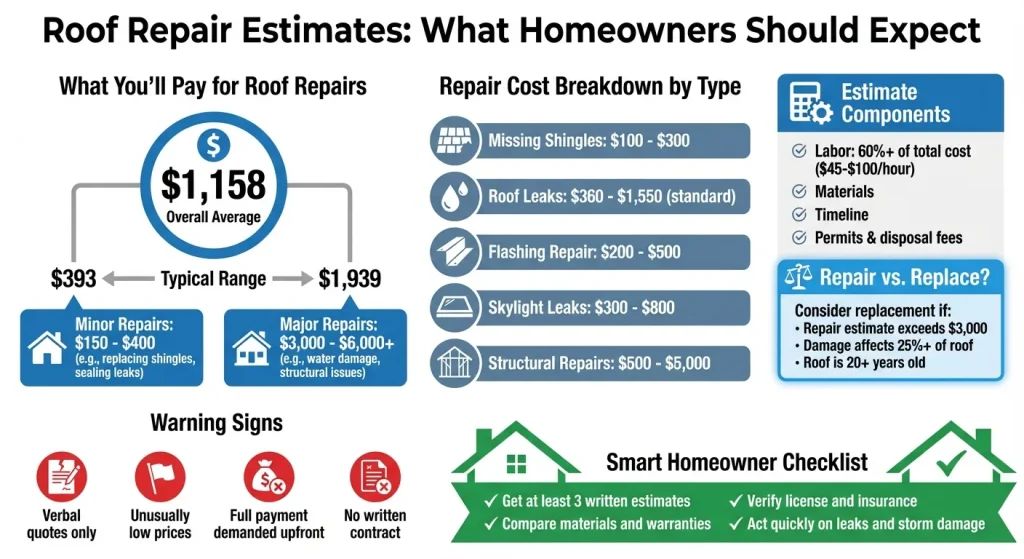
- Average Costs: Homeowners typically spend between $393 and $1,939, with an average of $1,158. Minor repairs (e.g., replacing shingles or sealing leaks) cost around $150–$400, while major fixes (e.g., water or structural damage) can exceed $3,000–$6,000.
- Why Estimates Matter: A detailed estimate helps you budget, compare contractors, and decide whether repairs or a full replacement is the better option. Repairs exceeding $3,000 or involving over 25% of the roof may warrant replacement.
- What’s Included: Estimates should break down labor, materials, timelines, and additional fees (e.g., permits, disposal). Labor costs alone make up 60%+ of the total and range from $45–$100/hour.
- Red Flags: Avoid contractors offering verbal quotes, unusually low prices, or demanding full payment upfront. Always request at least three written quotes to compare.
- Timing: Act quickly after spotting leaks, storm damage, or signs of wear. Regular inspections can catch issues early and save on costly repairs down the line.
What Should You Look For In A Roof Repair Estimate?- Roof Estimates and More
sbb-itb-e0ea4e0
What Are Roof Repair Estimates
A roof repair estimate is a detailed proposal outlining the expected costs, materials, and labor involved after a roof inspection [9]. Brian Dawson, Owner of Brian Dawson Roofing, puts it this way:
"A roofing estimate, often called a roof quote or roofing quote, is an itemized proposal provided by roofing companies that outlines the anticipated costs for your roofing project." [9]
Why Roof Repair Estimates Matter
Estimates provide a clear breakdown of costs, covering items like underlayment, flashing, labor (usually $45–$100 per hour), and disposal fees [9]. This transparency helps avoid unexpected charges and reflects the contractor’s professionalism. Having a detailed estimate also empowers you to negotiate. When you know what you’re paying for, you can ask specific questions about the scope of work or adjust the project to align with your budget [9].
How Estimates Help With Repair Planning
Estimates are crucial for effective budgeting and prioritizing repairs. For instance, fixing an active leak should take precedence, while replacing aging shingles in a dry area can often wait [5]. They also help you decide between repairing and replacing your roof. If an estimate exceeds $3,000 or involves more than 25% of the roof’s surface, a full replacement might make more financial sense [2][6]. Additionally, professional inspections that generate these estimates typically cost between $75 and $600, which could save you from costly surprises later [4][8].
Estimates vs Final Invoices
It’s important to distinguish between an estimate and a final invoice. An estimate is a preliminary cost projection provided before work begins, while the final invoice reflects the actual labor and materials used. Hidden issues like structural rot, damaged decking, or mold discovered during the repair process can lead to higher costs than initially estimated [1][6][7]. To avoid surprises, it’s a good idea to ask contractors in advance about how they handle unexpected damage.
The table below summarizes the key differences between estimates and final invoices:
| Feature | Roof Repair Estimate | Final Invoice |
|---|---|---|
| When Issued | Before the project starts | After the project is completed |
| Cost Basis | Projected based on inspection | Actual costs of labor and materials |
| Flexibility | May change if hidden damage is found | Final and binding amount |
| Primary Use | Budgeting, planning, and comparisons | Final billing and record-keeping |
Typical Roof Repair Costs
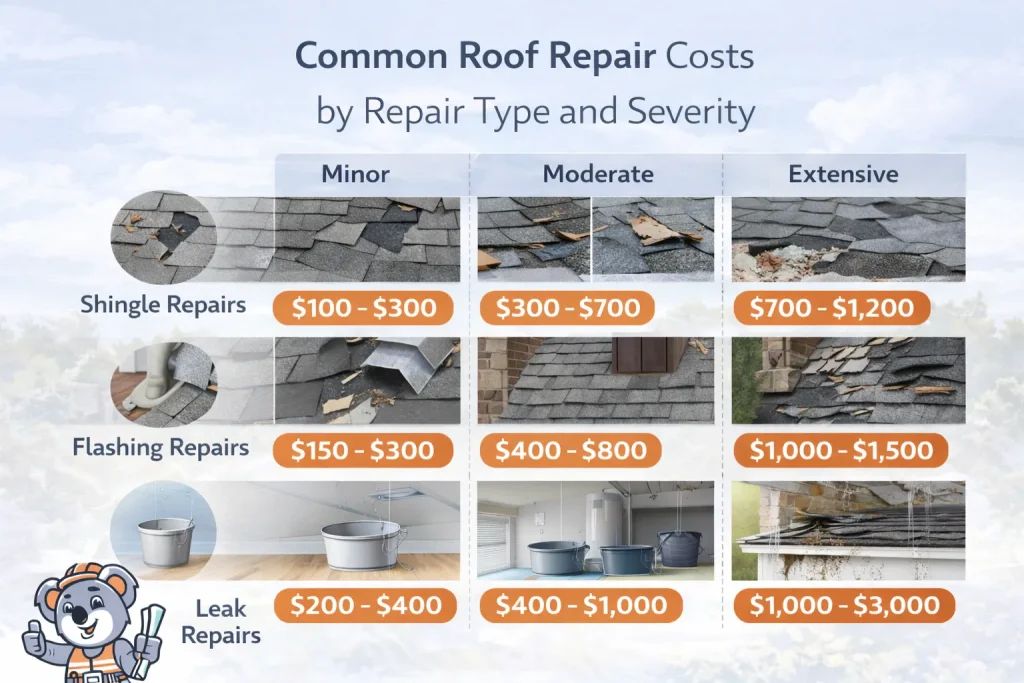
When it comes to roof repairs, understanding typical costs can help you budget effectively. Several factors influence these costs, including the type of damage, the materials involved, and the complexity of the repair work [4]. As Brad Broussard, Owner of B. Broussard Construction, puts it:
"The cost of roof repairs varies widely based on factors such as the type of roofing material, the extent of damage, labor rates, and your location." [4]
Here’s a breakdown of typical repair costs based on common issues.
Common Roof Repair Price Ranges
The table below outlines costs for various roof repair types:
| Repair Type | Cost Range |
|---|---|
| Missing Shingles | $100–$300 (up to 25 shingles) |
| Roof Leaks | $360–$1,550 (standard); $1,000–$6,000+ (extensive) |
| Flashing Repair | $200–$500 per area |
| Skylight Leaks | $300–$800 (resealing); $1,500–$3,500 (replacement) |
| Structural Repairs | $500–$5,000 (trusses/sagging) |
Labor rates generally range from $45 to $100 per hour, with emergency repairs adding an extra $100–$300 to the total cost [4]. If the repair estimate exceeds $3,000, many experts suggest evaluating whether a full roof replacement might be a better option [6].
Minor vs. Major Repair Costs
Roof repairs can be broadly categorized as minor or major:
- Minor repairs: These cost between $150 and $1,000 and include surface-level fixes like loose shingles or small leaks.
- Major repairs: These range from $3,000 to $8,000+ and address more severe issues like structural damage or widespread water problems [6][8].
Material choice also plays a role. For example, asphalt shingle repairs typically cost $350 to $1,000 per 100 square feet, while slate repairs can range from $1,000 to $3,000 for the same area [6]. Knowing these distinctions can help you better understand the estimates you receive.
Problems With Online Pricing Calculators
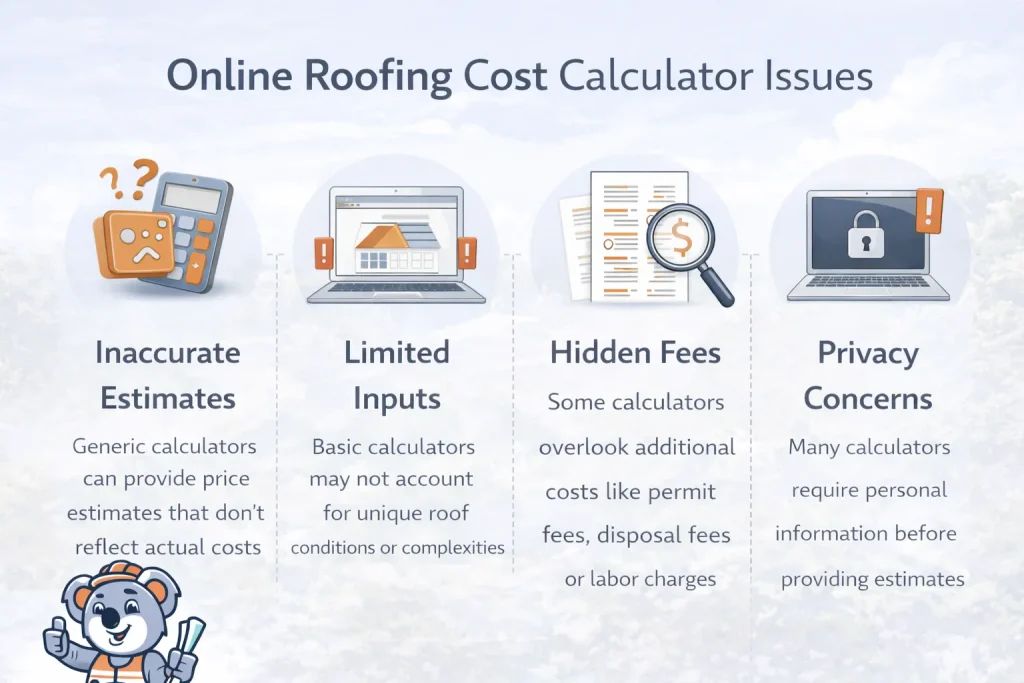
While an online roof replacement cost calculator can provide a starting point, they often fail to capture the full picture. These calculators rely on national averages and may overlook critical factors unique to your home. For instance, they might not account for:
- Roof pitch: Steeper roofs require specialized safety gear.
- Accessibility: Multi-story homes or obstacles like trees can complicate repairs.
- Hidden damage: Issues like rotten decking often go unnoticed until work begins.
- Permit fees: Local permits can cost anywhere from $70 to $250.
- Regional labor rates: Costs vary significantly depending on location [4][7][8].
John Foley, New England Branch Manager at Long Home Products, highlights another challenge:
"The average homeowner doesn’t have ladder elevators or that type of $10,000 equipment to get these things on the roof safely." [8]
While online calculators are a helpful starting point, they shouldn’t replace in-person estimates from local professionals. These detailed evaluations ensure you get an accurate understanding of what your roof repair will entail [1][7].
What Affects Roof Repair Estimate Costs
Roof repair costs hinge on several factors, including the type and extent of damage, materials used, labor rates, and safety requirements.
Damage Type and Severity
The kind of damage and its severity play a major role in determining repair costs. Structural issues like problems with trusses, rafters, or sagging can range from $1,500 to $7,000[8][10]. Damage caused by falling trees often requires debris removal, structural fixes, and surface repairs, which can push costs above $6,500[12][2]. Additionally, features like skylights and chimneys can increase expenses due to the need for specialized flashing and shingle removal to ensure proper sealing[2][5]. On average, roof repairs in 2026 are expected to cost around $1,150, but extensive structural repairs may fall between $2,000 and $8,000[12][8][3]. The type of roofing material and the design of your roof also significantly influence repair estimates.
Roofing Materials and Design
The material of your roof is a key factor in repair costs. For example, asphalt shingle repairs usually cost between $500 and $1,000, as they are widely available and relatively easy to install[2][8]. Metal roofing repairs tend to be pricier, averaging $750 to $2,500, while slate or tile repairs can exceed $2,500 due to the specialized skills and tools required[5][11][7]. Roof design complexity also affects pricing. A simple gable roof might cost $300 to $1,200 to fix, while intricate designs like mansard or butterfly roofs can range from $1,200 to over $6,000[4]. Features such as multiple planes, valleys, dormers, and chimneys add joints and seams that require precise attention[8][4]. As Brad Broussard, Owner of B. Broussard Construction, explains:
"As roofs age, shingles can become brittle, making repairs challenging and sometimes necessitating a complete roof replacement"[4].
Labor rates and regional pricing are additional factors to consider.
Labor Rates and Regional Pricing
Labor costs typically make up more than 60% of your total roof repair bill[8][6]. Hourly rates vary widely, ranging from $45 to $100, depending on the region[4][6]. In cities like Boston, New York, San Francisco, and Los Angeles, rates can climb as high as $80 to $100 per hour, while Southern and Midwestern states generally charge between $45 and $60 per hour[2]. Contractors also account for expenses like insurance, licensing, and bonding[8][5]. Emergency repairs may come with an additional fee of $100 to $300, and most roofers charge a minimum of $150 to $300 for a site visit[4][6]. Scheduling repairs during off-peak seasons, such as fall, can lead to savings of 10% to 15%[4].
Access and Safety Needs
The height, slope, and accessibility of your roof can further impact costs. Steep roofs with slopes exceeding 8/12 are considered hazardous and require specialized safety equipment like harnesses and ladder elevators, potentially adding $1,000 to $3,000 to your estimate[8][5]. Multi-story homes also increase labor costs due to the added effort of transporting materials[11][1]. Obstacles such as nearby trees or limited access points can complicate repairs and drive up expenses[4][1][8].
What Belongs in a Roof Repair Estimate
A roof repair estimate should provide a detailed breakdown of every part of the project. Contractors are expected to present itemized proposals to ensure full transparency about costs and services offered [1]. Andre Kazimierski, President & Co-Owner of HomeHero Roofing, highlights the importance of this approach:
"If a roofer is legit, they’ll be proud to show you their credentials. At HomeHero Roofing, our Illinois license, insurance coverage, and bond status are included on every estimate – no surprises, no games." [14]
Here’s what you should expect in a thorough roof repair estimate.
Specific Work Description
The estimate needs to outline the exact work planned for each section of the roof [14]. This includes specifying the brand, style, and grade of materials – such as shingles, underlayment, and flashing – instead of vague descriptions [13]. Any technical terms (like "valleys" or "ridge vents") should be clarified to avoid confusion [5]. Protect Preserve Roofing emphasizes the importance of clear documentation:
"A good contractor provides everything in writing: scope of work, materials, costs, warranties and start and finish dates." [13]
Cost Breakdown for Materials and Labor
A proper estimate will itemize both material and labor costs [1]. Labor often makes up 60% or more of the total expense, so you should see details like hourly rates or per-square pricing clearly outlined [6]. Additional administrative costs, such as permit fees ($70–$250), disposal fees ($300–$900), and cleanup charges, should also be included. Be cautious of contractors who provide only a lump sum without breaking down individual costs [1].
Project Timeline and Completion Date
It’s essential for the estimate to include start and completion dates as well as the total project duration [1]. For typical roof repairs, most jobs addressing common issues can be completed within 1 to 2 business days [2]. A documented timeline helps you plan accordingly and ensures the contractor stays accountable.
Warranty and Insurance Details
Beyond costs and timelines, the estimate should also address protections for your investment. It must include proof of liability insurance and workers’ compensation coverage [1]. Additionally, the document should detail warranties – both workmanship warranties (covering installation errors) and material warranties (covering defects in the materials). These warranties should specify their duration and what types of issues they cover [1][15]. To confirm your contractor is qualified, check their license against state databases [14]. Keep in mind that extended protection programs, such as those offered by GAF, may add a 10–20% premium to your total cost [15].
Why Estimates Differ Between Contractors
Getting quotes for the same roof leak can sometimes leave you scratching your head, especially when they vary by more than $1,000. These differences often come down to how thoroughly the contractor inspects the issue, the materials they recommend, and the overall costs of running their business.
Inspection Approach Differences
The way a contractor inspects your roof can significantly influence their estimate. Some roofers might stick to a quick visual inspection from the ground, while others will climb up to examine the roof closely and even check the attic for hidden issues. As RoofingCalc points out:
"Trying to determine the condition of a roof while standing on the ground or inside the home is inadequate. It takes inspection both on the roof and on the underside of the roof." [5]
A proper inspection isn’t free – it can cost anywhere from $75 to $600, with the average landing around $200 [4][2]. Contractors using advanced tools like drones or infrared cameras may charge more, but these methods often result in more accurate assessments [4]. For example, a handyman might spot damaged shingles and quote $400 for a patch job. Meanwhile, a professional who checks the attic might find mold or structural damage, pushing their estimate to $1,200 [5][2]. Thorough inspections often uncover deeper problems, which naturally leads to higher quotes.
Material Quality Choices
The materials a contractor selects also play a big role in price differences. A roofer using basic 3-tab asphalt shingles (costing $3.43–$4.65 per square foot) will quote less than one opting for architectural shingles, which range from $4.39 to $5.95 per square foot [11]. And it’s not just shingles – secondary materials like underlayment, flashing, and sealants vary in quality and price too. Synthetic felt underlayment, for instance, is pricier than traditional options but offers better durability [11].
Using high-quality materials can make a big difference in the roof’s lifespan. John Swindle warns:
"Some dishonest roofers might use lower-quality materials than promised to cut costs, which can result in a roof that doesn’t last as long as it should." [16]
Premium materials like slate or metal require specialized labor and components, which further elevates the cost. For instance, repairing a slate roof averages around $1,800, while asphalt shingle repairs typically cost about $975 [3][4]. Although the upfront investment is higher, premium materials often mean fewer repairs down the line.
Experience Level and Business Costs
The experience and qualifications of a contractor directly affect their pricing. Licensed, bonded, and insured roofers face higher operating costs due to liability insurance, workers’ compensation, and specialized tools. These expenses are reflected in their quotes but also provide homeowners with added protection [5][8]. John Foley, the New England branch manager at Long Home Products, highlights the importance of proper equipment:
"The average homeowner doesn’t have ladder elevators or that type of $10,000 equipment to get these things on the roof safely." [8]
Labor costs are another factor. Professional roofing labor typically ranges from $45 to $100 per hour, depending on the contractor’s expertise and location. Labor often makes up 60% or more of the total repair cost [2][6][8]. Contractors with years of experience and workmanship warranties will naturally charge more than a handyman who offers no guarantees [2][5]. As RoofingCalc.com explains, the added cost of hiring a professional often pays off in peace of mind:
"A pro is very likely to establish themselves to you as a professional contractor… by being licensed, bonded and/or insured… Sure, this comes at a premium, but is not really a high price to pay when considering the wager one would be taking if a non-professional… got injured while on the job." [5]
These factors – inspection methods, material quality, and contractor experience – are key reasons why roofing estimates can differ so widely.
Warning Signs in Roof Repair Estimates

Not all roofing estimates are equal. While many contractors are trustworthy, some estimates may include warning signs that could lead to costly mistakes or scams. Being aware of these red flags can help you make informed decisions and avoid unnecessary headaches.
Unclear or Verbal Estimates
If a contractor refuses to provide a written quote, it’s a major warning signal. Verbal agreements leave you unprotected if disputes arise or if the contractor abandons the job midway [17][19]. Without a written agreement, you’re vulnerable to unexpected charges – such as invoices increasing by 10% to 20% due to overlooked issues like rotted decking or material changes [18][19].
Arizona Roofers emphasizes:
"Never, ever accept a verbal agreement or a one-line price. Real value is found by comparing detailed, written estimates that break down every cost – materials, labor, permits, and disposal." [19]
Additionally, verbal estimates can void your warranty, as most manufacturers require documented proof of professional installation [5][19]. To protect yourself, always insist on an itemized written estimate that includes specifics like materials, labor, disposal fees, and permits before any work begins.
Unusually Low Prices
A quote that seems too good to be true often is. Suspiciously low estimates may indicate the use of inferior materials or skipping essential components like underlayment or flashing [9][1][6]. Contractors offering rock-bottom prices may also lack proper licensing, bonding, or insurance, putting you at risk if an accident occurs on your property [2][5].
These low-cost bids often cut corners, addressing only surface-level issues instead of tackling the root problem. Such shortcuts can lead to the same issue reappearing within months, forcing you to pay for another repair [20][5]. RoofingCalc.com cautions:
"A low-cost quote for repairs may sound wonderful, but could also be a trap of sorts." [5]
If you’re looking to save money, consider scheduling repairs during the off-season – fall or winter – when legitimate savings of 10% to 15% are more likely, rather than risking poor-quality work with a suspiciously low bid [4][20].
Full Payment Demanded Upfront
Demanding full payment before work begins is another red flag. Reputable contractors don’t ask for the entire payment upfront, as it removes their incentive to complete the job on time or meet quality standards. If the contractor isn’t bonded and disappears after being paid, you have little to no recourse [2][5][6]. HomeGuide advises:
"Avoid large upfront payments, especially for large jobs. Instead, negotiate a payment schedule for work completed." [6]
A fair payment plan ties payments to project milestones, ensuring both you and the contractor stay committed to the job’s completion. Before making any payments, ensure you have a signed, written contract that outlines the work scope, materials, timeline, and payment terms [1].
How Many Estimates to Get
Thorough estimates are essential for homeowners to plan roof repairs effectively.
Benefits of Getting Multiple Estimates
It’s a good idea to gather at least three quotes for any roof repair, no matter how minor the damage seems. In-person estimates are especially important for accuracy. As professional roofer Leo B explains:
The general guideline is to get a minimum of three quotes for any job, including minor repairs. You want to compare the services offered among the price range of estimates that you receive [2].
Having multiple quotes helps you understand the range of costs – high, low, and average – and ensures you won’t be pressured into unnecessary full roof replacements. It also provides clarity on what repairs are truly needed.
Key Points to Compare in Quotes
Once you’ve collected several estimates, look closely at what each one includes. Make sure every quote breaks down the costs for labor, materials, timelines, permit fees, cleanup, and disposal. Pay attention to the types of roof materials being proposed – whether it’s asphalt shingles, metal, or tile – since the quality can greatly affect both the price and the durability of the repair.
Verify that each contractor has an active license, bonding, and insurance for liability and workers’ compensation. Also, review the warranty details for both the materials and the work itself; reputable contractors provide written guarantees. Lastly, check whether the contractor performed a thorough inspection, including areas like your attic and the underside of the roof. This ensures the estimate reflects the actual scope of work needed. These comparisons will help you identify fair market rates.
Recognizing Fair Market Pricing
The middle estimate often represents fair market value, so be cautious of quotes that are significantly higher or lower. On average, homeowners spend between $300 and $1,200 for roof repairs, though costs vary by region. Minor repairs typically range from $150 to $1,000, while major structural fixes can cost anywhere from $3,000 to $8,000.
Expect higher rates on the East and West Coasts compared to the Midwest or South. If possible, schedule repairs during off-peak seasons to save 10%-15%. However, avoid extremely low bids – they may signal poor-quality work or insufficient insurance coverage.
Best Times to Request Estimates
Timing can make all the difference when addressing roof repairs. Acting promptly not only saves money but also helps prevent minor issues from escalating into major structural headaches.
When You Notice Leaks or Damage
The moment you spot water stains on your ceiling, missing shingles, or granule buildup in your gutters, it’s time to request an estimate. Even small leaks can lead to expensive structural repairs if ignored. Regularly inspect your attic for signs like dampness, musty odors, sagging insulation, or sunlight streaming through roof boards. Other red flags include curled shingles, moss growth, or eroded granules. An unexplained spike in your heating or cooling bills could also indicate compromised insulation due to roof damage [4][20]. Post-storm inspections are equally important to catch hidden damage early.
After Major Weather Events
Severe weather can wreak havoc on your roof, even if damage isn’t immediately visible. After storms, hail, or high winds, schedule a professional inspection and request estimates right away. Hidden issues, like damaged flashing or missing granules, can lead to leaks if left unchecked [21][5]. While emergency repairs might seem costly upfront, they pale in comparison to the expense of extensive water damage [20][4].
Take photos of visible damage immediately to support any insurance claims. Most homeowners insurance policies cover sudden storm damage, but claims may be denied if filed late or if the damage worsens due to neglect [20]. Contact your insurance provider promptly to confirm coverage details and deadlines [6]. Keep in mind that roofing contractors tend to book up quickly after storms, so acting fast is essential [20].
Before Small Problems Get Worse
Routine roof inspections are key to catching issues early. Inspect your roof twice a year – once in spring and again in fall – and schedule at least one professional inspection annually [21][5][6][2]. If your asphalt roof is between 15 and 25 years old, you’ll want to request estimates more frequently as the materials near the end of their lifespan [21][5]. Watch for signs like sagging rooflines, rusted or loose flashing around chimneys and vents, pooling water on flat sections, or ice dams forming in winter [4][8].
Addressing these problems early can prevent costly structural failures. As RoofingCalc warns:
Waiting for repairs to pop up and make themselves visible to you is a gamble. A huge gamble [5].
Timely estimates not only protect your roof’s integrity but also help you avoid skyrocketing repair costs down the line.
Conclusion
Getting a roof repair estimate is easier when you know what to focus on. Start by comparing several written estimates from licensed and insured contractors. This ensures fair pricing and lets you evaluate materials, timelines, and each contractor’s approach to the job [6]. Keep in mind that labor typically makes up 60% or more of your total repair cost, so differences in contractor experience and overhead will naturally impact the price [6]. Taking these steps can help you spot potential red flags and pick the right contractor by asking the right questions for your needs.
A good estimate should clearly break down labor and material costs, specify the materials being used, outline a timeline, and include warranty details [1]. Be cautious of contractors who only provide verbal quotes, ask for full payment upfront, or offer a price that seems unrealistically low. As Andre Kazimierski from HomeHero Roofing puts it:
"A cheap roof is the most expensive kind in the long run." [14]
Timing matters, too. If your roof is over 20 years old, the repair estimate exceeds $3,000, or the damage affects more than 20%–25% of the roof, it might be time to consider a full replacement [6]. Don’t let small issues grow into bigger problems like structural damage, mold, or wood rot.
For help finding trusted local roofers and getting multiple estimates, visit KoalatyRemodel.com. With the right information in hand, you’ll be ready to make a confident decision that protects both your home and your wallet.
FAQs
How do I know if a roof repair estimate is fair and accurate?
To gauge whether a roof repair estimate is fair and reasonable, start by comparing it to the typical price range for similar repairs in your region. A solid estimate should provide a clear and detailed breakdown of costs, including materials, labor, any extra fees, and a thorough explanation of the work involved.
Watch out for estimates that are vague, unexpectedly low, or missing key details. It’s wise to seek multiple quotes from trustworthy contractors to ensure you’re getting a competitive price. Keep in mind, the lowest price isn’t always the best choice – quality and dependability are just as important.
What should I do if contractors give me very different roof repair estimates?
If you’ve received roof repair estimates that vary widely, it’s worth taking the time to compare them closely. Differences can stem from factors like how inspections were conducted, the quality of materials proposed, or the contractor’s level of experience and overhead costs. Carefully review each estimate to check for a detailed scope of work, a breakdown of materials, labor costs, and a clear timeline for the project.
Watch out for warning signs such as vague or verbal-only estimates, prices that seem unusually low, or contractors asking for large upfront payments – these can signal potential issues. Instead of zeroing in on the cheapest option, look at the overall clarity and value of the estimate. Sometimes, a higher price reflects superior materials or more thorough workmanship. Choose contractors who offer clear, professional, and detailed estimates, as these often indicate reliability.
When should I replace my roof instead of repairing it?
Deciding between repairing or replacing your roof comes down to a few key factors: the level of damage, the roof’s age, and overall cost-effectiveness. For instance, if your roof has only minor issues – like a handful of missing shingles – it’s often possible to repair it, especially if the roof is still relatively new. On the other hand, if your roof is nearing the end of its typical lifespan (around 20–25 years for asphalt shingles) or has more serious problems like sagging or recurring leaks, replacement might be the smarter move.
Here’s a helpful guideline: if repair costs climb above 25% of what it would cost to replace the roof, or if the damage is extensive, replacing the roof could save you money over time. To make the most informed choice for your home and budget, consider having a roofing professional inspect the roof and provide an estimate.
Related Blog Posts
- The Average Price for a New Roof: Great Budgeting Tips for Homeowners in 2025
- Roofers Near Me 📅 How to Schedule a Free Roof Replacement Estimate Online
- 🧰 Roof Replacement Cost Calculator: Estimate Your Project Budget by Roof Type 2025
- 🛠️ Best Roofing Company Near Me for Roof Repairs and Roof Replacements in 2025