


The cheapest roofing quote can cost you more later. If I were hiring a roofer in Bergen County, I’d compare 10 things before price alone: licensing, insurance, estimate details, inspection method, materials, flashing, ventilation, change-order risks, communication, warranties, and cleanup. For broader planning context, review the roofing guide guide.
Here’s the short version: a roofing bid should spell out tear-off, disposal, permits, underlayment, ice and water shield, flashing, ventilation, and property protection. If it doesn’t, I’d expect added charges later. That matters in Bergen County, where snow, nor’easters, and freeze-thaw cycles put extra stress on roofs.
Before I sign with any company, I’d make sure they can answer these questions:
- Are you registered and insured in New Jersey?
- What is included in the written estimate?
- How do you inspect the roof before making a recommendation?
- What materials do you recommend, and why?
- How will you handle flashing, ventilation, and roof parts?
- What can change the final cost once work starts?
- Who manages the job and updates me?
- What warranty covers materials and labor?
- How will you protect my home and yard?
- What should I compare before I choose?
A few numbers stand out:
- A bid that is 25% or more lower than the others needs a close review.
- Many New Jersey roofers carry workmanship warranties in the 5- to 10-year range.
- Some certified contractors may offer 15- to 25-year workmanship coverage.
- For 2026, many full roof replacements in this market can range from about $8,000 to $45,000+, depending on material and roof type.
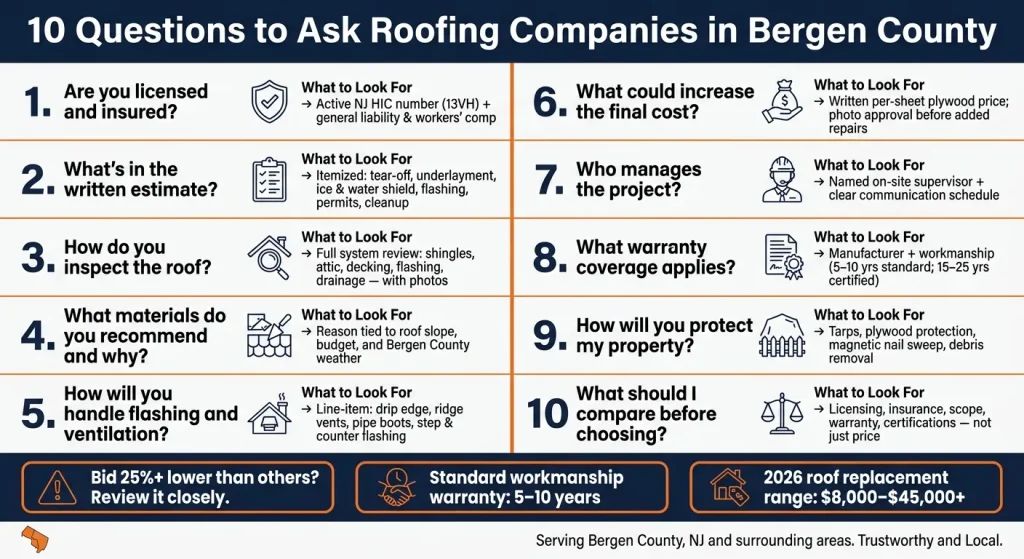 10 Questions to Ask Roofing Companies in Bergen County
Top Questions to Ask When Hiring a Roofing Contractor
Quick Comparison
| What I’d Check | What I’d Want to See |
|---|---|
| Registration | Active NJ HIC number starting with 13VH |
| Insurance | General liability and workers’ comp |
| Scope | Itemized estimate, not a one-line quote |
| Inspection | Roof and attic review with photos |
| Materials | Clear reason for shingle, metal, TPO, or EPDM choice |
| Roof parts | Flashing, underlayment, drip edge, vents, pipe boots |
| Cost risks | Written plywood replacement price per sheet |
| Communication | One point of contact and job schedule |
| Warranty | Material + workmanship details in writing |
| Cleanup | Tarps, nail sweep, debris removal, surface protection |
Bottom line: I’d use these questions to compare roofers side by side, spot missing scope, and avoid a low bid that grows after the job begins.
Questions 1-3: Licensing, Estimate Scope, and Inspection
These first three questions are your baseline screen. Ask them before you get into materials, timing, or cost. They make it much easier to compare bids and weed out weak contractors. Start with licensing, insurance, and scope first. Then talk about materials or price.
1. Are you licensed and insured for roofing work?
First, make sure the contractor is properly registered. New Jersey does not issue a separate roofing license. Instead, residential roofing contractors must register as Home Improvement Contractors (HIC) with the NJ Division of Consumer Affairs. A valid registration number starts with 13VH and then eight digits. You can check that status on the Division of Consumer Affairs website before you sign anything [9][5].
Then ask for a current Certificate of Insurance that shows general liability and workers’ compensation. Don’t just glance at it – verify it with the insurance carrier. This part matters more than many homeowners think. If someone on the crew gets hurt on your property and the contractor doesn’t carry workers’ compensation, you could end up on the hook for medical bills and lost wages [6][7].
It also helps to ask whether the crew is in-house or subcontracted. If subcontractors are involved, confirm they’re covered under the same policy [7][10].
Once coverage checks out, move to the estimate itself.
2. What exactly is included in the written estimate?
A one-line estimate that says "roof replacement – $X" tells you almost nothing. It doesn’t give you a fair way to compare one bid against another. A written estimate should break out the main parts of the job, including:
- Tear-off and disposal – how many roof layers will be removed and who pays dumpster fees
- Ice and water shield – protection at eaves and valleys during freeze-thaw cycles
- Underlayment – the type used as a second water barrier
- Flashing – work around chimneys, walls, and roof penetrations
- Ventilation – ridge vents or soffit vents
- Permits – confirmation that the contractor handles code compliance and municipal inspections
- Cleanup – including a magnetic nail sweep for the driveway and lawn
That kind of detail shows you what you’re paying for. It also helps you spot when one bid looks cheaper only because parts of the job were left out.
3. How do you inspect the roof before making a recommendation?
A quick look from the ground at worn shingles is not a full inspection. A proper review should cover the whole roofing system: shingles, step flashing, counter flashing, chimney flashing, roof decking, attic ventilation, drainage, valleys, pipe boots, and skylights [5][4][1].
The attic matters too. Problems often show up there first. Moisture intrusion or early decking damage can be visible inside the attic before you see anything from outside [4][1].
You should also ask how hidden wood damage is handled. Contracts need a pre-agreed per-sheet price for plywood replacement, so you don’t get hit with surprise charges once the tear-off starts and rotted decking is found [5][2].
Ask this directly:
"What does your inspection cover, and how will you document what you find?"
Clear, specific answers usually signal a contractor who knows their process. Vague answers usually don’t.
Once the inspection is documented, compare whether the suggested materials line up with the roof’s actual condition.
Questions 4-6: Materials, Roof Components, and Cost Risks
These next three questions help you figure out whether the material plan makes sense for your roof and your budget.
4. What roofing materials do you recommend and why?
A solid contractor should be able to tell you why a certain material fits your roof slope, your budget, and the weather in your area. In Bergen County, that matters. Roofs here deal with wind, snow, and repeated freeze-thaw cycles.
For most steep-slope homes, architectural shingles are a common mid-range option. They’re thicker and last longer than 3-tab shingles [5]. If you want a roof that can last much longer and you’re okay with a higher upfront price, standing seam metal is often a strong fit. It can last 25 to 50+ years and does a good job with heavy snow loads [5]. For low-slope or flat sections, TPO or EPDM membranes are the right fit [5][11].
Typical 2026 price ranges for a 1,500–2,500 sq. ft. home:
| Material | Typical Price Range |
|---|---|
| Asphalt 3-Tab Shingles | $8,000 – $15,000 |
| Architectural Shingles | $12,000 – $20,000 |
| Premium Designer Shingles | $18,000 – $30,000 |
| Standing Seam Metal | $25,000 – $45,000 |
| Flat Roof (TPO/EPDM) | $10,000 – $18,000 |
Keep your home secure with roofing solutions built for durability and efficiency.
5. How will you handle flashing, ventilation, and roof components?
Shingles get most of the attention. But leaks usually start at the seams, edges, and roof penetrations.
Skipped or poorly installed step flashing at walls and chimneys is a common cause of leaks in residential roofing [5]. That’s why it helps to check the proposal line by line. It should include underlayment, drip edge, ridge vents, pipe boots, step flashing, counter flashing, and chimney flashing. New Jersey code requires ice and water shield along the eaves, and solid proposals also include coverage at valleys and penetrations [5][7]. If one bid comes in much lower than the others, this is one of the first places to look.
For a full breakdown of what each component does and why it matters, the Roof Flashing Guide covers the details.
6. What could increase the final cost after work begins?
Once the scope is set, ask what might change the price after tear-off starts.
Hidden conditions are the big issue here. The most common cost driver is damaged decking, which often can’t be seen until the old shingles are removed. If the crew finds damaged plywood or OSB, it has to be replaced to meet code and keep the warranty valid [10][8].
Other things can add cost too, like ventilation fixes, hidden flashing problems around chimneys or dormers, and extra disposal charges if the roof already has two shingle layers. That matters because New Jersey code allows a maximum of two layers before a full tear-off is required [6][9].
Before the job begins, get a written per-sheet plywood replacement price [10][5]. Also ask the contractor to stop, take photos, and show you any damage they find before they move ahead with repairs [10].
Questions 7-10: Communication, Warranties, Property Protection, and Final Comparison
7. Who manages the project and handles communication?
Ask who will run the job day to day, who will be on site, and the best way to reach them. You’ll also want to know how updates are shared. A good contractor should be able to explain this in plain English.
It also helps to ask whether the crew is made up of in-house employees or subcontractors. That can affect who’s accountable if something goes wrong. And if hidden damage shows up once the roof is opened, ask who has the authority to approve added work.
A solid roof replacement process should include a project schedule, clear milestones, and regular progress updates. If the answers feel vague, rushed, or pushy, take that as a warning sign. [4][7][2][1]
Once you know who’s running the job, the next thing to check is the written coverage behind the work.
8. What warranty coverage applies?
Most roofing jobs come with two separate warranties. The manufacturer warranty covers material defects. The workmanship warranty covers installation mistakes. [4][6][5]
For reputable New Jersey contractors, workmanship coverage often lasts 5 to 10 years. Certified contractors may offer 15 to 25 years. [5][8]
Don’t stop at the headline number. Ask:
- Is the warranty prorated or non-prorated?
- Can it transfer to a future buyer?
- Who handles claims if there’s a problem?
That last point matters more than people think. A manufacturer-backed warranty may still be honored even if the original contractor goes out of business. [7][8]
After that, turn to how the crew will protect your house while the old roof comes off.
9. How do you protect the property during the project?
Cleanup isn’t a small detail. A roof replacement can leave behind thousands of nails, plus dust and debris. That’s why it’s smart to ask exactly how the crew will protect the rest of your property.
Look for clear steps around:
- Landscaping, gutters, siding, and windows
- The driveway and other hard surfaces
- Attic contents that could be exposed to dust or falling debris
You’re listening for specifics here, not general promises. Things like tarps, plywood protection, and magnetic nail sweeps show that the contractor has a real plan. [6][2][9]
Use those answers to compare companies side by side.
10. What should I compare before choosing a contractor?
| Comparison Factor | What to Look For |
|---|---|
| Licensing | Active NJ HIC registration (13VH number) [5][2] |
| Insurance | $1M+ general liability and workers’ comp for all crew [7][5][2] |
| Estimate Clarity | Itemized breakdown of labor, materials, and disposal [4][5][2] |
| Project Management | Dedicated on-site supervisor [7][2] |
| Property Protection | Tarps, plywood for windows, and magnetic nail sweeps [6][2][9] |
| Warranty | Workmanship duration, prorated vs. non-prorated, and transferability [6][5][8] |
| Certifications | Manufacturer certifications [7][5][8] |
When you line up estimates, don’t just look at the bottom-line price. Check what each contractor includes, how they communicate, what kind of warranty support they offer, and how they plan to protect your home during the job. That side-by-side view makes it much easier to spot gaps.
Conclusion: Use These 10 Questions to Choose With More Confidence
Once you compare scope, materials, and warranties, the choice usually gets a lot easier. Picking a roofing company in Bergen County comes down to what’s included in the estimate, how the work is documented, and how your roof and property will be protected. The best option is the contractor who lays out the work clearly and explains each cost based on the agreed scope.
These 10 questions help you compare contractors on more than price alone. Use them to review licensing, estimate details, inspection methods, materials, components, cost risks, communication, warranties, and property protection. In plain English: they help you judge contractors on facts, not sales pressure.
An estimate that comes in 25% or more below the others deserves a close look.[2][3] A gap that big can point to missing scope items, lower-grade materials, or extra charges that show up later. And that’s often where the cheap quote stops looking cheap.
If the answers are clear and written down, you have a much better basis for choosing. Request a free roofing quote through Koalaty Remodel to compare options with a full scope in writing.