


- Top Brands: SunPower leads with 22.8% efficiency, while Panasonic, Qcells, REC Group, Canadian Solar, and Tesla offer strong alternatives for different budgets and needs.
- Key Factors to Compare: Efficiency, durability, warranties, cost, and performance in various climates.
- Quick Picks:
- Best Efficiency: SunPower (Maxeon)
- Best Value: Panasonic
- Budget-Friendly: Qcells
- Tough Weather: REC Group
- Integrated Systems: Tesla
Quick Comparison Table
| Brand | Efficiency | Product Warranty | Power Warranty | Price per Watt | Temp. Coefficient | Panel Wattage |
|---|---|---|---|---|---|---|
| SunPower | 22.8% | 25 years | 92% @ 25 years | $3.20–$3.80 | -0.29%/°C | 400W–440W |
| Panasonic | 21.7% | 25 years | 91% @ 25 years | $2.90–$3.40 | -0.26%/°C | 370W–410W |
| Qcells | 20.9% | 25 years | 86% @ 25 years | $2.60–$3.00 | -0.34%/°C | 350W–400W |
| REC Group | 21.5% | 25 years | 92% @ 25 years | $2.80–$3.30 | -0.26%/°C | 365W–405W |
| Canadian Solar | 20.2% | 12 years | 83% @ 25 years | $2.40–$2.80 | -0.36%/°C | 340W–385W |
| Tesla | 20.6% | 25 years | 85% @ 25 years | $2.50–$3.00 | -0.34%/°C | 340W–400W |
Whether you prioritize efficiency, affordability, or durability, this guide simplifies your decision-making process. Read on for detailed reviews of each brand.
I Ranked Every Solar Panel (Here’s What’s ACTUALLY Good)
1. SunPower (Maxeon)
SunPower’s Maxeon panels are set to dominate the 2025 market. With an impressive efficiency rating of 22.8%, the M-Series panels are perfect for homeowners who want to make the most of limited roof space.
The standout M6 AC residential panels deliver up to 440 watts per panel. These panels come with built-in inverters, making installation easier and improving performance, even in partially shaded conditions.
Key Performance Features:
- Maximum Power Output: 440W
- Temperature Coefficient: –0.29%/°C
- Annual Degradation Rate: 0.25%
- Design: Sleek, all-black aesthetic
SunPower backs its panels with a 25-year warranty, ensuring at least 92% power output over the warranty period. However, this quality comes at a premium. Prices range from $3.50 to $4.00 per watt, meaning a typical 6kW system will cost $21,000 to $24,000 before federal tax credits or local incentives.
Best Applications:
- High-end residential projects
- Roofs with limited space
- Areas with harsh weather conditions
- Long-term investments focused on premium home value
These panels excel in a variety of environments, from the intense heat of the Southwest to the cloudy skies of the Pacific Northwest, thanks to their strong performance in low-light and temperature extremes.
| Performance Metric | Rating |
|---|---|
| Efficiency | 22.8% |
| Power Output | 440W |
| Temperature Performance | –0.29%/°C |
| Warranty Length | 25 years |
| Price Per Watt | $3.50–$4.00 |
Up next, we’ll take a closer look at Panasonic’s durable and reliable residential solar solutions.
2. Panasonic
Panasonic’s EverVolt series continues to stand out in 2025 as a reliable option for homeowners looking for efficient and long-lasting solar panels. These panels are designed to maintain steady performance, even in challenging environmental conditions.
Key Features:
- High energy output with consistent efficiency
- Designed to perform well in extreme climates and low-light settings
- Built to withstand heavy snow and strong winds
- Excellent temperature coefficient for better performance in high heat
Panasonic backs its panels with a 25-year warranty that covers both product quality and performance. This extensive warranty is among the best in the industry, giving homeowners peace of mind and protecting their investment for the long haul.
Best Uses:
- Homes in areas with very hot or extreme weather
- Locations prone to severe storms or heavy snow
- Mid to high-end residential projects
While Panasonic panels may not achieve the efficiency levels of some ultra-high-end options, they offer a great mix of durability, performance, and value. Their strong reputation and robust warranty make them an attractive choice for homeowners focused on long-term dependability.
Up next, we’ll take a closer look at Qcells, known for combining affordability with solid performance.
3. Qcells (Hanwha)
Qcells, part of Hanwha Solutions, stands out in the U.S. residential solar market with its Q.PEAK DUO series. Known for solid performance at a competitive price, these panels are a strong choice for 2025.
Performance Highlights:
- Efficiency: 19.5%–21.4%
- Power Output: 350W–415W per panel
- Temperature Coefficient: –0.34%/°C
The Q.PEAK DUO ML-G10+ series includes advanced features like zero-gap cell technology, anti-reflective glass coatings to boost light absorption, and a reinforced frame that can handle winds up to 134 mph and snow loads of 75 lbs/ft².
Warranty Details:
- 25-year product warranty
- 25-year performance guarantee, ensuring 86% output by year 25
- Protection against potential induced degradation (PID)
Qcells offers high-end features at a mid-tier price point.
Best Uses:
- Large residential projects focused on cost per watt
- Installations needing high power output in limited roof space
- Areas with tough weather conditions
- Budget-conscious setups seeking dependable performance
To strengthen its role in the U.S. market, Qcells has expanded domestic production. The company now manufactures both cells and modules in the U.S., improving supply availability and keeping prices steady. Each panel undergoes rigorous testing, including electroluminescence (EL) checks and varied lighting condition evaluations, to meet and exceed industry standards.
The Q.PEAK DUO ML-G10+ series is a smart choice for those looking to maximize energy output per square foot without overspending. It offers a blend of efficiency, durability, and affordability, making it ideal for a range of residential installations.
4. REC Group
REC Group solar panels are known for their solid build and reliability, making them a popular choice for residential installations in 2025. Positioned in the mid-premium price range, they strike a good balance between cost and performance. When installed by certified professionals, these panels come with extended product and performance warranties, adding extra peace of mind.
Designed to perform reliably in various climates, REC Group offers a combination of durability and competitive pricing. Their strict quality control measures and focus on sustainable manufacturing further enhance their reputation as a dependable choice for energy-conscious homeowners.
sbb-itb-e0ea4e0
5. Canadian Solar

Canadian Solar offers budget-friendly solar panels for homeowners in 2025, combining affordable pricing with reliable performance thanks to their global manufacturing process.
Their residential panels achieve efficiency ratings ranging from 19.3% to 21.2%, making them a dependable option for most home setups. The BiHiKu series is a standout choice, balancing energy output and cost-effectiveness.
Key specifications:
- Power output: 370W to 405W for residential models
- Temperature coefficient: -0.34% per °C
- 25-year performance warranty
- 12-year product warranty
- Average cost: $2.70 to $3.10 per watt installed
These panels are built to last, performing well in durability tests. They resist potential-induced degradation (PID) and handle high temperatures effectively. Canadian Solar also ensures strict quality control with features like:
- Triple EL testing during production
- Wind resistance up to 130 mph
- Snow load capacity of 5,400 Pa
- Salt mist corrosion testing
These panels work especially well for:
- Large residential setups focused on reducing cost per watt
- Whole-house solar systems
- Installations with plenty of roof space
While Canadian Solar panels don’t reach top-tier efficiency levels, they deliver excellent value and a solid return on investment. With a wide U.S. distribution network and reliable warranty support, they’re a smart pick for residential solar projects.
6. Tesla
Tesla’s solar panels in 2025 stand out for their sleek design and integrated system, making them a popular choice for homeowners who value aesthetics. Their product line includes standard solar panels and Solar Roof tiles, both designed to deliver strong performance while maintaining a low-profile, modern look.
These solar solutions are part of Tesla’s broader energy ecosystem, which includes the Powerwall battery. The Powerwall pairs seamlessly with both the panels and Solar Roof, offering a unified energy system. Plus, Tesla’s mobile app allows users to monitor and control their energy usage in real time, making energy management more convenient.
Tesla’s solar products come with several standout features, including:
- An all-black design with discreet mounting hardware for a polished appearance.
- Built-in compatibility with the Powerwall for efficient energy storage.
- A mobile app that provides detailed system monitoring and control.
Tesla offers competitive pricing for their standard panels, while the Solar Roof serves as a premium option for those looking to replace their entire roof. However, there are some drawbacks to consider.
For instance, installation wait times can be long in certain areas, and customization options are somewhat limited. Availability may also vary by region. Additionally, installing the Solar Roof is more complex compared to standard panels, which could add to the installation process.
Tesla’s solar solutions are especially suited for homeowners planning a full roof replacement, those wanting a fully integrated energy setup, and users who value app-based energy management. While the ordering process is streamlined to keep costs down, it does reduce flexibility in design choices.
7. LG Solar
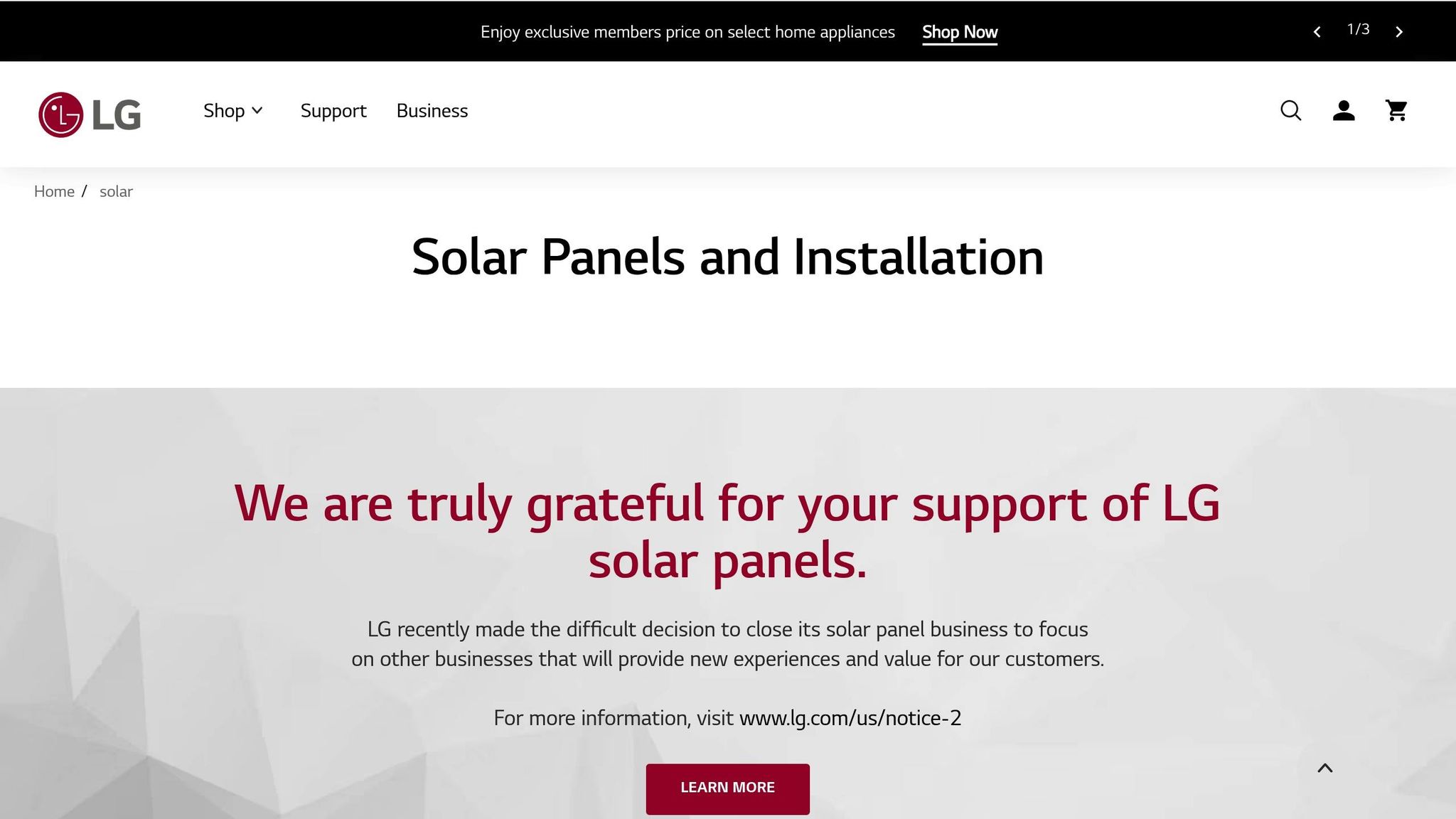
LG Solar stopped manufacturing solar panels in late 2022 after spending a decade in the residential market. However, existing LG solar panel installations are still covered under the original 25-year warranty. Homeowners can access support through LG Electronics’ service centers or their online portal. Warranty claims can be submitted via authorized service partners or directly through the online support system.
LG panels were known for their efficiency of up to 21.7%, durable construction, and strong resistance to weather conditions. If you own LG panels, make sure to keep your purchase records, report any issues promptly, use certified installers for repairs, and register your system with LG’s warranty service to ensure smooth support.
For those planning new solar installations, brands like Panasonic, SunPower, and REC offer similar performance and warranty options. While LG no longer produces panels, its reputation serves as a benchmark for choosing reliable alternatives.
Brand Comparison Chart
Here’s a breakdown of key specifications, warranties, and pricing for leading residential solar panel brands in 2025:
| Brand | Efficiency | Product Warranty | Power Warranty | Price per Watt | Temperature Coefficient | Panel Wattage Range |
|---|---|---|---|---|---|---|
| SunPower (Maxeon) | 22.8% | 25 years | 92% at 25 years | $3.20 – $3.80 | -0.29%/°C | 400W – 440W |
| Panasonic | 21.7% | 25 years | 91% at 25 years | $2.90 – $3.40 | -0.26%/°C | 370W – 410W |
| Qcells | 20.9% | 25 years | 86% at 25 years | $2.60 – $3.00 | -0.34%/°C | 350W – 400W |
| REC Group | 21.5% | 25 years | 92% at 25 years | $2.80 – $3.30 | -0.26%/°C | 365W – 405W |
| Canadian Solar | 20.2% | 12 years | 83% at 25 years | $2.40 – $2.80 | -0.36%/°C | 340W – 385W |
| Tesla | 20.6% | 25 years | 85% at 25 years | $2.50 – $3.00 | -0.34%/°C | 340W – 400W |
| LG Solar* | 21.7% | 25 years | 90% at 25 years | N/A | -0.30%/°C | 365W – 405W |
*LG Solar panels are no longer manufactured but are included for reference regarding existing installations.
Additional performance details are outlined below:
| Brand | Annual Degradation Rate | Snow/Wind Load Rating | Made in | Black Frame Option |
|---|---|---|---|---|
| SunPower (Maxeon) | 0.25% | 5400Pa/2400Pa | Mexico/Malaysia | Yes |
| Panasonic | 0.26% | 5400Pa/2400Pa | Malaysia/USA | Yes |
| Qcells | 0.35% | 5400Pa/2400Pa | USA/South Korea | Yes |
| REC Group | 0.25% | 7000Pa/4000Pa | Singapore | Yes |
| Canadian Solar | 0.55% | 5400Pa/2400Pa | China/Vietnam | Yes |
| Tesla | 0.50% | 5400Pa/2400Pa | USA | Yes |
| LG Solar* | 0.33% | 5400Pa/2400Pa | South Korea | Yes |
- Price Variability: Costs depend on region, installer, and system size.
- Snow/Wind Load Ratings: Indicate the maximum pressure (measured in Pascals) the panels can handle.
- Temperature Coefficient: Reflects power loss per degree Celsius above 25°C; lower values mean better performance in high heat.
Final Recommendations for Residential Solar Panels
After analyzing various options, here are tailored suggestions for different homeowner priorities:
- Maximum Efficiency: SunPower (Maxeon) stands out for its top-tier efficiency and strong warranty. It’s a great choice if you have limited roof space and don’t mind paying a premium.
- Best Value: Panasonic offers reliable performance with solid warranty coverage at a mid-range price point.
- Budget-Friendly: Qcells delivers reliable results at competitive prices, making it a smart pick for those on a budget.
- Weather Resistance: REC Group panels are built to handle tough conditions, including heavy snow and strong winds.
- Smart Integration: Tesla panels combine sleek design with smooth integration into their energy systems.
When making your final choice, keep these key factors in mind:
- Climate: Pick panels that can handle your area’s typical weather.
- Warranty: Look closely at both product and performance guarantees.
- Space: If roof space is tight, opt for high-efficiency panels.
- Value: Weigh upfront costs against long-term energy savings.
Select a system that aligns with your energy goals, location, and budget. Certified installers can help ensure you get the best performance.