


If you’re comparing window costs, start with the room – not just the top window types. From what I see in the numbers, awning windows usually cost $477 to $1,150 installed, with a U.S. average near $638. Double-hung windows often land at $300 to $850, casement windows at $300 to $1,000, and fixed or picture windows at $300 to $1,200.
Here’s the short answer:
- Awning windows make sense when you want airflow, privacy, and light rain protection.
- Double-hung windows fit spots where you want easy cleaning and no outward swing.
- Casement windows are often the pick for stronger airflow and egress use.
- Fixed windows work best when light and views matter more than ventilation.
A few price points matter right away:
- Labor can take 40% to 50% of the total cost.
- Custom sizes can add 20% to 50%.
- Low-E glass with argon can add about 30% to glass cost.
- Triple-pane glass can add about 10% to 15% to total project cost.
- Awning windows need about 12 to 24 inches of outside clearance.
So, if you’re pricing windows for a bathroom, kitchen, basement, bedroom, or living room, I’d compare them by airflow, privacy, cleaning, egress, and outside space first. That tells you more than unit price alone.
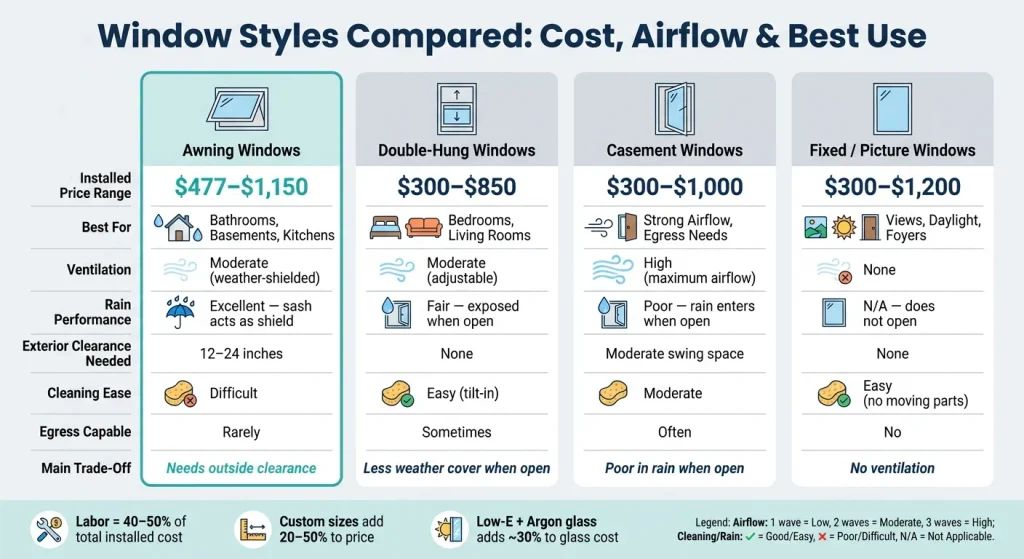
Awning vs. Double-Hung vs. Casement vs. Fixed Windows: Cost & Feature Comparison
What is an Awning Window Pros, Cons, and Costs? | Fairway Exteriors
Quick Comparison
| Window Style | Installed Price | Best For | Main Trade-Off |
|---|---|---|---|
| Awning | $477–$1,150 | Bathrooms, basements, kitchens | Needs outside clearance |
| Double-hung | $300–$850 | Bedrooms, living rooms | Less weather cover when open |
| Casement | $300–$1,000 | Strong airflow, some egress uses | Poor choice in rain when open |
| Fixed / Picture | $300–$1,200 | Views, daylight, stairwells, foyers | No ventilation |
My takeaway: if the room needs moisture control and privacy, awning windows often earn the added hardware cost. If it needs easy cleaning, a clear opening path, or a big view, another style may be the better buy.
What Affects Awning Window Prices and How They Compare
Awning window prices tend to go up because you’re paying for moving parts, hardware, and a tighter seal than you’d get with fixed glass. That usually matters most in rooms where airflow and clearance shape the choice. In plain terms, price comes second. First, you need to know whether the room actually needs that mix of ventilation and outward-opening access.
The hardware is a big reason costs climb. Each part has to be installed with care, and the seal needs to close evenly on all four sides. That means the unit must sit level and square. If it doesn’t, leaks can show up, and the warranty may be voided [3]. Size also plays a part. A standard awning window is about 24" x 36" [1][3]. Go larger or order a custom size, and the price can jump by 20% to 50% [1][3].
Here’s how the four main styles stack up on installed price:
| Window Style | Typical Installed Cost | Key Cost Driver |
|---|---|---|
| Awning | $477 – $1,150 | Mechanical hardware and tight seals [5] |
| Double-Hung | $300 – $850 | Two operable sashes and tilt-in mechanisms [5] |
| Casement | $300 – $1,000 | Large glass panes and heavy-duty crank hardware [5] |
| Fixed / Picture | $300 – $1,200 | Large glass surface; no moving parts [5] |
Cost Factors Homeowners Often Overlook
One of the biggest missed checks is exterior clearance. An awning sash swings outward 12 to 24 inches, so nearby bushes, walkways, or A/C units can get in the way or force you to trim things back [3]. It sounds small, but it can change whether the window works well day to day. On upper floors, access can also push labor costs up. Installers may need ladders and safety gear just to reach the window for setup or cleaning [1].
The condition of the existing frame is another cost people don’t always see coming. As Constantine Anest, Owner of Ethos Roofing and Restoration, puts it:
"Visible damage to the frame, signs of rot in wooden windows or cracks in vinyl systems usually mean that minor repairs won’t hold up over time and the windows need to be replaced." [7]
If the frame is rotted or out of square, you may need a full-frame replacement instead of a simpler retrofit insert. That means taking out trim all the way down to the studs. Labor alone can account for 40% to 50% of the total installed price [5].
How Frame Material and Glass Upgrades Affect Total Price
Frame material is one of the clearest budget levers. Vinyl is usually the lowest-cost and easiest to maintain, at $450–$800 installed. Fiberglass costs more, at $500–$1,500, but offers better longevity and energy-efficient performance. Wood sits at the top end for appearance and upkeep, with installed costs between $875 and $1,865 [5].
Glass upgrades can move the total fast too. Common options in the U.S. include Low-E coatings, argon or krypton gas fills, and tempered glass [2][3]. Moving from standard double-pane glass to Low-E glass with argon gas adds about 30% to the glass cost [5]. Triple-pane glass can add around 10% to 15% to the total project cost and is often chosen for colder climates or rooms where noise reduction matters [2][5].
Those price drivers set up the part that matters most: figuring out which window style fits the room’s ventilation, clearance, and access needs. Once that baseline is clear, the style-by-style trade-offs are much easier to judge.
Awning Windows vs. Double Hung and Casement Windows
Awning windows, double-hung windows, and casement windows each solve a different problem. The best pick usually comes down to three things: airflow, reach, and how much space the window needs outside.
Awning vs. Double Hung: Airflow Control and Placement
Awning windows fit high-wall openings well, which helps with privacy while still letting fresh air in. That makes them a smart fit for spots where you want ventilation but don’t want the window sitting at eye level.
Double-hung windows work differently. Since both sashes move within the frame, they don’t need any exterior clearance. Awning windows do need room to open outside, usually about 12–24 inches of swing space [3]. That’s a small detail, but it matters if the window faces a walkway, patio, or other tight area.
Cleaning is another clear difference. Awning windows can be harder to clean because the open sash gets in the way of the glass. Many double-hung models tilt inward, which makes interior cleaning much easier [2][3][4][7].
So the trade-off is pretty simple: awning windows give you higher placement and rain-friendly ventilation, while double-hung windows give you easier cleaning and no need for exterior clearance.
| Feature | Awning Windows | Double Hung Windows |
|---|---|---|
| Ventilation Style | Top-hinged; opens outward from the bottom | Adjustable; top and/or bottom sash |
| Privacy | High; ideal for high-wall placement | Moderate |
| Exterior Clearance | Requires 12–24 in. [3] | None [3] |
| Cleaning | Difficult; sash blocks glass [2][3] | Easy; many designs tilt inward [4][7] |
| Best Room Fit | Bathrooms, basements [2][7] | Bedrooms, living rooms [4][7] |
Give your home a cleaner, more modern appearance with professional window replacement.
If airflow is the bigger goal, casement is the next style worth looking at.
Awning vs. Casement: Wide Airflow vs. Compact Ventilation
Casement windows are the stronger match when maximum airflow matters more than privacy. They’re side-hinged and swing outward like a door, which helps pull side breezes into the room [6]. Awning windows take a different approach. They offer gentler ventilation and do a better job shielding the opening from weather [2][6].
"Awning windows can be left open during light rain, which is why they are common in bathrooms, basements, and kitchens above sinks." – Roman Semryk, Senior Windows & Doors Specialist, Vinyl Light [6]
That rain performance is one of the biggest reasons awning windows show up so often in bathrooms, basements, and above sinks. Casement windows move more air, but they’re not as forgiving when the weather turns.
Egress is another key point. Casement windows are often used where egress is required because the sash swings fully out of the opening. Awning windows rarely meet egress codes since the hardware and sash can block the exit path [3][6].
Both styles use compression seals. In general, those seals do a better job with air sealing than the sliding seals common in double-hung windows [3][6].
| Feature | Awning Windows | Casement Windows |
|---|---|---|
| Airflow | Gentle; weather-shielded [2][6] | Maximum; funnels side breezes [6] |
| Opening Direction | Top-hinged; opens outward from the bottom [6] | Side-hinged; swings out like a door [6] |
| Rain Performance | Excellent; sash acts as a shield [2][6] | Poor; can allow rain inside [6] |
| Ease of Operation | Crank; good for hard-to-reach spots [4][6] | Crank; good for reach [4][6] |
| Egress | Rarely meets egress codes [3][6] | Often meets egress requirements [6] |
| Ideal Placement | Bathrooms, basements, above sinks [2][6] | Living rooms, bedrooms with egress needs [6] |
The main split is straightforward: casement windows give you wider airflow when ventilation or egress matters most, while awning windows give you compact, weather-shielded ventilation where privacy and high-wall placement matter more. That difference sets up the next comparison with fixed windows and room-by-room value.
Awning Windows vs. Fixed Windows and Room-by-Room Value
Fixed windows change the decision. Instead of airflow, you’re mostly weighing light, view, and price. That’s why they make the clearest comparison to awning windows. In plain terms, fixed windows give up ventilation in exchange for lower hardware costs and a cleaner view.
Awning vs. Fixed: Lower Cost vs. Added Ventilation
Fixed windows don’t have cranks, hinges, or support arms, so they usually cost less to make. Awning windows, on the other hand, tend to cost 15% to 25% more than simpler window styles in the same size because of that extra hardware. A crank operator alone can run $40 to $80, while hinges and support arms can add another $50 to $100 to the build [3]. Even so, the installed price ranges overlap more than many homeowners expect.
| Feature | Awning Windows | Fixed Windows |
|---|---|---|
| Installed Price Range | $477–$1,150 per window [1] | $300–$1,200 per window [5] |
| Ventilation | Excellent | None (does not open) |
| Best Use | Bathrooms, basements, kitchens | Living rooms, foyers, stairwells |
Fixed windows make the most sense in rooms that mainly need daylight, like a foyer, stairwell, or a wall built around the view. But they’re a weak pick for bathrooms and kitchens because they can’t vent moisture.
A smart middle-ground option is to pair a large fixed picture window with a smaller awning window below it or off to one side. You keep the open view from the fixed glass and still get airflow from the awning unit. One window doesn’t have to do everything.
Use that trade-off to fit the window to how the room works day to day.
Where Awning Windows Are Worth the Cost
This is where placement matters. Awning windows earn their keep in rooms that need privacy, moisture control, and wall placement higher up.
In bathrooms and kitchens, a high-mounted awning window can let steam out without putting the whole room on display. In basements, the top-hinged design lets the window stay open during light rain, which can help reduce humidity and lower mold risk – something a fixed window simply can’t do [3][6]. Laundry rooms follow the same pattern: in a small damp space, steady airflow usually matters more than a broad view.
Awning windows are a poor match when other needs come first, such as:
- Egress
- Wide, open views
- Tight exterior clearance
Installation, Buying Checklist, and Final Recommendation
Installation Details That Can Change the Final Cost
After you compare window styles, installation is usually the last big thing that changes the price. In many replacement quotes, labor accounts for 40% to 50% of the total. So the condition of the opening matters just as much as the window itself.
There are two main installation paths:
- Retrofit (insert) replacement: A new window goes into the existing frame.
- Full-frame replacement: The old unit is removed all the way back to the studs.
A full-frame replacement makes sense when the frame is rotted or the opening is out of square [5]. If the old frame has problems, dropping in a new unit without fixing the base can turn into a headache later.
Awning windows also need careful leveling and shimming so the compression seal closes evenly. If that step is done poorly, you can end up with air leaks and even a voided warranty [3].
Exterior space can change labor needs too. When open, the sash swings outward 12 to 24 inches. That means tight walkways, shrubs, window wells, or other obstacles may call for extra prep before the install starts [3]. And if the window is hard to reach, labor costs usually go up because installers need ladders and safety gear [1].
Homeowner Checklist Before Comparing Quotes
Use these questions to compare quotes based on the same scope, not just the same window name.
- What problem are you trying to fix? Better airflow, more privacy, moisture control, more light, or some mix of those?
- Is the window easy to reach and use?
- Is there at least 24 inches of clear exterior space so the sash can open without hitting anything [4]?
- Does the room need better glass? Low-E with argon usually adds $50–$100 per window, while triple-pane glass costs about 1.8 times as much as standard glass [3][5].
- Does the quote include the full scope? Look for labor, sealing or weatherproofing, interior trim, old window disposal, and a clear warranty for both parts and labor [1][2].
If you want a better sense of what should be included in a full project scope, check the Window Replacement Cost Guide. If you’re still deciding whether this style works for the room, the Awning Windows Guide can help. And for start-to-finish planning, the Complete Window Replacement Guide covers the process from measuring through final inspection.
The cheapest quote can look good on paper, but a bad install can eat up those savings fast. The better quote is the one that fits the room, the opening, and the work involved.
See What Your Windows Project Costs