


If you want better airflow, awning windows work best in small, moisture-heavy rooms with enough space outside for the sash to swing open. I’d look at room size, window reach, outside clearance, hardware, and full install cost before picking one. This factor also matters in a broader window replacement project.
Here’s the short answer:
- Best rooms: bathrooms, kitchens, basements, and laundry rooms
- Best use: airflow aimed at one area, plus privacy
- Watch for: decks, stairs, walkways, plants, and furniture blocking the swing path
- Good size rule: one small unit may not move enough air for a large room
- Typical size range: 24 x 18 in. to 36 x 60 in.
- Typical retail price: $300–$700 per unit
- Typical install cost: $100–$300 per window
- Custom sizes: often cost 15%–20% more
If I were choosing one, I’d ask a simple set of questions first:
- Does the room need directed airflow or just more open area?
- Can the window open outward without hitting anything?
- Will I be able to reach and use it every day?
- Do I need privacy glass or Low-E glass?
- Is the full quote clear on flashing, trim, removal, and sealing?
A quick comparison helps too:
| Window Style | Air Opening | Rain Handling | Outside Space Needed | Good Fit |
|---|---|---|---|---|
| Awning | Up to 100% | High | High | Small rooms, higher wall spots, over sinks |
| Casement | Up to 100% | Medium | High | Rooms that need the most airflow |
| Slider | About 50% | Low | None | Wide, low openings |
| Double-hung | About 50% | Low | None | Common room layouts |
Bottom line: I’d choose an awning window when the room is small, privacy matters, and the wall and yard space can handle an outward-opening sash without causing access or water issues.
Awning Windows: The Ultimate Home Improvement Guide | Benefits, Placement, Materials & Styles
Why Awning Windows Work for Targeted Airflow
Awning windows work differently than sliders or single-hung windows. Because they’re hinged at the top and open outward, they help pull air into the room in a more directed way. That makes them a smart fit for targeted ventilation, especially in compact spaces where you want airflow aimed where it matters most, not just a general swap of indoor and outdoor air.
That’s why awning windows tend to work best when a room needs controlled, one-way airflow.
They can also move more air than many operating windows of a similar size.
Room conditions where awning windows fit best
This style works best in smaller rooms that need both ventilation and privacy. Good examples include:
- Bathrooms
- Kitchens
- Basements
- Laundry rooms
When placed higher on the wall, awning windows can let rising heat and steam escape while still helping with privacy. That said, higher placement only helps if the window is still easy to reach and operate.
They’re also a good match above a kitchen sink or counter. In that spot, a crank-operated window is often much easier to open than other styles.
Still, room size matters. One small awning window can’t handle every airflow need.
When a small awning window cannot meet the room’s airflow needs
Large awning windows can get heavy and less practical, so a single small unit usually isn’t enough to ventilate a large room. In many cases, wider units work better than tall, narrow ones.
If the room needs more air than one unit can deliver, this window style likely isn’t the right match.
At that point, the next step is to look at the room layout, reach, and exterior clearance. The main question is simple: can the wall layout and the space outside support the way the window opens?
Check Room Layout, Clearance, and Ventilation Needs
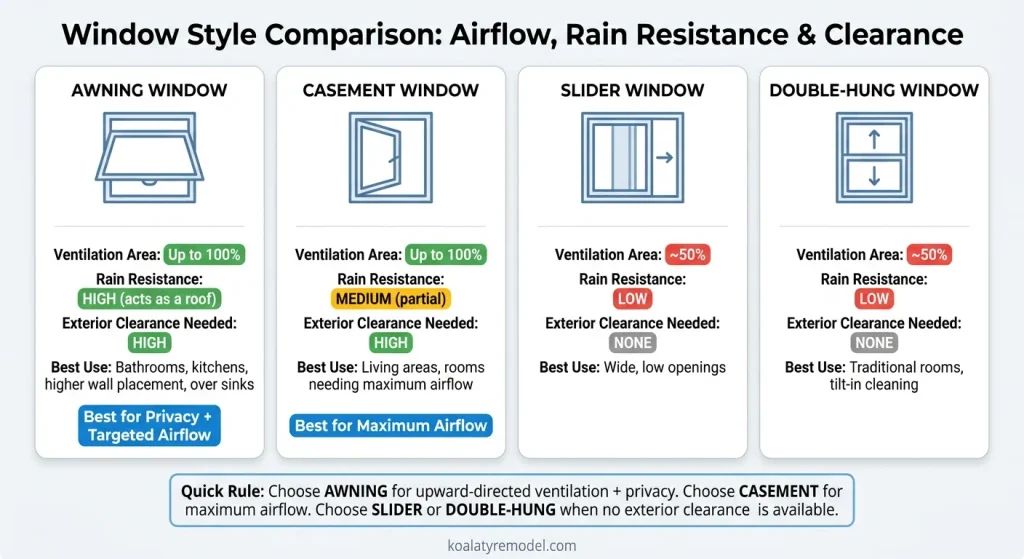 Awning vs. Casement vs. Slider vs. Double-Hung Windows: Airflow & Clearance Comparison
Awning windows make sense only if the room can support airflow, reach, and exterior clearance. On paper, a space might look fine. But before you move ahead, you need to check the opening, how easily someone can reach the window, and whether there’s enough space outside for it to work the way it should.
Measure Wall Placement, Reach, and the Swing Path
Start with the rough opening. Leave space for shims and leveling, and size it so the window fits with proper installation clearance. Then look at the opening size and day-to-day reach together. A window that fits the wall but feels awkward to open later is a bad setup.
The main thing to check is simple: can the sash open without hitting furniture or nearby fixtures? If not, change the placement before moving to anything else.
Once the opening and reach look good, check the swing path outside too. An awning window doesn’t just need to fit the wall. It needs room to open.
Check Outside Clearance Around Walkways, Decks, Plants, and Stairs
Because the sash swings outward in an arc, the exterior side matters just as much as the interior. Look at the area around the window before locking in placement. Walkways, stairs, decks, and landscaping can all get in the way.
Installing an awning window next to a busy walkway or a deck seating area can turn into a foot-traffic hazard [3]. In many cases, placing the window higher on the wall helps keep the sash above people’s path while still giving you privacy and ventilation [1][2].
Compare Awning Windows With Other Operating Styles by Airflow and Clearance
If an awning window still looks like a good fit, compare it with other operating styles based on airflow and clearance.
| Window Style | Ventilation Area | Rain Resistance | Exterior Clearance Needed | Best Use Case |
|---|---|---|---|---|
| Awning | Up to 100% [1] | High (acts as a roof) [2] | High [2][3] | Bathrooms, higher wall placement, kitchens |
| Casement | Up to 100% [1] | Partial [1] | High [2] | Living areas, rooms needing maximum airflow |
| Slider | ~50% [1] | Low [1] | None [2] | Wide, low openings |
| Double-Hung | ~50% [1] | Low [1] | None [2] | Traditional rooms, tilt-in cleaning |
Here’s the short version:
- Pick casement when maximum airflow is the top goal.
- Pick awning when you want upward-directed ventilation plus better privacy.
After you settle on the operating style, the next call is window size and hardware.
Choose Size, Materials, and Hardware for Daily Use
Once you’ve picked the opening style, the next pieces are size, materials, and hardware. Those details shape how the window feels to use every day.
Match Window Size to the Room
Pick the smallest awning window that still gives the room enough airflow. Smaller units work well in tight spaces. Wider units, or two placed together, make more sense in rooms that need more air.
For reference, standard awning window sizes usually range from 24 x 18 inches to 36 x 60 inches [6].
Choose Frame, Glass, and Privacy Options for the Room
Frame material affects upkeep and how well the window holds up in damp spaces.
| Frame Material | Maintenance Level | Moisture Resistance | Best For |
|---|---|---|---|
| Vinyl | Low | High | Bathrooms, basements |
| Fiberglass | Low | High | Coastal or humid climates |
| Composite | Low | High | High-durability needs |
| Wood | High | Low unless clad | Historic or traditional aesthetics |
Refresh your exterior with high quality windows built for durability and performance.
Glass choice matters just as much. If the window faces hot afternoon sun, a Low-E coating can help cut heat gain. In bathrooms, frosted, textured, or tinted glass lets light in while blocking the view from outside [5].
Choose Hardware That Stays Easy to Operate Over Time
For windows that get opened a lot, or windows set high on the wall, go with heavy-duty hardware. Weak cranks tend to wear out sooner with repeated use and wind pressure [1].
If the window sits high up or over a kitchen sink, fold-away or tuck-away cranks are a smart pick. They stay out of the way of blinds and curtains. Multi-point locking systems are also worth asking for. They pull the sash tight on all sides, which helps the seal and supports long-term weatherstripping performance [1][4].
After size and hardware, installation and sealing determine whether the window performs as intended.
Plan Installation, Cost, and the Full Remodel Fit
After size and hardware are set, installation is the last big test.
Installation Details That Affect Sealing and Durability
Even a well-made awning window can fall short if the install is rushed or messy. The opening should be square, level, and free of rot, soft spots, or other damage before the new unit goes in. Installers usually leave about 1/2 inch total for shimming and leveling [6].
Sealing is where a lot can go wrong. Awning windows use a compression seal. That means the sash pulls tight against the frame when closed. It works best when the frame is set the right way and the sash presses evenly against the weatherstripping. Use proper head and sill flashing, and keep weep holes clear [3][5]. A correct install helps protect airflow, keeps the window easy to operate, and helps stop leaks.
Once the opening is ready, look at the full installed price, not just the unit price.
Separate Product Cost from Installation Value
A standard awning window unit usually costs $300–$700 at retail, and professional installation adds about $100–$300 per window [6]. Custom sizes often cost 15%–20% more than standard dimensions [6]. What matters most is the full installed scope.
| Cost Factor | Product-Related | Installation-Related |
|---|---|---|
| Core Components | Frame material, glass package (Low-E, double/triple pane) | Opening prep, leveling, shimming |
| Performance | Hardware type, weatherstripping quality | Flashing, caulking, perimeter insulation |
| Finish Work | Hardware finish, grille patterns, glass privacy options | Interior trim, exterior brickmold, site cleanup |
When you compare quotes, make sure each one lists labor, flashing, interior and exterior trim, old window removal, cleanup, sealing, and any opening repairs. The best value isn’t just the lowest number. It’s the window that vents the room well and fits the opening for the long haul.
Conclusion: A Simple Decision Sequence Before You Commit
Before you sign off on an awning window project, go through a simple check.
- Confirm the room’s airflow and moisture needs, and make sure an awning window is the right fix.
- Verify wall placement and exterior clearance. The sash needs enough room to swing open without hitting walkways, decks, or plants [2][3].
- Match the size and materials to how the window will be used day to day.
- Review the full installation scope with your contractor, including how the opening will be prepared and sealed.
To move ahead, Get Your Free Windows Quote to connect with a local contractor who can inspect the opening and walk you through the full installed cost.