


Double-hung window replacements typically cost $300 to $3,700 per window, including materials and installation. Labor makes up 25% to 50% of the total cost, with standard vinyl window replacement cost being the most affordable at $300–$500 per unit installed, while premium wood options can exceed $3,000 per window. Key factors affecting pricing include:
- Frame material: Vinyl, wood, fiberglass, aluminum, and composite options vary in cost and durability.
- Labor and installation: Simple "pocket" installations are cheaper, while full-frame replacements add $150–$250 per window.
- Energy-efficient upgrades: Features like Low-E coatings and argon gas fills cost $150 or more per window but can reduce energy bills by 35–40%.
- Location and project size: Urban areas and large projects may cost more, but bulk discounts (10–15%) and off-season savings (10–20%) help lower expenses.
Replacing 10–15 windows costs $6,000–$15,000 for standard vinyl or over $25,000 for high-end materials. To save, mix materials (e.g., premium wood for visible areas, vinyl for others) and request detailed quotes from multiple contractors.
 Discover high quality window solutions designed for durability and long term performance.
Understanding the Cost of a Double Hung Window
Why Double Hung Windows Are a Common Choice
Double-hung windows are a favorite among homeowners, thanks to their practical design and ease of use. These windows feature two operable sashes that slide vertically and tilt inward, making cleaning a breeze and offering excellent control over ventilation [2]. By opening the top sash, warm air can escape, while the bottom sash allows cooler air to flow in – creating a natural airflow. Their adaptability to various architectural styles makes them a go-to option for both new builds and renovation projects. These functional perks contribute to their popularity, and choosing the best double-hung windows can further justify the range of costs explored below.
Typical Price Ranges
The price of professionally installed double-hung windows can vary significantly based on the chosen materials and additional features. On average, you can expect costs to range from $300 to $3,700 per window [2].
| Frame Material | Installed Cost Per Window | Expected Lifespan |
|---|---|---|
| Vinyl (Standard) | $300 – $500 | 20–30 years |
| Aluminum | $350 – $750 | 20–30 years |
| Composite | $550 – $850 | 30–40 years |
| Fiberglass | $325 – $3,700 | 30–40 years |
| Wood (Premium) | $750 – $3,100 | 40–60 years |
Labor and installation fees typically account for an additional 25% to 50% of the total cost. Standard labor charges range from $75 to $300 per window, though more complex installations can climb as high as $1,850 per window. For a home with 10 to 15 windows, the total cost could fall between $6,000 and $15,000 for standard vinyl windows – or exceed $25,000 for high-end materials [2]. Planning ahead is essential to manage these expenses effectively.
Why Early Budget Planning Matters
Planning your budget in advance can help you prepare for hidden costs like repairs for rotted frames, lead paint removal in homes built before 1978, or custom trim work, which can add anywhere from $100 to $300 per window [2]. These expenses often arise after a contract is signed, catching homeowners off guard.
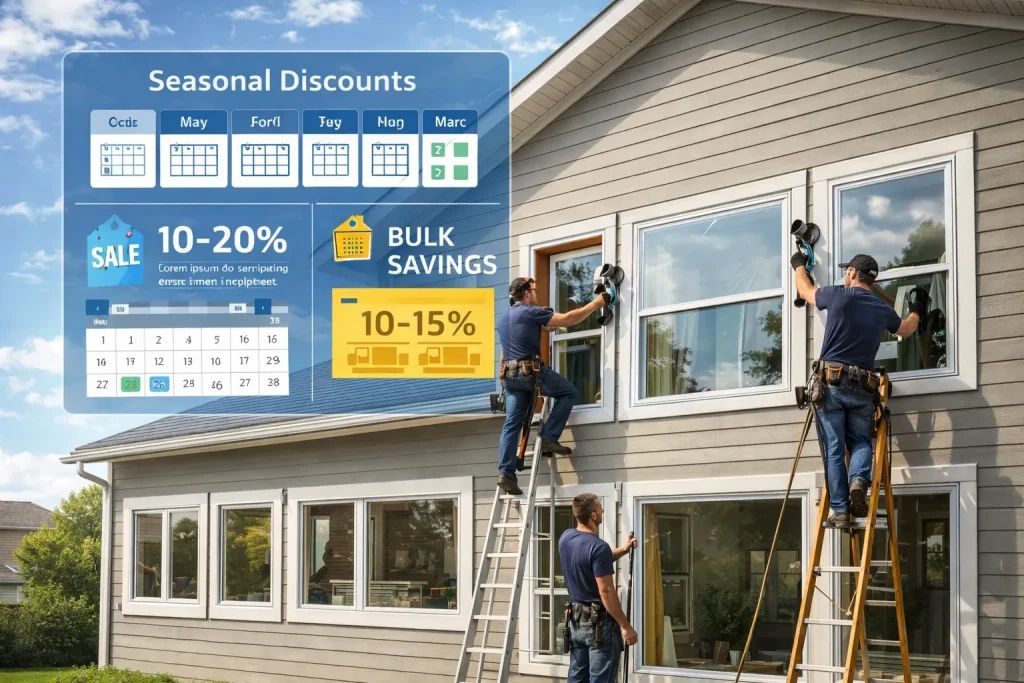
Early research also gives you the chance to take advantage of discounts. Many contractors offer seasonal price reductions of 10% to 20% during slower months (October to March) or bulk discounts of 10% to 15% for replacing 10 or more windows at once [2].
Understanding the type of installation you need is equally important. A "pocket" installation – where the new window fits into the existing frame – is typically less expensive. However, if your current frames are damaged or uneven, a full-frame replacement will be necessary, adding an extra $150 to $250 per window [2].
sbb-itb-e0ea4e0
Average Double Hung Window Prices in 2026
Window Unit and Installation Costs
By 2026, the average cost for installing a double-hung window across the country is around $800 [4]. However, most projects fall within a range of $325 to $1,275 per window [4]. This total includes both the window unit itself ($250–$3,700) and labor costs ($400–$1,500), with labor making up 30%–50% of the overall expense [4][6].
The size of the window plays a major role in determining the cost. For example:
- A small 24" x 36" window, fully installed, costs between $250 and $850.
- A standard 36" x 48" window ranges from $475 to $1,700.
- Larger windows, like a 36" x 72" unit, cost $725 to $2,500.
- Extra-large 48" x 78" windows can reach $1,050 to $3,700 [4].
If you’re considering custom-sized windows or unique installation needs, expect costs to increase by 30%–50% [2][5].
The type of installation also affects pricing. A full-frame replacement – where the entire window, including the frame, is removed – tends to cost more than a pocket installation, where the new window is placed into the existing frame [6]. Additionally, removing and disposing of old windows usually adds $10 to $20 per unit to the bill [4].
Factors like location and material choices also play a big part in shaping overall costs.
How Location and Materials Affect Prices
Where you live and the materials you choose can significantly influence the final price of your double-hung window project. Labor costs vary widely depending on the region. Urban areas and coastal locations often have higher rates, while rural areas and the Midwest tend to be more affordable [5][4]. Labor charges range from $30 to $100 per hour, depending on your location [4]. If you schedule your installation during the off-season (October through March), you might save 10%–20%, as contractors often offer discounts during slower periods [2].
Material choice is another key cost factor. Here’s a breakdown of typical price ranges by frame material:
- Vinyl: The most affordable option, costing $250 to $2,100 per unit [4].
- Wood: Prices range from $300 to $3,100, with a classic look but more maintenance [4].
- Fiberglass: A premium choice, priced between $325 and $3,700 [4].
- Aluminum: Costs between $400 and $750 per unit [4].
- Composite: Falls in the middle, at $300 to $1,800 [5].
Each material has its own benefits and maintenance needs. For instance, vinyl windows can last 20–30 years with minimal upkeep, while wood frames can endure 40–60 years but require regular painting or sealing to maintain their appearance and durability [2].
Window Replacement Cost In 2024 | Get Price Breakdowns And Target Price Points
What Affects Double Hung Window Prices
 Invest in windows that improve both appearance and home value.
Several factors influence the cost of double hung windows beyond the basic unit price. Knowing these details can help you decide where to allocate your budget wisely and where you might save without compromising on quality.
Frame Materials and Longevity
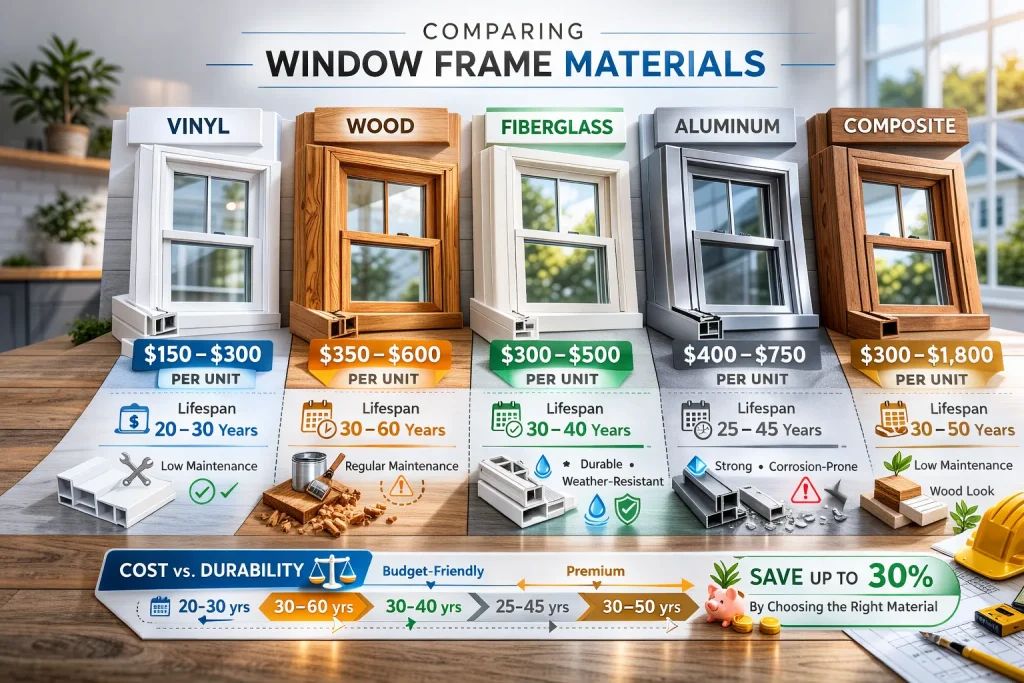
The type of material used for the window frame significantly impacts both upfront costs and long-term durability. Here’s a breakdown:
- Vinyl: This is the most budget-friendly option, costing between $150 and $300 per unit. It’s low-maintenance but may fade over 20–30 years [4][5].
- Wood: Known for its classic appeal, wood frames last 30–60 years but come at a higher price of $350–$600 per unit. They also require regular upkeep, such as painting or sealing, to avoid rot and pest damage [2][4].
- Fiberglass: Priced at $300–$500 per unit, fiberglass is durable and resists warping or rotting, even in extreme temperatures. Its lifespan ranges from 30–40 years [4][5].
- Aluminum: These frames are strong and relatively affordable, costing $400–$750 per unit, but they offer poor insulation and are prone to corrosion in coastal regions [2][5].
- Composite: Combining wood fibers and plastic, composite frames mimic wood’s appearance while requiring less maintenance. Prices range from $300 to $1,800 per unit [5][6].
For a balance of aesthetics and cost, consider using premium materials like wood or fiberglass for front-facing windows and more economical options like vinyl for less visible areas. This approach can cut costs by up to 30% [2].
Glass Options and Energy Savings
Upgrading glass can increase initial costs but lead to substantial savings on energy bills over time. Here’s what to consider:
- Double-pane glass: Now standard, it costs $50–$100 more than single-pane glass but reduces energy expenses by 25–30% [2].
- Low-E coatings: These coatings, priced at $30–$70 per window, block UV rays and improve energy efficiency by 10–15% [2].
- Argon gas fills: Adding argon gas between panes costs an extra $30–$50 and enhances insulation by 5–10% [2].
Combining Low-E coatings and argon gas – at a total cost of less than $150 per window – can boost efficiency by 35–40%, making it one of the most cost-effective upgrades [2]. For extreme climates, triple-pane glass offers 40–50% better efficiency than standard windows but adds $150–$300 per unit [2][5]. Replacing outdated single-pane windows with ENERGY STAR-rated models can save homeowners anywhere from $125 to $465 annually [2].
Installation Complexity and Labor Costs
Installation is another critical factor in overall pricing. The method of installation and labor rates can vary widely:
- Pocket installation: This is the least expensive option, where the new window fits into the existing frame.
- Full-frame replacement: Costs $150–$250 more per window because it involves removing the trim, casing, and sometimes siding [2][3].
"Installation is at least as important as the window itself. A great product installed poorly won’t perform."
- Dan Schweihs, Founder of The Window Dog [3]
Full-frame replacements are necessary if the existing frame has rot, moisture damage, or mold. These repairs can add $100–$300 per window to the total cost [2]. Installing windows on a second story is pricier due to scaffolding and safety requirements [2][4]. Additionally, homes built before 1978 may require lead paint abatement, which adds $100–$300 per window [2].
Labor rates also differ by region, with urban and coastal areas typically charging higher fees [4]. By understanding these cost factors, you can make smarter choices when planning your window replacement project.
Are $99 Replacement Window Offers Real
Let’s dig into the truth behind those tempting $99 window replacement ads. While these offers do exist, they often don’t reflect what most homeowners actually need. Understanding what’s included – and more importantly, what isn’t – can help you avoid surprise costs.
What $99 Offers Usually Include
These promotions generally cover a basic, standard-sized vinyl window. But here’s the catch: they rarely include professional installation. In fact, even the most basic vinyl double-hung window typically costs around $185 on its own [5]. So, a $99 price tag that claims to include installation? It’s not realistic.
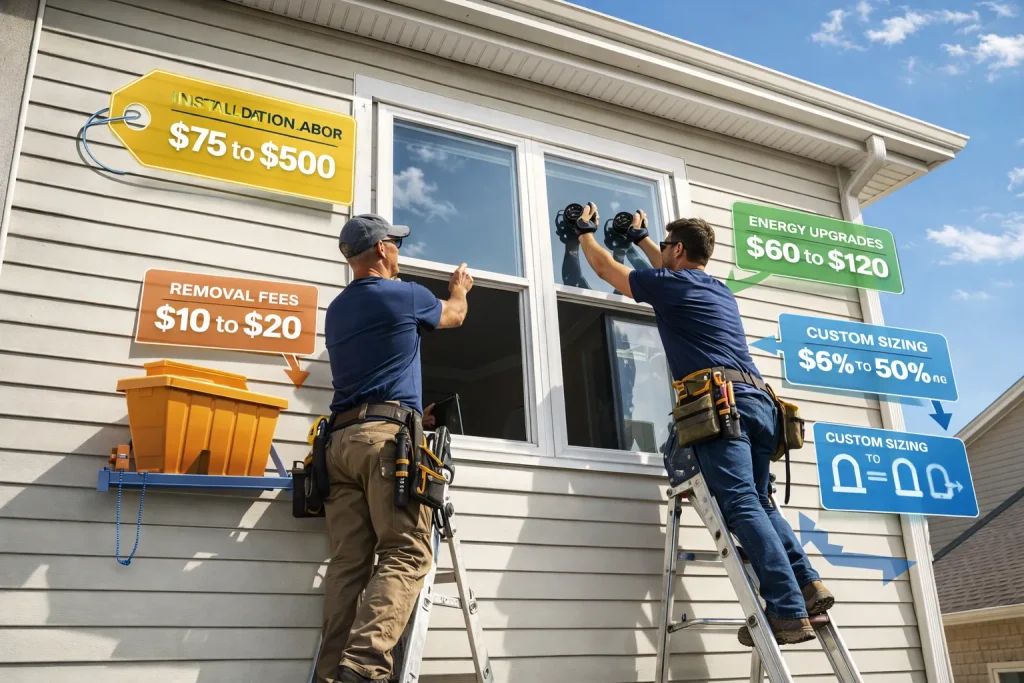
Here’s what’s often left out of that enticing $99 price:
- Installation labor: Depending on the complexity, this can range from $75 to $500 per window [4][6].
- Old window removal and disposal: Add another $10 to $20 per unit [4].
- Energy-efficient upgrades: Features like Low-E coatings and argon gas fills can cost $60 to $120 combined, but they improve efficiency by 35% to 40% [2].
- Exterior trim, capping, and caulking: These are often billed as extra services [3].
- Custom sizing: If your window openings aren’t standard, custom sizes can cost 30% to 50% more [2].
Many companies use these $99 offers as bait to get you in the door, only to push you toward pricier mid-range options that typically cost $800 to $1,100 per window when installed [3].
"The first number was never real. The ‘discount’ was just smoke and mirrors."
- Dan Schweihs, Founder of The Window Dog [3]
How to Review Promotional Deals
To avoid unexpected expenses, take these steps when evaluating promotional window deals:
- Request an itemized quote: Make sure the quote breaks down costs for the window unit, labor, disposal fees, and finishing work. This will help you identify hidden charges [3].
- Verify the installation type: Most $99 offers assume a "pocket installation", where the new window fits into your existing frame. If your frames are damaged or rotted, you’ll likely need a full-frame replacement, which adds $150 to $250 per window [2][6].
- Beware of high-pressure tactics: Legitimate companies will give you a written quote valid for at least 30 days. If someone insists on a "today only" deal, it’s a red flag [3].
- Compare multiple quotes: Get at least three to five bids to find the true market rate for your project [2][3].
- Check energy efficiency ratings: If the window doesn’t have a U-Factor of 0.30 or lower, you could end up paying more in energy bills over time [2].
Keep in mind that a professionally installed vinyl double-hung window typically costs between $300 and $500 per unit [2]. If a deal seems too good to be true, it probably is. The real value lies in clear, transparent pricing and a detailed breakdown of all costs.
Comparing Double Hung Window Brands
Choosing the right brand for double-hung windows can significantly impact both initial costs and long-term value. Andersen is often seen as a premium option, with prices ranging from $280 to $1,025 per unit [5]. Pella offers a wider price range, starting with budget-friendly vinyl windows at around $950 installed, and going up to custom units that can exceed $2,100 per unit [1][5]. Marvin, on the other hand, positions itself in the mid-to-high range, with prices between $595 and $995 [5].
What Andersen Double Hung Windows Offer
 Andersen is known for its quality and innovation, particularly with its Fibrex material. Fibrex is a composite that combines wood fibers with thermoplastic polymers, offering the look and insulation of wood while maintaining the durability of vinyl or aluminum [6]. This material resists warping, decay, and rot, and it performs better than all-metal frames in terms of thermal insulation [5]. ENERGY STAR-certified windows from Andersen can reduce energy bills by an average of 12% [6]. Additionally, homeowners typically recoup over 76% of the cost of Andersen windows when selling their home [6].
Price Differences Between Brands
Energy efficiency and brand reputation play a big role in pricing. Premium brands like Andersen and Pella tend to cost more due to their strong warranties and proven reliability [1]. Material choice is another key factor. Vinyl is the least expensive, with prices ranging from $200 to $900, while composite materials (like Fibrex) and wood are at the higher end, costing between $400 and $2,500+ [6]. Andersen’s prices fall in the mid-range, between $280 and $1,025 per unit, whereas Pella offers options from $200 to $2,105, covering both budget and luxury categories [5].
| Brand | Cost Range | Material Focus |
|---|---|---|
| Andersen | $280 – $1,025 | Wood, Composite (Fibrex) |
| Pella | $200 – $2,105 | Vinyl, Wood, Fiberglass |
| Marvin | $595 – $995 | Wood, Fiberglass |
| American Craftsman | $210 – $380 | Vinyl |
For those on a tighter budget, American Craftsman offers vinyl windows priced between $210 and $380, though these lack some of the premium features [5]. Upgrades like triple-pane glass or Low-E coatings can add $150 to $300 per unit but may reduce energy bills by 15% to 25%, saving homeowners between $125 and $465 annually [2]. In terms of longevity, high-quality wood windows from brands like Andersen and Marvin can last 30 to 60 years with proper maintenance, while standard vinyl windows typically last 20 to 30 years [2][5].
Understanding these differences in materials, warranties, and pricing helps homeowners make informed decisions, balancing upfront costs with long-term durability and energy savings.
Planning Your Double Hung Window Replacement
Replacing double hung windows at the right time and managing your budget wisely can help you save a lot in the long run. Homeowners often face a key decision: replace all windows at once or tackle the project in phases. Each option has its perks, depending on your budget and what your home requires.
When to Replace Your Windows
Certain signs make it clear when it’s time to replace your windows. If you notice drafts around the frames, hear outside noise while the windows are closed, or feel air moving through them, the seals are likely damaged. Condensation trapped between panes is another red flag – it points to a broken seal that can’t be fixed. Visible issues like rot, moisture damage, or mold on the frames also call for immediate action to prevent structural problems.
Another way to decide is by comparing repair costs to replacement costs. If a repair quote exceeds 50% of the price of a new window (average repair costs hover around $360), replacement is usually the smarter choice [4][5]. Once you’ve identified failing windows, it’s time to map out your budget.
Budgeting and Phasing Your Project
Whether you replace all your windows at once or spread the project out depends on your financial situation and the urgency of the work. Replacing all windows in one go can save you money through bulk discounts – contractors often offer 10%–15% off for projects involving 10 or more windows [2]. Labor costs also tend to drop per window when the work is done in bulk, as installers can streamline the process. For a home with 10 to 15 windows, you can expect total replacement costs to range between $6,000 and $15,000 [2].
If a full replacement isn’t feasible, phasing the project over time is another option. Spreading costs across several years might also let you take advantage of a federal tax credit of 30%, up to $600 annually [2][3][4][7]. When phasing replacements, it’s wise to start with windows facing the street or those exposed to heavy sun and drafts – this approach maximizes energy savings. Scheduling replacements during the off-season (October–March) can further reduce costs by 10%–20% [2].
You can also mix materials to save money: use premium wood for visible areas and standard vinyl for less noticeable spots. This strategy can cut overall project costs by as much as 30% [2].
Investing in energy-efficient replacement windows pays off in the long term.
"Quality double-hung windows (ENERGY STAR rated) typically pay for themselves through energy savings in 7-12 years." – Builds and Buys [2]
What to Remember About Double Hung Window Prices
Understanding double hung window costs can help you budget effectively and avoid unexpected expenses. Standard vinyl windows, including installation, typically range from $300 to $500, while higher-end wood options can exceed $750. Labor alone accounts for 25% to 50% of the total cost [2][3].
As mentioned earlier, the material you choose plays a key role in pricing. Vinyl is the most affordable and requires little upkeep, whereas wood and fiberglass offer superior insulation and durability but come with a higher price tag. If you’re considering energy-efficient upgrades, features like Low‑E coatings or argon gas fills can add about $150 per window, improving efficiency by 35% to 40% [2]. Opting for ENERGY STAR‑certified windows can further reduce your household energy bills by an average of 12% nationwide [6].
Be cautious of ads promoting windows for $99 – these often exclude installation and come with hidden fees. As Dan Schweihs points out, these low prices can be misleading [3].
To ensure you’re getting a fair deal, request detailed, itemized quotes that include costs for labor, materials, disposal, and any necessary trim or structural repairs. It’s a good idea to gather three to five written quotes from licensed and insured contractors. Additionally, confirm that quotes remain valid for at least 30 days – reputable companies won’t pressure you into making a decision on the spot. Proper installation is crucial to protect your investment and maintain the manufacturer’s warranty, so always work with qualified professionals for the best long-term results.