


If you compare window quotes by unit price alone, you can miss the part that drives the bill: the install. For broader planning context, review the window replacement cost guide.
From what I see in this article, mobile home window replacement usually costs about $250 to $700 per window, while standard-home replacement often runs $450 to $1,500 per window. But the lower mobile home price does not always mean a lower total once you add custom sizes, wall repairs, trim work, and shipping.
Here’s the short version:
- Mobile homes often use thinner walls, so they need a different window fit and mounting style.
- Standard homes often cost more because of deeper framing, taller access, and more finish work.
- A same-size swap is usually the lowest-cost job in either home type.
- Rot, moisture damage, and opening changes can push the price up fast.
- A quote is only useful if it lists labor, removal, sealing, trim, insulation, disposal, and hidden-damage terms.
- In some cases, repair is enough. In others – like fogged panes, warped frames, or soft wood near the sill – replacement makes more sense.
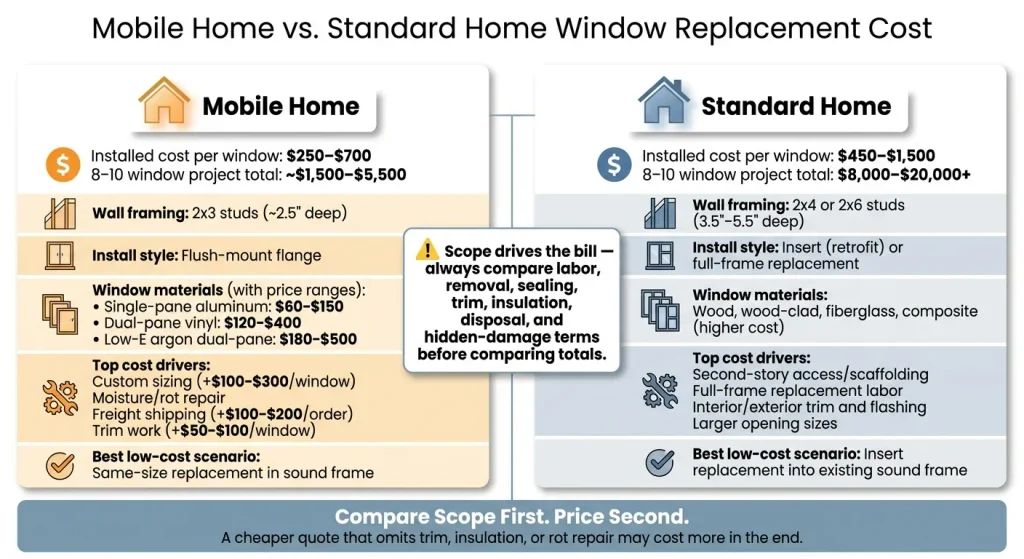 Mobile Home vs. Standard Home Window Replacement Cost Comparison
COMPLETE Wall and Window Rebuild | Budget Mobile Home Remodel #17
Quick Comparison
| Item | Mobile Home | Standard Home |
|---|---|---|
| Installed cost per window | $250–$700 | $450–$1,500 |
| 8–10 window project | About $1,500–$5,500 | About $8,000+ |
| Main fit issue | Thin walls, special sizing | Access, frame depth, finish work |
| Common extra costs | Custom orders, rot, freight | Second-story labor, trim, full-frame work |
| Best low-cost case | Same-size replacement | Insert replacement in sound frame |
Bottom line: I’d compare scope first, price second. If two bids do not cover the same work, the cheaper one may end up costing more.
Mobile Home Window Replacement Cost and Scope
Mobile-home window pricing depends on wall depth, mounting style, and the condition of the opening – not just the size of the window. So the main thing to compare isn’t the sticker price of the unit. It’s whether the window fits, whether the wall is in good shape, and how much install work the job needs, which is why having clear window replacement strategies is essential.
Typical Mobile Home Cost Ranges Per Window and Per Project
For a simple swap, labor from professional window installation near me services usually runs labor alone usually runs $100 to $200 per window00 to $200 per window [1][2]. If you’re replacing windows in a single-wide with 8 to 10 windows, the full job often falls between $1,500 and $5,500 [3][1]. For a double-wide with 8 to 12 windows, total project cost can land around $3,000 to $8,400, based on the window material, wall condition, and how many openings need extra work [4][1].
Material pricing also moves quite a bit by window type:
- Single-pane aluminum windows start around $60 to $150 each
- Dual-pane vinyl windows run about $120 to $400
- Low-E argon-filled dual-pane windows can hit $180 to $500 before installation [3][4][1]
Those starting prices can change fast if the opening needs to be resized, repaired, or finished with custom trim.
Construction Details That Affect Mobile Home Pricing
Mobile home walls are usually built with 2×3 studs, which creates a wall depth of about 2.5 inches. That’s shallower than the 2×4 or 2×6 framing used in many site-built homes. Because of that, mobile home windows use a flush-mount flange that sits flat against the exterior siding and screws right into the wall studs [5][3]. A standard residential window flange often won’t reach the siding on a thinner mobile home wall, which can leave gaps and lead to water intrusion [4].
Put simply, mobile-home windows are made for thinner walls and a different mounting setup. Standard residential windows often don’t drop in cleanly.
There’s also a sizing issue. Common mobile home window sizes like 30″ × 60″ or 36″ × 54″ usually aren’t stocked at most big-box stores. That often means placing a special order, which can add $100 to $300 per window on top of the base material price [1]. Once you add custom sizing or repair work, both labor and material costs go up.
Mobile Home Cost Drivers
The biggest price factor is whether the opening can take a same-size replacement or needs to be changed. If the opening has to be enlarged or reshaped, the job can get more involved fast. Mobile home walls work as part of the wall assembly that supports the opening, so changing that space may call for new load-bearing headers and more labor [7].
Moisture damage is the other big wildcard. If there’s soft framing, staining, or moisture damage around the opening, that has to be fixed before the new window goes in. Labor can also climb if the crew has to remove specialty siding or trim, and interior or exterior trim work can add $50 to $100 per window. On top of that, freight shipping for bulky specialty units can tack on $100 to $200 per order [1][3].
So while the window itself matters, the final bill often comes down to three things: fit, repairs, and finish work. Standard-home pricing tends to shift for other reasons, especially deeper framing and the fact that stock sizes are much easier to find.
Standard Home Window Replacement Cost and Scope
Standard-home pricing starts in a different place. Compared with mobile-home projects, site-built homes often have deeper wall framing and more common window sizes. That can make sourcing simpler, but labor, access, and finish work can still push costs up.
Typical Standard Home Cost Ranges Per Window and Per Project
For a standard home, installed window replacement usually falls between $450 and $1,500 per window [3]. If you’re replacing 8 to 10 windows, a typical project can run about $8,000 to $20,000+ [3], based on the number of windows, the frame material, and how hard the installation is.
That spread isn’t random. It usually comes down to the wall system, the install approach, and how easy the crew can reach each opening.
Construction and Access Factors in Site-Built Homes
Standard homes usually use 2×4 or 2×6 framing, with wall depths of 3.5 to 5.5 inches [5][6]. That extra depth changes the install. In many cases, the window sits inside the rough opening, with fasteners hidden behind the interior and exterior trim [3]. It also means the crew needs to handle flashing and weather-resistant barriers the right way, which adds labor and material.
One place site-built homes have it easier is size selection. Standard windows are sold in hundreds of common sizes and setups [8], so matching an old unit is usually much less of a headache than it is with mobile-home windows. But access can change the math fast. A second-story window may need scaffolding or ladder staging, and that adds crew time, equipment use, and cost.
Standard Home Cost Drivers
When you compare quotes, the biggest cost shifts often come from the install method and the amount of repair work, not just the window itself.
Material choice plays a big role. Standard homes can use wood, wood-clad, fiberglass, and composite frames [8]. Those heavier, higher-end materials often cost more to buy and more to install.
The install method matters just as much:
- An insert (retrofit) replacement puts a new window into the current frame. It’s usually faster if the old frame is still in good shape.
- A full-frame replacement removes the whole unit, including the frame and trim. It’s often used to fix rot or get more glass area, and it takes more labor and more finish work to do well [4].
Interior and exterior finish work can add a lot to the final number too. Inside the home, trim repair or replacement may be part of the job. Outside, flashing and sealing are standard parts of a proper install. Those aren’t small throw-in items. They cost money, and if a quote skips them, the price may climb once work begins.
Mobile Home vs. Standard Home: Direct Cost Comparison
The gap is real, but installation scope is what drives the price. If you want a fair comparison, start with the work involved, not just the window unit.
| Factor | Mobile Home | Standard Home |
|---|---|---|
| Avg. Cost (Installed) | $250 – $800 per window [1][6] | $450 – $1,500 per window [3] |
| Whole-Home Total (8–10 windows) | $2,500 – $5,500 [3] | $8,000+ [3] |
| Install Style | Flush-mount flange designed for thin walls [3][4] | Insert replacement or full-frame replacement [4] |
| Major Cost Drivers | Custom sizing, wall rot, trim [1][7] | Large openings, height/access, interior trim [2] |
Explore window installation options built for durability and long term reliability.
The price gap tends to widen or shrink based on fit, repair work, and access. That’s where projects start to move away from the neat averages in the table.
Per-Window and Whole-Home Price Differences
Mobile home window projects usually cost less on a per-window basis. But that lower starting point doesn’t always hold. Repairs and custom sizing can eat into the savings fast.
Across a full home, a 10-window mobile home project might total about $5,500, while the same number of windows in a site-built home can go past $8,000 [3]. So yes, mobile homes often come in lower. But if there’s hidden damage, that edge can shrink fast, even on a smaller project.
Where Mobile Homes Can Add Costs
In mobile homes, the biggest surprise costs usually come from window sizing and wall condition, not the glass or frame itself. That’s the part many homeowners don’t see coming.
Custom-ordered units can add $100 to $300 per window to material cost [1]. And if the opening has moisture damage, the installer may need to stop and repair the area before the new window can go in. That adds labor, time, and more money to the job.
In other words, a low-priced window doesn’t always mean a low-priced project.
Where Standard Homes Can Cost More
Standard homes have their own pressure points, and most of them show up in labor. Bigger openings take more work. Second-story access can mean more setup and more equipment. Interior finish work can also add to the final bill.
So while mobile homes often run into fit-related costs, standard homes are more likely to cost more because the install itself is harder. Those labor and access issues show up clearly on the final invoice.
How to Judge Quotes, Decide on Repair vs. Replacement, and Plan the Project
When Repair Is Enough and When Replacement Makes More Sense
Some window problems are small and fixable. Others are a sign the whole unit is on its way out.
Minor hardware issues, worn caulk, bad weatherstripping, or torn screens usually mean repair is enough. But fogging between panes, warped frames, drafts that keep coming back, and soft wood below the sill usually mean replacement makes more sense. Repair only saves money when the opening and frame are still in good shape.
| Situation | Repair | Replacement |
|---|---|---|
| Glass | Single small crack in single-pane glass | Fogging or condensation between double panes |
| Operation | Stiff crank or broken lock/latch | Warped frame or a window that no longer opens or latches |
| Drafts | Minor gaps fixed with caulk or weatherstripping | Visible daylight around the frame; recurring drafts |
| Wall Condition | Minor trim damage | Soft, spongy, or discolored wood below the sill |
| Window Type | Vinyl window with a minor hardware issue | Obsolete jalousie windows or failing single-pane aluminum windows |
There’s one more thing to check if several windows start failing at the same time. The problem may not be the windows alone. A house that’s out of level can make windows stick, leak, or look misaligned. In that case, foundation movement can mimic window failure, so it’s smart to rule that out before pricing full replacements.
What a Clear Window Estimate Should Include
If replacement is the better move, the next job is reading the quote with a careful eye. Some estimates cover the full install. Others cover little more than the window unit itself. That’s where people get tripped up.
Because the scope can change from one home to the next, a detailed estimate is the only fair way to compare bids.
A complete estimate should spell out labor, removal, sealing, trim, insulation, disposal, and any allowance for hidden damage.
| Estimate Component | What to Verify |
|---|---|
| Exact rough opening dimensions | Framed opening size, not just the old window size |
| Window type and fit | Unit designed for the home type and matching wall depth |
| Frame material and glass package | Exact frame material and glass package listed |
| Mounting style and wall match | Flush-mount or lap-siding installation matched to wall type |
| Sealant and tape | Butyl putty tape and exterior sealant specified |
| Insulation | Low-expansion foam specified for the interior gap |
| Interior and exterior trim work | Trim adjustments included; can add $50 to $100 per window [1] |
| Disposal | Removal and hauling of old units included |
| Allowance for hidden rot or water damage | Process for handling hidden damage explained |
One small detail matters more than it seems: confirm that the installer will not caulk the bottom flange. It may sound safer to seal every edge, but that bottom edge needs a way to let moisture escape. If it gets sealed shut, water can stay trapped inside the wall cavity and lead to rot over time.
Conclusion: Compare Scope First, Then Compare Price
After you get the estimate, compare each line item before you look at the total price. A cheaper quote can look good at first glance, then fall apart once you notice it leaves out trim, insulation, siding adjustments, or hidden-damage repairs. Compare scope first, then price.
FAQs
How do I know if my mobile home windows are custom-sized?
Measure the rough opening, not the old window itself. Check the width in three spots and the height in three spots, then use the smallest numbers. If the opening doesn’t line up with common replacement sizes, you may need a custom-sized window.
Mobile home windows aren’t the same as standard residential windows. Wall thickness and framing can be different, and that can throw off the fit. If the window is even a little off, gaps can show up around the frame. Before installation, inspect the opening for rot too.
Is it cheaper to replace all windows at once?
It can be, but not every time. Mobile home window replacement usually costs $250 to $700 per window installed. The final price comes down to the window size, frame material, and how hard the job is.
Compared with standard homes, costs can shift because mobile homes often use thinner wall framing, less common window sizes, and a different install process. Exact rough-opening measurements, proper sealing, and good drainage details all play a part in the final price.
What should a window replacement quote include?
A window replacement quote should spell out exactly what you’re paying for. At a minimum, it should list the window size, materials, labor, removal of the old window, sealing, trim, any repairs, cleanup, and warranty details.
For mobile homes, the quote should go a step further. It should note wall thickness, non-standard sizing, flange installation, and proper sealing. It should also say whether any water damage or rot in the framing needs to be fixed before installation.
That matters because mobile home window jobs can get tricky fast. A quote that skips those details may look fine at first glance, but it can leave room for surprise costs once the work starts.