


I’d plan around installed cost, not the sticker price. In 2026, replacement windows in the U.S. can run from about $300 to $5,000+ per window, with many standard projects landing near $450 to $1,200 installed. For broader planning context, review the window replacement cost guide. This factor also matters in a broader window replacement project.
Here’s the short version:
- Labor matters a lot and can make up 40% to 55% of the total bill
- Style, size, frame material, and glass are the biggest price drivers
- Pocket installs usually cost less than full-frame work
- Second-story access, trim work, and hidden rot can add extra charges fast
- Replacing 10+ windows at once may cut per-window pricing by 15% to 25%
- I’d leave a 5% to 10% cushion for hidden damage, especially in older homes
A low quote is not always a low total. If trim, cleanup, disposal, permits, or repair work are missing, the final bill can climb after the job starts.
If I were comparing bids, I’d focus on three things first: what type of window is included, what install method is being used, and what finish work is part of the price.
| Cost factor | What it does to price |
|---|---|
| Window style | Bay, bow, and custom shapes cost more than single-hung or sliders |
| Size | Oversize units can add 20% to 50% |
| Frame material | Vinyl is often lower priced; fiberglass and wood cost more |
| Glass package | Low-E and argon add cost; triple-pane adds much more |
| Install method | Full-frame usually adds $150 to $400 per window |
| Access and repairs | Upper floors, stucco, siding, or rot can push labor higher |
I’d use this guide to set a budget, spot missing line items, and compare quotes on the same scope.
How Much Do Windows Cost? | Your Guide to Fair Pricing on Window Projects
What Drives the Cost of Window Replacement
Installed cost usually comes down to six things: size, style, access, frame material, glass package, and any surprise repairs inside the opening. The price range above gives you a starting point. These details explain why one quote lands lower and another jumps fast.
Size, Style, and Access Conditions
Window style has a direct effect on price. Single-hung and sliding windows are usually the lower-cost options because they have fewer moving parts and are easier to find in standard sizes. Bay and bow windows cost more because installation takes more labor and may involve structural changes. Installed costs can reach $7,000 for these styles [1][3].
Size matters too. Windows wider than 36 inches or taller than 60 inches can come with a 20% to 50% premium compared with standard-size units [4].
Access can push labor costs up as well. Second-story installation and exterior finish work can add $50 to $150 per window. If siding or stucco repair is needed, expect another $100 to $300 on top of that [4].
After size and access, frame material is usually the next big driver.
Frame Material and Glass Package Choices
Frame material affects the upfront price, upkeep over time, and how the window handles your local weather. Fiberglass and composite tend to hold up better in hot or cold climates. Wood is still the premium pick for looks, but it needs the most care.
| Frame Material | Typical Installed Cost | Maintenance Level |
|---|---|---|
| Vinyl | $300 – $1,600 | Very Low |
| Aluminum | $300 – $1,000 | Low |
| Composite | $500 – $1,700 | Low |
| Fiberglass | $500 – $2,200 | Very Low |
| Wood / Wood-Clad | $600 – $2,200+ | High |
Glass upgrades can make a room feel better, but they add cost at the same time. Low-E coatings usually add $30 to $75 per window, and argon gas fill adds another $20 to $50 [4]. Triple-pane glass can increase the glass cost by about 80% and usually makes sense only in cold climates or rooms with a lot of outside noise [1]. For most U.S. homes, double-pane with Low-E and argon is the practical standard [1][4].
Installation Method and Hidden Opening Problems
Installation method can turn a simple replacement into a much bigger job. There are two main paths:
- Pocket (insert) replacement: The new window fits into the existing frame. This is faster and can save $200 to $300 per window, but it only works if the current frame is square and structurally sound [4].
- Full-frame replacement: Everything comes out down to the rough opening. This adds $150 to $400 per window in labor and is usually needed when the frame is rotted, out of square, or when you’re changing the window size or style [4].
Hidden damage is where budgets often get hit. Water damage, structural rot, and uneven framing may not show up until the old window is removed. When that happens, contractors often handle the repair as a separate change order after work has started [2][5].
Before you ask for quotes, take a close look at the trim and frame. Soft spots, stains, or drafts can point to trouble. If wood stays indented when you press it with a screwdriver, structural repair may be needed [4][5]. Sashes that stick or won’t lock can point to a deeper problem too. In homes built before 1990, it’s smart to set aside an extra $150 to $500 per window for possible framing repairs [5].
Cost Breakdown by Style, Material, and Glass Package
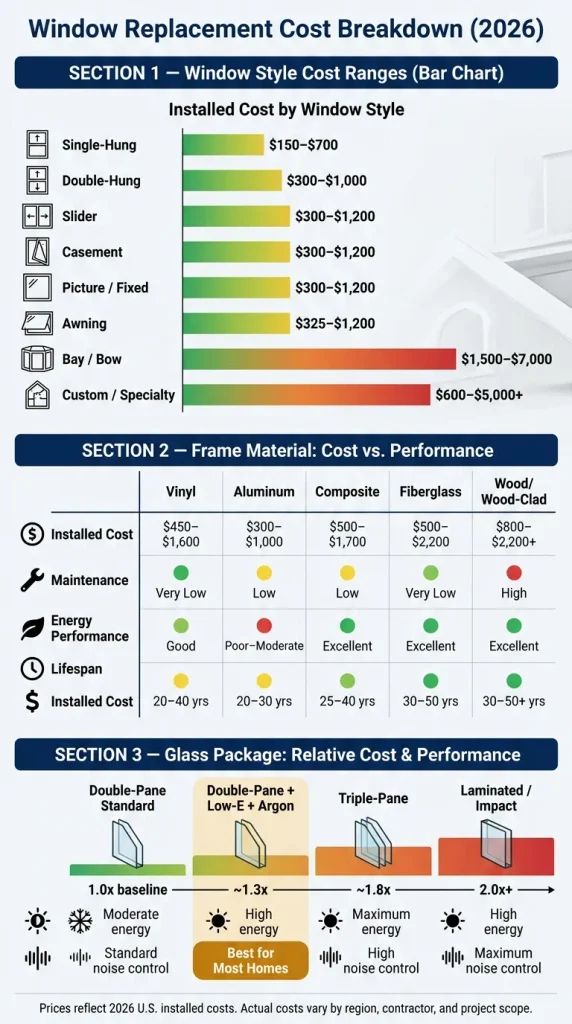 Window Replacement Cost by Frame Material & Style (2026 Guide)
Once you know the scope of the install, it gets a lot easier to compare pricing. In most cases, three things drive the bill: window style, frame material, and glass package.
Window Styles and Installed Cost Levels
Single-hung and sliding windows usually land on the lower end of the price range. The reason is pretty simple: they use less complex hardware and often come in more standard sizes.
| Style | Installed Cost Range | Typical Use | Installation Complexity |
|---|---|---|---|
| Single-Hung | $150–$700 [1][3] | Budget projects, rentals | Simple |
| Double-Hung | $300–$1,000 [1][3] | Most rooms, classic style | Standard |
| Slider | $300–$1,200 [1][3] | Wide openings, modern homes | Standard |
| Casement | $300–Casement | $300–$1,200,200 [1][3] | Maximum ventilation, hard-to-reach spots |
| Picture / Fixed | $300–$1,200 [1][3] | Unobstructed views, natural light | Simple to Moderate |
| Awning | $325–$1,200 [1][3] | Rain protection, basement openings | Moderate |
| Bay / Bow | $1,500–$7,000 [1][3] | Living rooms, architectural focal points | Complex (Structural) |
| Custom / Specialty Shapes | $600–$5,000+ [3][5] | Historic homes, unique openings | Complex |
Bay, bow, and custom windows can change the budget fast. They often need more labor, more trim work, and sometimes structural changes too. A basic single-hung swap is one thing. A bay window install is a whole different animal.
After style, the next big cost shift usually comes from the frame material.
Frame Materials and Long-Term Value
Fiberglass costs more at the start, but it can last 30 to 50 years and tends to hold up well in places with very hot summers or very cold winters [1][6]. Wood offers strong natural insulation and a high-end look, but it needs a lot more upkeep. Composite sits between the two. It gives you a wood-like appearance, needs much less maintenance, and deals with moisture better [5]. Aluminum is often cheaper and easy to maintain, but it moves heat and cold too easily, so its thermal performance is weak unless the frame has a thermal break [5].
| Material | Installed Cost Range | Maintenance Level | Energy Performance | Typical Lifespan |
|---|---|---|---|---|
| Vinyl | $450–$1,600 [1][6] | Very Low | Good | 20–40 Years [1] |
| Aluminum | $300–$1,000 [3][4] | Low | Poor to Moderate | 20–30 Years [1] |
| Composite | $500–$1,700 [3][4] | Low | Excellent | 25–40 Years [1] |
| Fiberglass | $500–$2,200 [1][6] | Very Low | Excellent | 30–50 Years [1] |
| Wood / Wood-Clad | $800–$2,200+ [1][6] | High | Excellent | 30–50+ Years [1] |
This is where a lot of quotes can look similar at first glance but mean very different things over time. A lower upfront price may come with more upkeep, shorter lifespan, or weaker insulation.
Glass is the last major lever, and it can change both cost and day-to-day comfort.
Glass Upgrades That Change Price and Comfort
For most U.S. homes, double-pane glass with Low-E coating and argon gas fill is the current baseline. It adds about 30% to base glass cost, but it can make a real difference in energy use [1][4]. Triple-pane glass costs about 80% more than standard double-pane units [1]. It usually makes the most sense in cold climates or in places where outside noise is a problem. Laminated or impact glass is mostly used in hurricane-prone areas or where added security matters, and it gives the best noise reduction of the main options [5].
| Glass Package | Relative Cost Level | Energy Performance | Noise Control | Best Use Case |
|---|---|---|---|---|
| Double-Pane (Standard) | 1.0x (Baseline) [1] | Moderate | Standard | Mild climates [1] |
| Double-Pane + Low-E + Argon | ~1.3x [1] | High | Standard | Most U.S. homes [1][4] |
| Triple-Pane | ~1.8x [1] | Maximum | High | Cold climates, noisy areas [1] |
| Laminated / Impact | 2.0x+ [5] | High | Maximum | Hurricane zones, high security [5] |
Choose expert window installation for clean results and dependable performance.
Before you compare quotes, ask what glass package is actually included. Two bids can look close on price and still give you very different results in insulation, noise control, and comfort.
How to Build a Budget and Compare Quotes
Once you know what drives cost, the next move is simple: turn that info into a budget you can use and a quote checklist you can trust.
A Step-by-Step Budget Framework for U.S. Homes
Start by counting every window. Then measure each opening to the nearest 1/8 inch and mark any size that might come with a premium [4]. Small detail? Not at all. A slight size jump can change the price fast.
Next, decide what needs attention first. Focus on drafty rooms, failing sashes, visible water stains, and the side of the house that takes the most weather [2]. If you’re working on bedroom windows, check emergency-egress sizing too. That can change both the product you can use and the final cost [4].
A few smart budget rules help here:
- Stick with standard-size openings when possible to avoid extra charges.
- Bundle windows into one project phase so setup costs, permits, and disposal are spread across more units [5].
- Add a 5% to 10% contingency for hidden framing damage or lead-paint compliance if the home was built before 1978 [5].
Once you have a working budget, compare bids against the same exact scope.
What a Complete Window Quote Should Show
Only compare quotes when they cover the same window type, same job scope, and same finish work. If one contractor includes trim and cleanup and another doesn’t, the prices may look close on paper but tell two very different stories.
Check each quote for:
- installation method
- frame material
- glass package
- trim and exterior finish
- cleanup
- warranty
- permit costs
The installation method needs to be spelled out clearly – pocket or full-frame – because that one line item alone can shift labor by $150 to $400 per window [4]. That’s not a rounding error. That’s a budget changer.
Use the table below when collecting bids so you’re comparing the full installed scope, not just the headline number.
| Comparison Factor | Contractor A | Contractor B | Contractor C |
|---|---|---|---|
| Exact model | |||
| Per-window installed price | $ | $ | $ |
| Install method | Pocket or Full-Frame | Pocket or Full-Frame | Pocket or Full-Frame |
| Frame material | |||
| Glass package | |||
| Trim and exterior finish | Yes / No | Yes / No | Yes / No |
| Disposal and cleanup | Yes / No | Yes / No | Yes / No |
| Warranty |
If two quotes seem close, look at what’s missing. A lower bid that leaves out trim repair, exterior capping, or debris removal isn’t a lower apples-to-apples price [2][5]. Those gaps can quietly add 5% to 10% to the final bill [5].
When to Use Koalaty Remodel for Quote Planning
If the scope still feels fuzzy, get a preliminary assessment first. Use Koalaty Remodel for a free assessment and quote when you need help defining the work before lining up bids.
Conclusion: Spend Based on Performance, Not Just Price
Once you know what drives cost, the smart move is to compare total value, not just the lowest number on the page. Installation labor alone can make up 40% to 55% of the total project cost [3][5]. So the window’s sticker price is only one piece of the bill.
What counts is the full scope of the quote. Does it include installation, old window removal, finish work, and money set aside for repairs? A low unit price only helps if sealing, labor, and repair work are part of the deal.
It makes sense to spend more when the upgrade adds comfort, better performance, or curb appeal. On the other hand, you can save money when the opening is standard and the room doesn’t ask for much.
Use these cost factors to pressure-test the quote sitting in front of you.
Key Takeaways for Smarter Planning
If the frame is rotten or out of square, a pocket replacement won’t cut it. Match the frame material and glass package to the room. Budget vinyl is often a good fit for lower-priority spaces. A Low-E glass upgrade or fiberglass frame can be worth the added cost in sunny rooms, drafty spots, or places with big temperature swings.
Leave a 5% to 10% contingency for surprises, especially if the home was built before 1978. Get a free quote through Koalaty Remodel to confirm the full installed scope.