


For Denver window replacement, I’d compare total installed costs – not just window prices. Full-frame work can cost 40%–80% more per opening than insert replacement, so I’d first ask which method each window needs.
Here’s what I’d check before choosing a quote:
- Windows: Size, count, style, frame material, and custom finishes.
- Glass: Insulation and solar-control ratings, plus suitability for Denver’s elevation and each room’s sun exposure.
- Installation: Frame condition, flashing, sealing, trim, and exterior repairs.
- Added costs: Upper-floor access, weather protection, disposal, permits, and historic approvals.
- Contract terms: Product and labor warranties, exclusions, and <u>written approval before extra repairs</u>.
- Project timing: Whole-home versus phased pricing, including repeat setup charges.
My rule: compare the same products and work scope across quotes. A lower price means less if repairs, finishing, or permit fees are left out.
Window Choices That Affect Cost
Window Size, Quantity, Style, and Custom Options
Larger windows cost more because they need more material and handling. Oversized units also require specialized handling, adding to both product and labor costs [4][5]. Unusual shapes, custom colors, decorative grids, and premium hardware finishes can push prices higher. Ordering more windows at once may lower the per-window cost through bulk purchasing and shared crew setup costs [2][6].
Double-hung windows and horizontal sliders are common starting points for price comparisons. Casement, awning, and specialty windows usually cost more because their hardware and frames are more complex. Bay, bow, and custom-shaped windows can cost 2–3 times as much as a standard double-hung window [2][4].
When comparing quotes, separate performance upgrades from cosmetic extras. For more detail, see the Double Hung Windows Guide.
Frame Materials: Cost and Maintenance
After size and style, frame material is the next major factor in price. For an apples-to-apples comparison, use the same window dimensions and glass package. Then weigh durability, upkeep, and insulation.
| Frame material | Relative upfront cost | Maintenance | Insulation | Best fit |
|---|---|---|---|---|
| Vinyl | Lowest | Very low | High | Budget control and low upkeep |
| Fiberglass | Mid-high | Low | Very high | Strength and stability during extreme temperature swings |
| Wood | Highest | High | High | Historic details and high-end looks |
| Aluminum | Low | Low | Low | Shops, garages, and other non-living spaces |
These are relative comparisons. Whole-window ratings matter more than frame material alone.
Choosing Glass for Denver’s Climate
Compare U-factor and solar heat gain coefficient (SHGC) separately. A lower U-factor means less heat passes through the window. A lower SHGC means less solar heat enters the room.
South- and west-facing windows get the strongest sun, so stronger Low-E solar control often helps [1][4][7]. North-facing rooms often gain more from triple-pane glass [2][7]. Check the NFRC label to compare each window’s actual specifications [1][3].
| Glass option | Relative cost | Comfort benefit | Reason to select it |
|---|---|---|---|
| Double-pane | Baseline | Standard insulation | Common starting point for Denver projects |
| Triple-pane | About 10–15% more than double-pane [2] | Better insulation and possible noise reduction | North-facing rooms or noisy areas [2][5] |
| Low-E coatings | Often included or low cost [2] | UV protection and heat control | High Denver sun exposure |
| Argon gas fill | Standard [2] | Less heat transfer | Better insulating performance |
Before ordering for a Denver project, confirm whether you need altitude-rated glass and where tempered glass is required. Both can affect performance and cost [2][5].
Next, the installation method and the condition of the opening can affect the quote as much as the window itself.
Window Replacement Denver Cost: Installation Methods and Opening Conditions
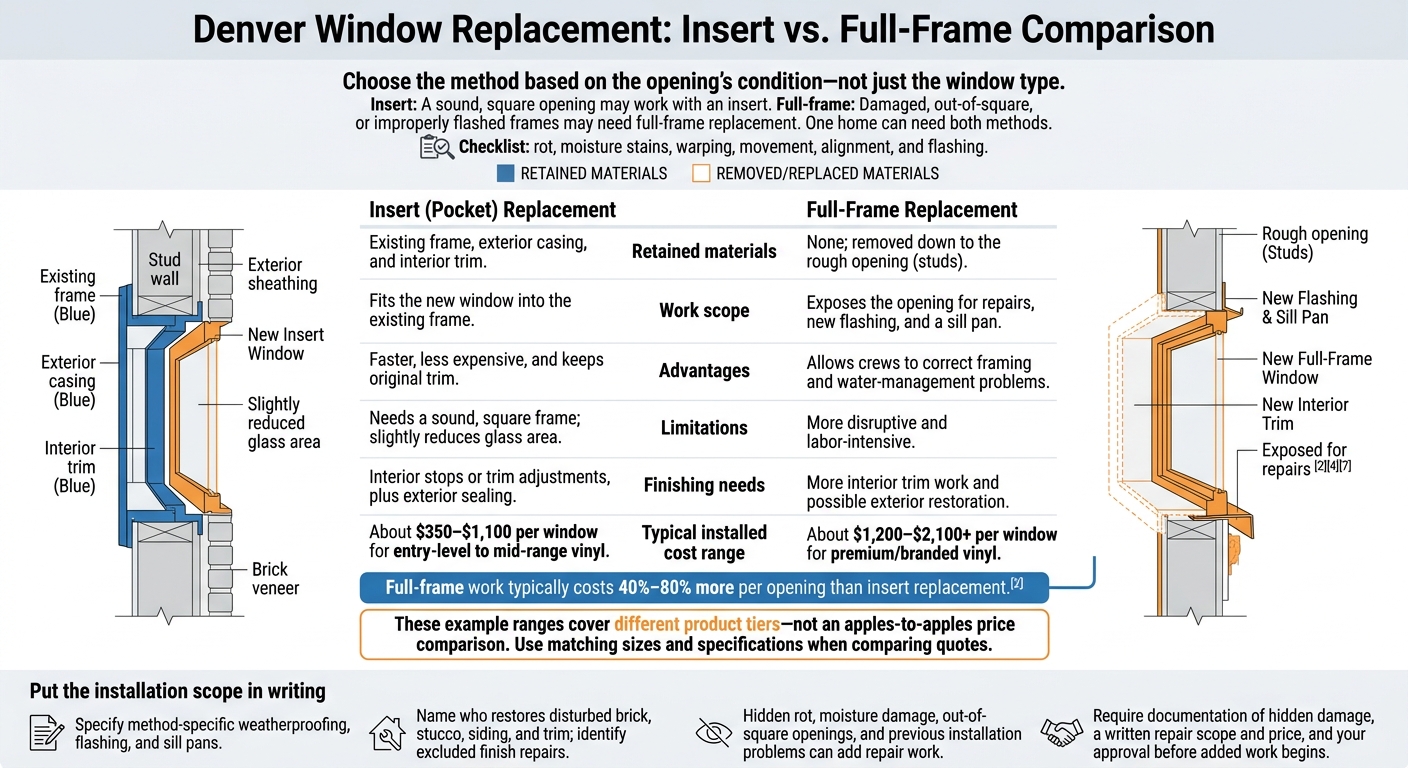
Denver Window Replacement: Insert vs. Full-Frame
Insert vs. Full-Frame Replacement
Choose the installation method based on the opening’s condition – not just the window type. Check each opening for rot, moisture stains, warping, movement, alignment, and flashing. A sound, square opening may work with an insert. Damaged, out-of-square, or improperly flashed frames may need full-frame replacement. One home can need both methods. [2][4][7]
Here’s how the methods compare, including the work and finishing each involves:
| Detail | Insert (Pocket) Replacement | Full-Frame Replacement |
|---|---|---|
| Retained materials | Existing frame, exterior casing, and interior trim | None; removed down to the rough opening (studs) |
| Work scope | Fits the new window into the existing frame | Exposes the opening for repairs, new flashing, and a sill pan |
| Advantages | Faster, less expensive, and keeps original trim | Allows crews to correct framing and water-management problems |
| Limitations | Needs a sound, square frame; slightly reduces glass area | More disruptive and labor-intensive |
| Finishing needs | Interior stops or trim adjustments, plus exterior sealing | More interior trim work and possible exterior restoration |
| Typical installed cost range | About $350–$1,100 per window for entry-level to mid-range vinyl | About $1,200–$2,100+ per window for premium/branded vinyl |
Use matching sizes and specs when comparing these ranges. Full-frame work typically costs 40%–80% more per opening than insert replacement. [2]
Frame Damage and Exterior Repairs
Removing the old window can reveal damage that changes the job’s scope. Rot and hidden moisture damage add repair work. Out-of-square openings and problems from earlier installations may need correction before the new window fits properly. Worn-out trim adds finishing costs, while surrounding brick, stucco, or siding affects removal, flashing, and restoration. Ask which materials crews will disturb and whether the price includes their repair. [2][4][7]
Put the process for handling hidden damage in the contract. Require crews to document what they find, provide a written repair scope and price, and get your approval before starting added work. Set the repair-pricing terms before the job begins. [2][3]
Installation Work to Put in Writing
Once you choose the installation method, put the scope in writing. The quote should spell out method-specific work, including weatherproofing, flashing, and sill pans. It should also name who will restore disturbed exterior materials and list any excluded trim or finish repairs. See the Window Installation Guide. [1][2][4]
Access, Weather, and Denver Permits
Access, weather protection, and approvals add costs beyond the windows themselves.
Upper-Floor Access and Weather Protection
Second-story windows often require ladders or staging. Rooflines, decks, fences, landscaping, and narrow side yards can make it harder to reach windows and move materials. Upper-floor access can add $150 to $320 per window in labor. Ask whether the quote includes equipment and setup charges. [2][4]
Access and protection checklist: Your quote should cover access equipment, staging, and protection for landscaping, decks, and interior finishes. Request a written work sequence that explains how crews will protect open windows during weather delays and secure any opening left unfinished at the end of the day. [1][2][4][6]
Once access is planned, permits and approvals are the next scheduling factor.
Permits, Egress, and Historic Approvals
In Denver, same-size insert (pocket) replacements often don’t require a permit. Changing an opening’s size, adding a window, or installing an egress window usually does. Confirm current requirements with Denver Community Planning and Development before construction. [1][2]
Requirements and fees vary by municipality. If your property is in Arvada, Lakewood, or Aurora, check with the building department that serves it. Denver building permits for windows typically cost $35 to $300, based on the project’s value. [1][2]
Egress work can involve excavation, drainage planning, opening modifications, and inspections. For historic properties, check exterior approval requirements before choosing frames or changing the windows’ appearance. Material restrictions and review time can affect both cost and scheduling. [2][4][5][7]
The contract should state who’s responsible for permit applications, fees, inspections, and any required historic-district approvals. Confirm which approvals you need before ordering windows or starting work, and check again if the scope changes. [2][5]
Compare Quotes and Plan Your Budget
Compare Specifications, Warranties, and Terms
Once you’ve set the scope, review proposals line by line. Match products and the full scope of work – not just the totals. Ask for pricing for each opening so you can compare the same windows across quotes. [3][6]
| Quote item | What to match or confirm |
|---|---|
| Window count, size, and operating style | Same counts, dimensions, and styles |
| Frame material | Material, product series, and finish |
| Glass | NFRC U-factor and SHGC ratings; altitude-rated glass for Denver’s elevation |
| Installation | Insert or full-frame method for each opening |
| Finishing and repairs | Interior trim, exterior capping/wrap, sealing, and rot-repair terms |
| Access and permits | Upper-floor equipment, permit fees, and who handles approvals |
| Total installed cost | Products, labor, removal, disposal, taxes, and other fees |
Check product and workmanship warranties separately. Compare how long each lasts, what it excludes, and who handles service calls. Watch for vague scopes, lump-sum quotes without itemized details, efficiency claims without NFRC ratings, pressure to sign tonight, and unclear terms for rot found during installation. [3][4][5]
For larger projects, compare full-home and phased pricing side by side.
Whole-Home vs. Phased Replacement
Keep needed repairs separate from optional upgrades in your pricing. Spend extra where it solves a specific comfort or maintenance problem. [2][6][7]
| Factor | Whole-home replacement | Phased replacement |
|---|---|---|
| Cash flow | Higher upfront expense | Lower cost per phase; easier to pay as you go |
| Setup charges | One setup and permit process | Setup, disposal, and permit charges may repeat |
| Scheduling | One coordinated installation project | Multiple installation visits |
| Product consistency | Easier to match finishes and specifications | Product lines or colors may change |
Ask for prices for both approaches, including any repeat charges. If you replace windows in phases, start with the problem windows. Record the exact product series, frame color, and glass package for later orders – but keep in mind that future orders may not match. [2][6][7]
Budget Checklist and Free Quote
Before signing, confirm each opening, its installation method, and every exclusion. Require photos and your written approval before extra repairs begin. Koalaty Remodel’s free quote can help you define the scope before you sign. [2][3][4]
FAQs
Are the window dimensions, materials, and glass specifications identical across the quotes?
Compare quotes using the same window dimensions, frame materials, and glass specifications. Differences in these details, the installation method, or the scope of work can change the price.
Ask for itemized quotes that spell out the installation method, glass package, and work included for each opening. Vague estimates can lead to change orders once the installer finds actual site conditions.
Does the estimate include both interior and exterior finishing?
Review the written scope to confirm it covers both interior and exterior finishing. Ask for an itemized estimate that spells out the installation method and work needed for each opening, including trim and exterior restoration. Check whether repairs and finishing are included or priced separately. Work left out of the estimate can increase your total cost.
How are hidden framing problems documented and priced?
Ask for an itemized proposal that states whether framing repairs are included or priced separately, and how the contractor will handle unexpected conditions. The scope should also spell out the installation method and the work needed for each opening.
Vague estimates can lead to change orders if hidden framing problems turn up. Review the repair and change-order terms before accepting the estimate.
What is the projected schedule, and how will openings be protected during bad weather?
Weather can affect the project timeline and the steps needed to protect exposed openings. Before accepting an estimate, ask about the expected schedule and how the crew will protect openings during bad weather. Make sure the proposal includes weather protection and any access requirements.