


Metal roofing can cost anywhere from $7 to $22 per sq. ft. installed – and the gap usually comes down to roof design, labor, and what’s missing from the quote. If I wanted to avoid overpaying, I’d focus on four things first: the roof’s condition, the exact material specs, the full scope of work, and how long I plan to stay in the home.
Here’s the short version:
- Standing seam often costs more than exposed-fastener metal
- Labor can be about 60% of total cost
- Roofs with dormers, steep pitch, or hard access often cost more
- A low quote may leave out underlayment, flashing, tear-off, trim, or deck repair
- If a quote does not list gauge and finish, I would ask before signing
- Some add-ons are worth it; others are not, based on climate and ownership timeline
A few price checks matter right away:
- Standing seam: about $14 to $22 per sq. ft. installed
- Exposed-fastener: about $7 to $12 per sq. ft. installed
- Tear-off and disposal: about $1.50 to $3.00 per sq. ft.
- Decking repair allowance: about $90 to $160 per sheet
- Three dormers can push cost up by 25% to 40%
- Roofs over 12/12 pitch can add a 15% to 25% labor premium
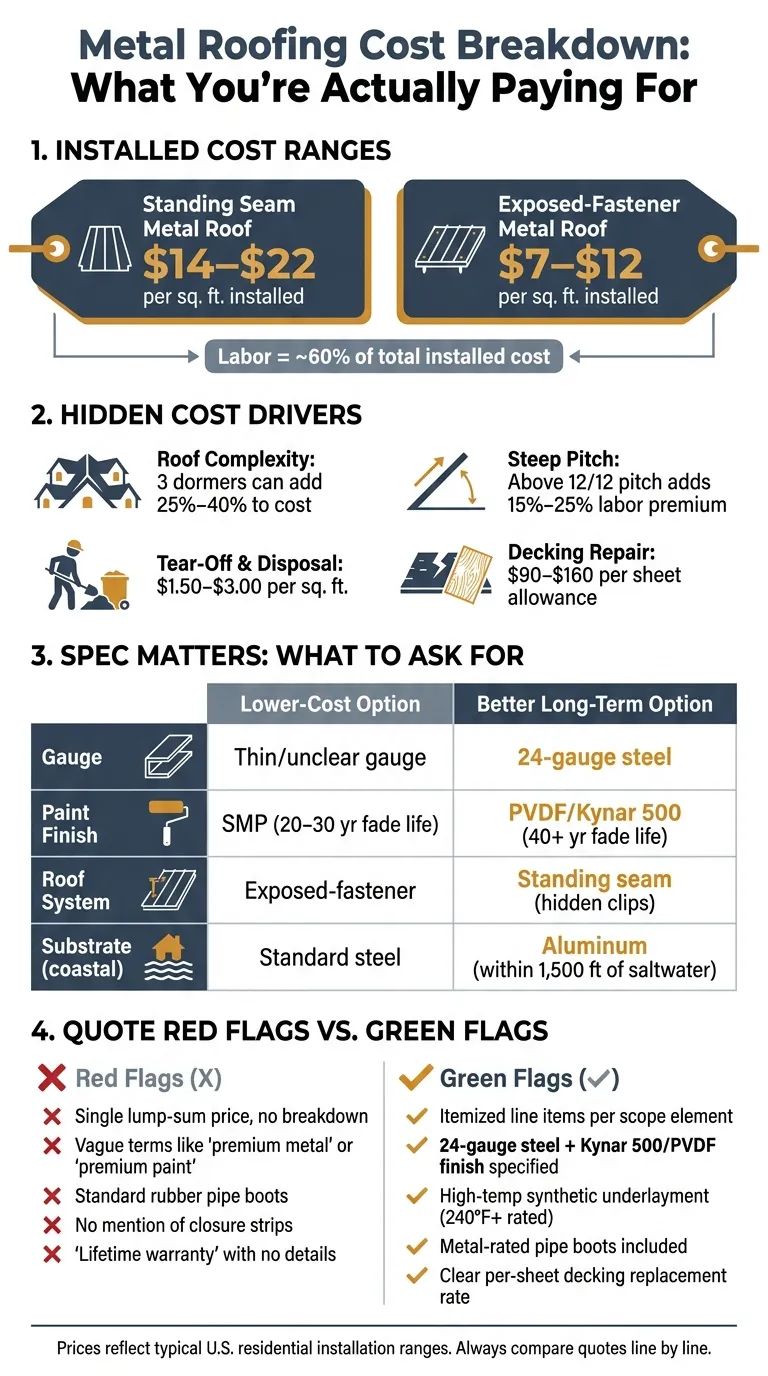 Metal Roofing Cost Comparison: What Drives Your Price
Don’t Compare Metal Roofs By Price Until You Watch This
Quick Comparison
| What to Compare | Lower-Cost Side | Higher-Cost Side | What I’d Check |
|---|---|---|---|
| Roof system | Exposed-fastener | Standing seam | Price vs. life span |
| Steel spec | Thin or unclear gauge | 24-gauge steel | Exact gauge in writing |
| Paint finish | SMP | PVDF / Kynar 500 | Fade life and warranty |
| Roof shape | Simple gable | Dormers, valleys, cut-up layout | Extra flashing and labor |
| Roof pitch | Lower slope | Steep slope | Safety setup and labor time |
| Scope | Basic or vague | Itemized full scope | Underlayment, trim, boots, closures |
| Add-ons | Nice-to-have upgrades | Climate-based items | Whether I need them at all |
My bottom line: I would not judge a metal roof quote by price alone. I’d compare the system type, roof condition, labor drivers, and line-item scope first. That’s usually where overpaying starts – or where a higher quote turns out to make more sense.
Step 1: Understand What Actually Drives the Cost of a Metal Roof
Most homeowners look at the panels first when they review a metal roofing quote. That makes sense. The panels are the part you can see.
But on a typical residential standing seam job, panels usually make up only 50% to 60% of the total materials cost. The rest of the money goes to trim, accessories, and fasteners [1]. So if you compare quotes based on panel price alone, you’re missing a big part of the bill. A better move is to split each quote into materials, labor, and site complexity before you stack prices side by side.
Material, Profile, Gauge, and Finish
The two most common residential choices are standing seam and exposed-fastener systems.
Standing seam usually costs $10 to $22 per sq. ft. installed and uses hidden clips that let the metal expand and contract as temperatures change [3][1]. Exposed-fastener systems, like corrugated panels or R-panel, usually cost $4 to $12 per sq. ft. installed [3][4].
Profile isn’t the only thing that matters. Gauge and finish can change both price and life span. 24-gauge steel is the common residential standard for standing seam. If a quote doesn’t spell out the gauge and finish, ask before you sign. You might be looking at a lower-grade product than you had in mind.
Finish matters too. PVDF (Kynar 500) coatings can give you 40+ years of fade resistance, while standard SMP paints usually last 20 to 30 years [3].
Once the product details are clear, the next piece is labor. And this is where roof design can change the math fast.
Roof Size, Slope, Access, and Detail Work
Square footage is only the starting point. Roof shape and pitch often push labor costs more than homeowners expect.
For example, a roof with three dormers can cost 25% to 40% more to install than a simple gable roof with the same area. Why? Every dormer adds flashing intersections, valleys, cuts, and extra flashing work [3].
Pitch plays a big role too. Once a roof goes past an 8/12 pitch, crews may need harnesses, which slows the job. Roofs above 12/12 can bring a 15% to 25% labor premium [3]. Access can add to that. A two-story home with a tight staging area may carry another 5% to 15% labor premium just because it’s harder to work on [4].
Even when labor pricing looks fair, the quote can still miss trouble if no one has checked the roof’s condition first.
Required Work vs. Optional Upgrades
Some items belong on every metal roof quote. Others depend on your climate, your location, or the shape of your roof. That difference matters. If a contractor leaves out work that should have been there from the start, those costs often come back later as change orders.
Usually required on metal roofs:
- High-temp synthetic underlayment – Metal panels can hit 160°F to 180°F in summer, so standard felt isn’t a stand-in [3][1].
- Custom flashing – Chimneys, skylights, valleys, and roof-to-wall transitions all need metal flashing sized and fitted to the panel profile.
- Tear-off and disposal – This usually adds $1.50 to $3.00 per sq. ft. when the current roof has two or more layers or damaged decking [3][1].
- Decking repair allowance – Many quotes include a per-sheet allowance of $90 to $160 for damaged wood found after tear-off [3][1].
May be optional depending on your home:
- Ice and water shield – Needed in snowy areas where ice dams are a risk; less important where freezing weather isn’t part of the picture.
- Snow guards – A fit for places with steady winter snowfall; not something warm-climate homes usually need.
- PVDF (Kynar) finish – Worth paying for when long-term color hold matters; less important for agricultural or lower-cost jobs.
- Aluminum substrate – Recommended for homes within 1,500 feet of saltwater; usually unnecessary for inland homes.
Next, make sure the roof can handle the system before you choose the final product.
Step 2: Check Roof Condition Before Picking a Metal System
Check the roof’s condition before you choose a metal system. Hidden damage is often the reason one bid comes in much higher or lower than another. Even a high-end panel can fail early if it’s installed over bad decking, active leaks, or an attic that doesn’t vent well.
Problems That Should Be Fixed Before Installation
Roof condition comes first. Product choice comes after.
Rotted or soft decking needs to be fixed before anything else. Metal panels depend on solid wood to hold fasteners and clips in place. If the sheathing is weak, screws may not stay secure [1]. Sagging areas should be repaired too. Uneven decking can make the finished panels look wavy, a problem called oil canning [5][4].
Leaks and moisture damage matter just as much. Putting metal over wet or decaying wood can lead to early failure [5]. Attic ventilation is another area people miss. If ventilation is poor, moisture can get trapped under the panels on cool nights [1][5].
Deal with structural and moisture problems before you compare panel grade or finish. Premium panels won’t solve soft decking or blocked soffit vents.
What a Contractor Should Inspect Before Recommending Metal Roofing
Start with the issues that affect system choice. Then look for the hidden damage that affects cost.
A solid pre-installation inspection goes beyond what’s easy to see from the ground. The contractor should check roof slope first, because slopes below 3:12 may need mechanical-lock panel systems. They should also inspect the decking, attic ventilation, roof layers, and any hidden moisture damage.
Valleys, penetrations, and roof-to-wall joints need a close look. These spots are common trouble areas for decking rot and often call for custom flashing [1][3]. Damaged fascia boards along the roof edge are another warning sign. If the fascia feels soft, the decking around the perimeter may have taken on water too [1].
| Inspection Point | What to Look For | Why It Matters |
|---|---|---|
| Decking | Soft spots, rot, water stains | Needed for secure fastener/clip attachment [1] |
| Attic Ventilation | Blocked soffits, missing ridge vents | Helps prevent underside condensation and deck rot [1][5] |
| Roof Pitch | Slope below 3:12 | May require mechanical-lock panel systems [1][3] |
| Penetrations | Chimneys, vents, skylights | Common leak points that need custom flashing [1][3] |
| Fascia and Edges | Soft or damaged boards | Can point to moisture damage at the decking perimeter [1] |
| Existing Layers | More than one shingle layer | Full tear-off may be needed to inspect the deck [3][5] |
Work with trusted roofing professionals focused on quality craftsmanship.
After the roof is in good shape, compare quotes line by line so you’re judging scope, not just price.
Step 3: Compare Quotes Line by Line Before You Decide
After you check the roof’s condition, compare quotes by scope, not just by the total price. That part matters more than most people think. A low quote can look like a bargain, then turn out to be cheap because it leaves out trim, fasteners, or key material specs.
What Every Metal Roofing Quote Should Include
A complete quote should spell out each major part of the job. You want to see tear-off, underlayment, flashing, ventilation, pipe boots, trim, and decking allowance listed clearly.
It should also name the panel manufacturer, gauge, finish, and warranty terms. That includes the finish warranty and a contractor workmanship warranty of at least 10 years [2].
Warning Signs in Low or Unclear Estimates
A strong quote is specific. A weak one gets fuzzy right where the price can change.
Watch for vague wording like "premium paint", "as needed" for decking, or "lifetime warranty" with no details behind it. Those phrases can sound good on paper, but they don’t tell you much.
Standard rubber pipe boots are another red flag on metal roofs. Missing closure strips can also slip past people. But they matter. Without them, air and pests can get in at the ridge and eave lines.
| Good Quote Signs | Red Flags |
|---|---|
| Itemized line items for each major scope element | Single total price with no breakdown |
| Specifies 24-gauge steel and Kynar 500 or PVDF finish | Vague terms like "premium metal" or "premium paint" |
| High-temp synthetic underlayment (240°F+ rating) | "Standard synthetic" or felt underlayment |
| Metal-rated pipe boots | Standard rubber boots |
| Includes closure strips and color-matched trim | No mention of closures |
| Clear per-sheet decking replacement rate | Decking "not priced per sheet" |
| Explicit finish and labor warranty terms | Vague "lifetime warranty" with no details |
Use Koalaty Remodel Resources to Compare Scope and Costs
Use the Roofing Cost Guide to check whether quoted prices fit realistic U.S. ranges. Use the Metal Roofing Guide to compare product options. And use the Roofing Contractors page to request estimates.
When you can compare quotes line by line, it gets much easier to see whether a higher price gives you more for your money.
Once the quote scope is clear, the last step is deciding whether the added cost is worth the long-term value.
Step 4: Decide Based on Long-Term Value and Finalize the Project
Once the scope is locked in, the last call comes down to one thing: is the extra cost buying real protection? After you’ve compared quotes line by line, the final check is pretty simple. Ask whether each upgrade earns its price over the years you expect to own the home.
When Spending More Makes Sense and When It Does Not
Pay more for upgrades that help the roof last longer or handle water better. That includes options like PVDF finish and high-temp underlayment.
Other add-ons look nice on paper but don’t do much for most homes. Copper or zinc panels, for instance, can cost 2x to 3x more than steel without adding functional protection for a typical residential roof [5].
Your ownership timeline should guide the upper limit of what you spend on premium options. If you think you may move within 5 to 7 years, it’s usually smart to skip upgrades that likely won’t pay back before you sell.
Homeowner Checklist Before You Sign
Before you approve the contract, make sure these points are clear:
- The full scope is itemized, with no vague line items or open-ended allowances
- Required work and optional upgrades are separated
- The contractor has checked the decking condition and flagged any leak-prone areas
- Warranty terms – for both materials and workmanship – are written out clearly
- The total cost lines up with how long you plan to keep the home
Get a free roofing quote to compare a complete, itemized scope.